Author: Gaurang Govind

  • The Retail Expansion Trap: Why Growth Between 10 and 30 Stores Matters Most

    The Retail Expansion Trap: Why Growth Between 10 and 30 Stores Matters Most

    Expansion is exciting. It gives a company the feeling of spreading its wings into new geographies, reaching new customers and building a stronger brand footprint.

    And that is exactly where the danger often begins.

    A retailer opens its first few stores outside its original market. The initial response is encouraging. Footfalls look healthy, customers appreciate the brand, and a few locations perform better than expected. Confidence rises. Suddenly, the organisation starts thinking bigger: If five stores can work, why not 20? If 20 can work, why not 50?

    The expansion engine accelerates.

    New locations are signed. Store openings become frequent. Teams become busy. The number of stores becomes a symbol of growth.

    Then, three to six months later, reality begins to surface.

    Some stores are performing well. Others are struggling. A few are nowhere close to the business case that justified their opening. Rentals are high, competition is stronger than anticipated, merchandise is not moving as expected, and catchments are behaving very differently from the original assumptions.

    Now imagine this happening not to one store, but to ten or fifteen stores simultaneously.

    The impact on the bottom line can be enormous.

    Expansion Is Not About Opening Stores. It Is About Repeating Success.

    Retail expansion is often mistaken for a real estate exercise. Find a location, negotiate the rent, sign the property and open the store.

    In reality, successful expansion is a far more complex process.

    Every new store represents a combination of several variables:

    • The right geography
    • The right micro-market
    • The right catchment
    • The right customer demographic
    • The right competition landscape
    • The right store size
    • The right merchandise mix
    • The right price points
    • And, of course, the right rental economics

    A mistake in any one of these variables can affect store performance. A mistake in several variables can turn a promising expansion plan into a financial burden.

    Consider a fashion retailer entering a new city. The company may identify a busy market and assume that high footfall will automatically translate into sales. But what if that footfall consists largely of students with lower spending power? What if three established fashion retailers already dominate the market? What if the retailer has selected a 15,000-square-foot store when the catchment can realistically support only an 8,000-square-foot format?

    The store may look impressive. The location may appear busy.

    But the economics may never work.

    That is why expansion should not focus only on where to open. It must focus equally on why that particular store should succeed.

    Catchments Have Changed Dramatically

    Retail catchment behaviour has also changed significantly.

    Earlier, retailers often considered a three- to five-kilometre radius while assessing a store’s potential. Today, particularly in dense urban markets, the effective catchment can be much smaller.

    In many large cities, customers do not want to travel unnecessarily.

    Why should they?

    There are competing brands nearby. Shopping malls are nearby. Local high streets offer alternatives. Online shopping provides another option altogether.

    In many urban markets, the practical catchment for a convenience-oriented fashion or lifestyle store may shrink to one or two kilometres.

    However, this logic cannot simply be copied across India.

    The situation changes dramatically in Tier 2, Tier 3 and Tier 4 towns.

    Many of these markets operate as self-contained ecosystems. Customers may willingly travel three, four or even five kilometres to visit a strong destination store. If the store offers the right combination of assortment, pricing, brand experience and product availability, distance becomes less of a barrier.

    For example, a well-designed value-fashion store in a smaller town may attract customers from several surrounding neighbourhoods because there are limited comparable options. In such a market, the retailer can build a much wider catchment than it could in a highly competitive metropolitan area.

    This is why a standard expansion formula is dangerous.

    The same catchment assumptions cannot work everywhere.

    The First Six Months Can Make or Break the Expansion Strategy

    The real challenge often starts after the store opens.

    The first three to six months are critical.

    During this period, the retailer discovers whether its assumptions were correct. Is the expected customer actually coming? Is the conversion rate healthy? Are customers buying the right categories? Is the average transaction value sufficient? Is the store attracting repeat customers?

    If one new store struggles, the organisation can usually manage the situation.

    But expansion creates a multiplier effect.

    Suppose a retailer opens 15 stores within six months. If ten of those stores underperform during their initial months, the company faces multiple pressures simultaneously: higher fixed costs, inventory requirements, employee expenses, rentals and working capital pressure.

    By the time the management fully understands what went wrong, the financial impact may already be substantial.

    This is one of the biggest differences between opening five stores and opening 30 stores.

    At five stores, mistakes are manageable.

    At 30 stores, mistakes become expensive.

    Retail History Has Already Taught Us This Lesson

    India has seen this pattern before.

    During the retail boom of the mid-to-late 2000s, there was enormous enthusiasm around expansion. Retailers were opening stores across cities and regions at a rapid pace.

    Growth itself became the objective.

    Stores opened everywhere.

    But not every store worked.

    Many retailers eventually had to close stores, withdraw from regions or rethink their formats. The problem was not that expansion was wrong. The problem was that companies expanded faster than they learned.

    A retailer would assume that a particular catchment would perform well. It would not.

    Another store would struggle because the customer profile was different from what the company expected. A third location would suffer because competition changed after the store opened.

    The most successful retailers were not necessarily those who made the fewest mistakes.

    They were the ones who learned from mistakes faster.

    That distinction is crucial.

    East India Is Entering a More Competitive Retail Phase

    This lesson is particularly relevant for East India today.

    The region has witnessed a significant increase in fashion and apparel retail activity. Numerous local and regional retailers have emerged alongside larger national players. Many of these companies have already expanded to 10, 20 or 30 stores, while some have grown much larger.

    Competition is no longer limited to a handful of established brands.

    A retailer entering a new market today must understand that the customer has more choices than ever before.

    This makes processes extremely important.

    A company cannot depend only on the intuition of its promoters or expansion team. It needs a disciplined operating system that continuously evaluates store performance.

    Regular retail audits become essential.

    Merchandise quality must remain consistent.

    Price points must match local purchasing behaviour.

    Data must reveal what is working and what is not.

    Management needs to ask sharper questions:

    Why is one store converting better than another?

    Why is the same merchandise selling in one town but not another?

    Why has footfall increased without a corresponding increase in sales?

    Is the problem the catchment, the merchandise, the price or the store experience?

    The faster a retailer identifies the real issue, the faster it can act.

    The Most Dangerous Phase Is Often Between 10 and 30 Stores

    Moving from 10 stores to 30 stores is one of the most critical stages in a retailer’s journey.

    The company is no longer small enough to manage everything informally.

    But it may not yet be large enough to have mature systems, strong data infrastructure and specialised leadership across every function.

    This is the risky zone.

    The promoter can no longer personally understand every market.

    The expansion team can no longer rely purely on experience.

    Store managers cannot operate without standardised processes.

    And small operational weaknesses begin to multiply.

    Yet this phase is also the gateway to larger scale.

    If a retailer cannot build strong processes between 10 and 30 stores, scaling from 30 to 100 stores becomes extremely difficult.

    The objective, therefore, should not simply be to open more stores.

    The objective should be to build the capability to operate more stores successfully.

    Growth Requires Better Metrics and Faster Action

    The future of retail expansion will belong to companies that combine ambition with discipline.

    Retailers need to track the right metrics, not just top-line sales. They need to understand store productivity, conversion, repeat customers, category performance, inventory movement, rent-to-sales ratios and local competitive changes.

    More importantly, they need to act quickly.

    A problem identified after six months is expensive.

    The same problem identified after four weeks may still be manageable.

    Expansion will always involve uncertainty. No retailer can predict every catchment perfectly. Not every store will succeed exactly as planned.

    But the goal is not to eliminate mistakes.

    The goal is to reduce the cost of mistakes and increase the speed of learning.

    Because in retail, expansion is not ultimately a test of how fast you can open stores.

    It is a test of how fast you can learn, correct and improve while opening them.

  • Hiring talent will not help if business processes undefined – build processes

    Hiring talent will not help if business processes undefined – build processes

    Before you blame your people for poor performance, ask yourself one question:
    Have you given them a process that allows them to succeed?
    Most business performance problems are not people problems. They are process problems.
    You may recruit highly skilled, capable people. But without clear processes, even the best talent cannot perform at its full potential.
    People need clarity: what to do, when to act, who owns the decision, and which framework should guide that decision. When these are unclear, decisions slow down. Employees naturally fall back on personal judgment, past experiences, and practices learned in previous organizations.
    The result is inconsistent execution.
    And inconsistency eventually reaches the customer.
    Different employees create different experiences, send different signals, and shape different perceptions of the same brand. You may invest heavily in customer acquisition, Customer Lifetime Value (CLV), retention, or Net Promoter Score (NPS), yet customers may still leave through gaps created by poorly defined processes.
    While one part of the business brings customers in, another may be pushing them out.
    This is why scalable organizations do not grow simply by adding more people. They grow by creating clear operating processes, defined decision-making frameworks, accountability, and consistency across the customer journey.
    People perform better when expectations are clear and decisions follow a structured path. A chaotic environment creates delays, confusion, inconsistent outcomes, and unnecessary pressure.
    Before questioning whether your people are capable, evaluate the system in which they are expected to perform.
    The right people create results. The right processes make those results repeatable, scalable, and sustainable.
    Fix the process before blaming the people.

  • The ₹100 Crore Retailer: How Much Inventory Should It Actually Carry?

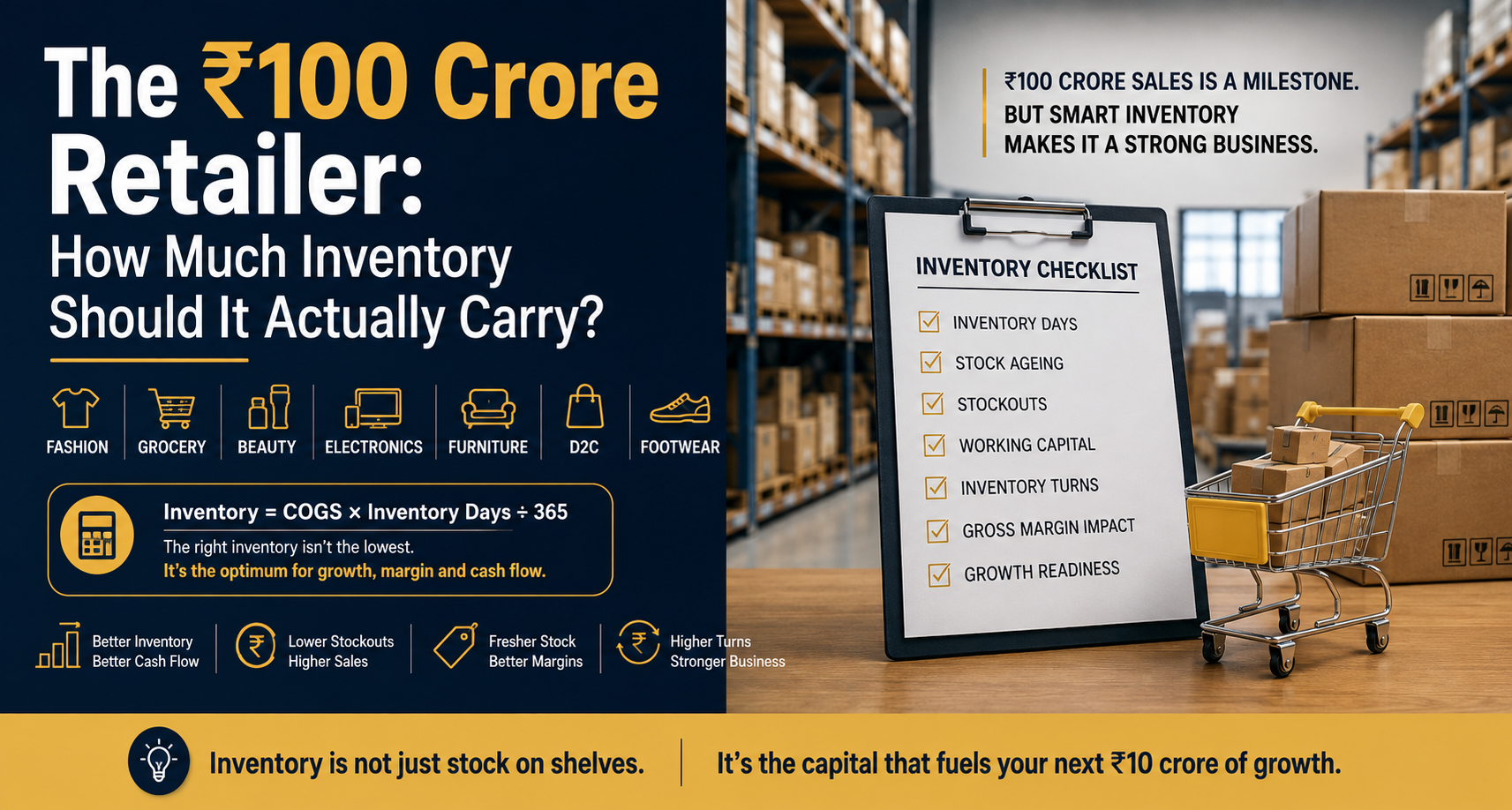
    The ₹100 Crore Retailer: How Much Inventory Should It Actually Carry?

    A retailer tells me:

    “We are now a ₹100 crore business.”

    My next question is usually not about sales.

    I ask:

    “How much inventory are you carrying?”

    The answer can tell us a lot more about the health of the business than the ₹100 crore revenue number itself.

    One retailer may be doing ₹100 crore with ₹6 crore of inventory.

    Another may need ₹18 crore.

    Both can be perfectly healthy.

    Or both can have a serious inventory problem.

    The difference lies in the business model, category, gross margin, inventory velocity, supplier lead time, assortment and, importantly, how much of that inventory is actually saleable.

    So, if you run a ₹100 crore retail business, what should your inventory really look like?

    There is no single answer.

    But let’s look at the economics category by category.


    Start with the basic calculation

    A simple way to think about inventory is:

    Inventory = Cost of Goods Sold × Inventory Days ÷ 365

    So, if a retailer has ₹100 crore of sales, a 50% gross margin means its annual COGS is approximately ₹50 crore.

    If the business carries 75 days of inventory:

    ₹50 crore × 75 ÷ 365 = ₹10.3 crore

    That gives us a starting point.

    But the interesting part begins when we apply this to different retail businesses.


    Fashion: ₹9–10 crore may not be unusual

    Consider a ₹100 crore fashion retailer.

    Suppose:

    • Gross margin: 55%
    • COGS: ₹45 crore
    • Inventory: 75 days

    The inventory requirement works out to approximately ₹9.2 crore.

    At first glance, that may look reasonable.

    But I would immediately ask another question:

    How much of that ₹9.2 crore is current and how much is ageing?

    Imagine the inventory looks like this:

    ₹5.5 crore — fast-moving/current ₹1.5 crore — normal-moving ₹1 crore — slow-moving ₹700 lakh — ageing ₹500 lakh — effectively dead

    The balance sheet still says ₹9.2 crore inventory.

    But commercially, it is a very different story.

    This is why fashion retailers should not look only at inventory value.

    They need to look at inventory age, sell-through and expected realisation.

    A ₹10 crore inventory number can be healthy.

    It can also be the beginning of a ₹3 crore markdown problem.


    Grocery: ₹5 crore can support ₹100 crore of sales

    Now take grocery.

    Suppose:

    • Gross margin: 25%
    • COGS: ₹75 crore
    • Inventory: 25 days

    Inventory requirement:

    ₹75 crore × 25 ÷ 365 = ₹5.1 crore

    That’s a completely different inventory structure.

    Why?

    Because grocery moves much faster.

    The retailer buys, sells and replenishes continuously.

    Now imagine this retailer carries 60 days instead of 25.

    Inventory becomes:

    ₹75 crore × 60 ÷ 365 = ₹12.3 crore

    The retailer has not generated one additional rupee of sales.

    But another ₹7.2 crore has become tied up in inventory.

    That is the part of inventory management that often gets missed.

    Inventory is not free.

    Every additional rupee sitting on the shelf is a rupee that cannot be used somewhere else.

    core expertise cgrbrands.com

    Beauty: the ageing problem is different

    Beauty is another interesting example.

    Take:

    • ₹100 crore sales
    • 55% gross margin
    • ₹45 crore COGS
    • 60 inventory days

    Inventory:

    ₹45 crore × 60 ÷ 365 = ₹7.4 crore

    So perhaps ₹7–8 crore of inventory looks reasonable as an illustrative starting point.

    But beauty has another risk:

    expiry and product relevance.

    A product sitting in the warehouse for six months is not necessarily the same economic asset as a product that sells every week.

    And then there are:

    • New formulations
    • Packaging changes
    • Seasonal products
    • Shade variations
    • New launches
    • Consumer preference changes

    So the question isn’t simply:

    “How much inventory do we have?”

    It is:

    “How much of our inventory is likely to convert into cash at the expected margin?”

    That is a much more useful question.


    Electronics: inventory can become obsolete before it becomes slow-moving

    Electronics is even more interesting.

    Assume:

    • ₹100 crore sales
    • 20% gross margin
    • ₹80 crore COGS
    • 60 inventory days

    Inventory:

    ₹80 crore × 60 ÷ 365 = ₹13.2 crore

    So an electronics retailer could be carrying ₹13 crore or more.

    But electronics has a unique risk.

    Technology moves faster than inventory.

    A product can be perfectly saleable today and commercially unattractive six months later.

    A new model arrives.

    The manufacturer reduces prices.

    A competitor launches a better product.

    Customers wait for the next version.

    Suddenly, ₹2 crore of inventory may require discounting.

    This is why I would rather see an electronics retailer carrying ₹14 crore of highly productive inventory than ₹10 crore containing ₹3 crore of ageing stock.

    The lowest inventory number is not necessarily the best inventory position.


    Furniture: ₹18 crore may actually be reasonable

    Furniture creates another interesting contrast.

    Suppose:

    • Gross margin: 45%
    • COGS: ₹55 crore
    • Inventory: 120 days

    Inventory:

    ₹55 crore × 120 ÷ 365 = ₹18.1 crore

    That sounds huge compared with grocery.

    But should we immediately call it inefficient?

    No.

    Furniture has:

    • Longer buying cycles
    • Longer supplier lead times
    • Larger ticket sizes
    • Large display requirements
    • Lower purchase frequency
    • Higher logistics complexity

    So 120 days of inventory may be perfectly understandable for the business.

    This is why comparing a furniture retailer’s inventory days with a grocery retailer’s inventory days is meaningless.

    Inventory benchmarks have to be category-specific.


    Footwear: having inventory doesn’t mean having availability

    Now consider footwear.

    Suppose:

    • ₹100 crore sales
    • 50% gross margin
    • ₹50 crore COGS
    • 75 inventory days

    Inventory:

    ₹50 crore × 75 ÷ 365 = ₹10.3 crore

    Again, roughly ₹10 crore.

    But here’s the problem.

    Footwear doesn’t just have SKU-level inventory.

    It has size-level inventory.

    You may have:

    100 pairs of a particular style.

    But if your customers predominantly want sizes 8, 9 and 10, having 40 pairs in sizes 6 and 7 doesn’t solve the problem.

    You can have:

    ₹10 crore of inventory

    and still tell customers:

    “Sorry, your size is unavailable.”

    This is where inventory productivity becomes much more important than inventory value.


    D2C: the problem often starts with the buying decision

    D2C businesses have another challenge.

    Suppose a ₹100 crore D2C brand has:

    • 60% gross margin
    • ₹40 crore COGS
    • 60 inventory days

    Inventory:

    ₹40 crore × 60 ÷ 365 = ₹6.6 crore

    That looks efficient.

    But now look inside the number.

    Suppose the brand has 100 SKUs.

    10 SKUs generate most of the demand.

    30 are average.

    60 are struggling.

    The overall inventory number may still look perfectly acceptable.

    But the problem is sitting at the SKU level.

    This is where I believe many D2C businesses need to move from:

    “How much inventory do we have?”

    to:

    “Which SKUs are consuming our working capital?”

    Because one bad buying decision repeated across 50 SKUs can quietly lock up crores.


    So, what does a ₹100 crore retailer really need?

    Using the illustrative assumptions above, the picture could look something like this:

    Article content

    These are illustrative calculations, not universal industry targets.

    And that’s exactly the point.

    There is no magic number called:

    “Ideal inventory for a ₹100 crore retailer.”


    The bigger question is inventory productivity

    Let’s say two retailers both have ₹100 crore revenue.

    Retailer A carries:

    ₹8 crore inventory

    Retailer B carries:

    ₹16 crore inventory

    It is tempting to say Retailer A is twice as efficient.

    But we need to know more.

    What if Retailer A is constantly out of stock?

    What if it is losing sales because its best-selling SKUs aren’t available?

    What if Retailer B has higher availability and faster growth?

    Now the answer changes.

    The objective isn’t:

    Minimum inventory.

    The objective is:

    Optimum inventory.

    Enough inventory to maintain availability and support growth.

    But not so much that working capital gets trapped in slow-moving or obsolete stock.


    And this is where I would ask a ₹100 crore retailer five questions

    1. How many inventory days are we carrying?

    Not just at company level, but by category and channel.

    2. What percentage of inventory is older than 90/120/180 days?

    Ageing tells us much more than the total number.

    3. Which SKUs are consuming working capital without producing sufficient sales?

    This is where SKU-level analysis becomes powerful.

    4. Where are we overstocked while another store/channel is out of stock?

    Inventory in the wrong location is almost as problematic as not having inventory.

    5. If sales grow from ₹100 crore to ₹150 crore, how much additional inventory will we need?

    This may be the most important question of all.


    The ₹100 crore → ₹150 crore test

    Suppose a retailer grows from ₹100 crore to ₹150 crore.

    The conventional approach says:

    Sales +50% → Inventory +50%

    So:

    ₹10 crore inventory → ₹15 crore.

    But what if better forecasting, replenishment, transfers and assortment management allow the retailer to reach ₹150 crore with ₹12 crore inventory?

    The business has effectively released ₹3 crore of capital.

    No new store.

    No additional borrowing.

    No additional investor capital.

    Just better inventory productivity.

    That is why inventory management should not sit only with the supply-chain team.

    Inventory is a finance issue.

    Inventory is a merchandising issue.

    Inventory is a buying issue.

    Inventory is a customer-experience issue.

    And ultimately, inventory is a CEO issue.


    The number I would like every retailer to know

    Not:

    “Our inventory is ₹12 crore.”

    But:

    “Every ₹1 of inventory in our business generates ₹X of annual sales and ₹Y of gross margin, and we know exactly where the unproductive inventory is.”

    That is a much more meaningful measure of retail health.

    Because the objective of inventory is not to sit in a warehouse.

    It is not to fill a store.

    It is not even to make the balance sheet look healthy.

    Inventory has only one job: to be converted into sales, margin and ultimately cash.

    And the faster and more profitably you can do that—without compromising availability—the stronger your retail business becomes.

    ₹100 crore of sales is a milestone.

    But ₹100 crore of sales with disciplined inventory is a much stronger business.


    What is your view?

    For a ₹100 crore retailer, what is more dangerous:

    ₹5 crore of excess inventory—or ₹5 crore of lost sales because of stockouts?

    I’d be interested in hearing how retailers and D2C businesses are looking at this today.

    Welcome

  • India What a Decade of Borrowing Actually Bought Us. Are we in a Debt Trap?

    India What a Decade of Borrowing Actually Bought Us. Are we in a Debt Trap?

    India’s Public Debt Story (2015–2025): What a Decade of Borrowing Actually Bought Us. Are we in a Debt Trap?

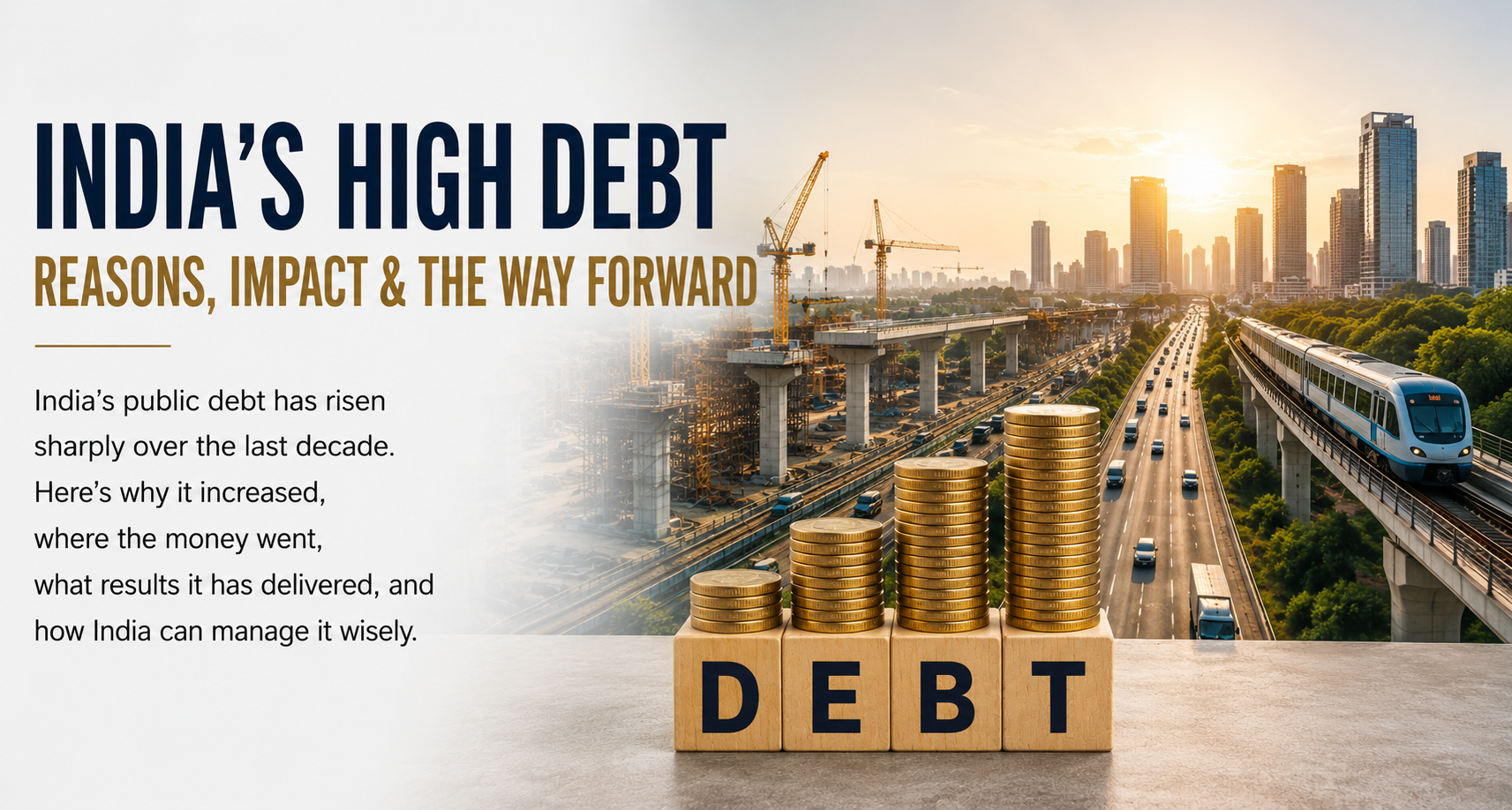
    India’s combined government debt has roughly doubled over the past decade. Central government debt alone climbed from about ₹121 trillion in FY2020 to an estimated ₹197 trillion by FY2026. State liabilities nearly tripled, from ~₹32.6 trillion in FY2016 to ~₹94 trillion by FY2025.

    Numbers like these trigger one of two reactions: alarm or indifference. Neither is entirely right.

    The better question is: What drove this rise, where did the money go, and where does it leave India today?

    Here’s the decade, unpacked.

    The pattern: steady drift, then a shock, then a slow climb-down

    Pre-2020, India’s fiscal deficit sat in a fairly disciplined 3–4% of GDP band, broadly consistent with FRBM targets — even if actual numbers occasionally missed the mark (FY2019 came in around 3.4% against a 3.3% target).

    Then COVID hit. The central fiscal deficit spiked to roughly 9.5% of GDP in FY2021 as revenue collapsed and emergency spending — cash transfers, free food grain, MSME credit guarantees, health spending — went out the door. Debt-to-GDP jumped by an estimated 8–10 percentage points in a single year.

    Since then, the story has been consolidation: the deficit has been brought down to around 5–6% of GDP, with a budgeted target of 4.4% for FY2026. It’s real progress, even if the debt base it’s working off is now structurally higher than it was five years ago.

    Three episodes that explain most of the swings Debt to GDP ratio %

    Demonetisation (Nov 2016): Intended to curb black money and push digital transactions, it also slowed activity and tax collections in the short run — GDP growth cooled and the fiscal deficit widened modestly (to around 3.5% of GDP against a 3% target) in FY2017.

    GST rollout (Jul 2017): A genuine structural reform with long-term revenue upside, but the transition wasn’t free. Collections initially undershot expectations, and the Centre had to borrow to compensate states during the changeover — nudging FY2018’s deficit above target.

    COVID-19 (2020–21): By far the biggest driver. A relief package of ₹20 trillion, layered onto a collapsing revenue base, took the deficit from roughly 3.5% to 9.5% of GDP in one year. Was it worth it? Most independent analyses — including from the IMF and RBI — suggest yes: the counterfactual (a sharper austerity response) likely meant a materially deeper contraction. The trade-off was a permanently higher debt stock in exchange for a shallower recession.

    Add to this two smaller but persistent pressures: periodic PSU bank recapitalisation (roughly ₹2.2 trillion across FY2018 and FY2020, needed to clean up bad loans) and an expanding footprint of welfare and housing schemes (PMAY, Ujjwala, MGNREGA) that keep revenue spending elevated even as capital expenditure has also been rising.

    The quiet number that matters most: interest payments

    Debt totals get the headlines, but the number that actually constrains policy choices is the interest bill. Central government interest payments rose from about ₹6.6 trillion in FY2020 to roughly ₹8.1 trillion by FY2022 and now consume somewhere in the range of 20–25% of central revenue receipts. That’s revenue that isn’t available for capex, subsidies, or further consolidation — it’s simply the cost of past borrowing. As global and domestic interest rates moved up through 2022–23, this burden has only gotten heavier.

    Where did the borrowed money go?

    It helps to separate how much India borrowed from what it was spent on. The story changed significantly after COVID:

    • FY2020–21: Borrowing largely supported emergency needs — food distribution, welfare support, MSMEs and bank recapitalisation. Necessary at the time, but with limited long-term growth impact.
    • FY2022–24: The focus shifted toward capital expenditure — roads, railways, healthcare and infrastructure. Capex as a share of GDP steadily increased.

    The positive shift: India increasingly moved from borrowing to support consumption toward borrowing to build productive assets.

    The road ahead

    The government’s own glide path targets a fiscal deficit closer to 4% of GDP, with debt-to-GDP expected to ease from its COVID-era peak (above 60%) toward the high-50s by FY2026. Getting there sustainably will likely depend on a few things playing out together: continued nominal GDP growth outpacing debt growth, disciplined targeting of subsidies rather than blanket cuts, tighter oversight of contingent liabilities and off-budget borrowing (state guarantees, PPP obligations), and a continued shift of the expenditure mix toward capital rather than revenue spending.

    None of this is dramatic. Fiscal consolidation rarely is — it’s mostly the unglamorous work of holding a line over several budget cycles. But the direction, so far, has been the right one.

     The takeaway

    The last decade brought demonetisation, GST, COVID-19 and a major infrastructure push. As a result, India’s public debt is roughly twice what it was in 2016.

    But debt is only one side of the story. India also built a stronger digital payments ecosystem, a unified tax system and significantly better infrastructure, while managing a strong post-COVID recovery.

    The key question now isn’t how much India owes, but whether economic growth can continue to outpace the growth in debt.


    What’s your read — was the post-COVID borrowing surge the right call, or did it set a debt base that will constrain policy for years to come? Would like to hear other perspectives on this.

    #IndianEconomy #PublicFinance #FiscalPolicy #Macroeconomics #Debt #Budget2026 #EconomicPolicy #India

  • D2C Brands: Stop Chasing Revenue. Start Measuring Customer Profitability.

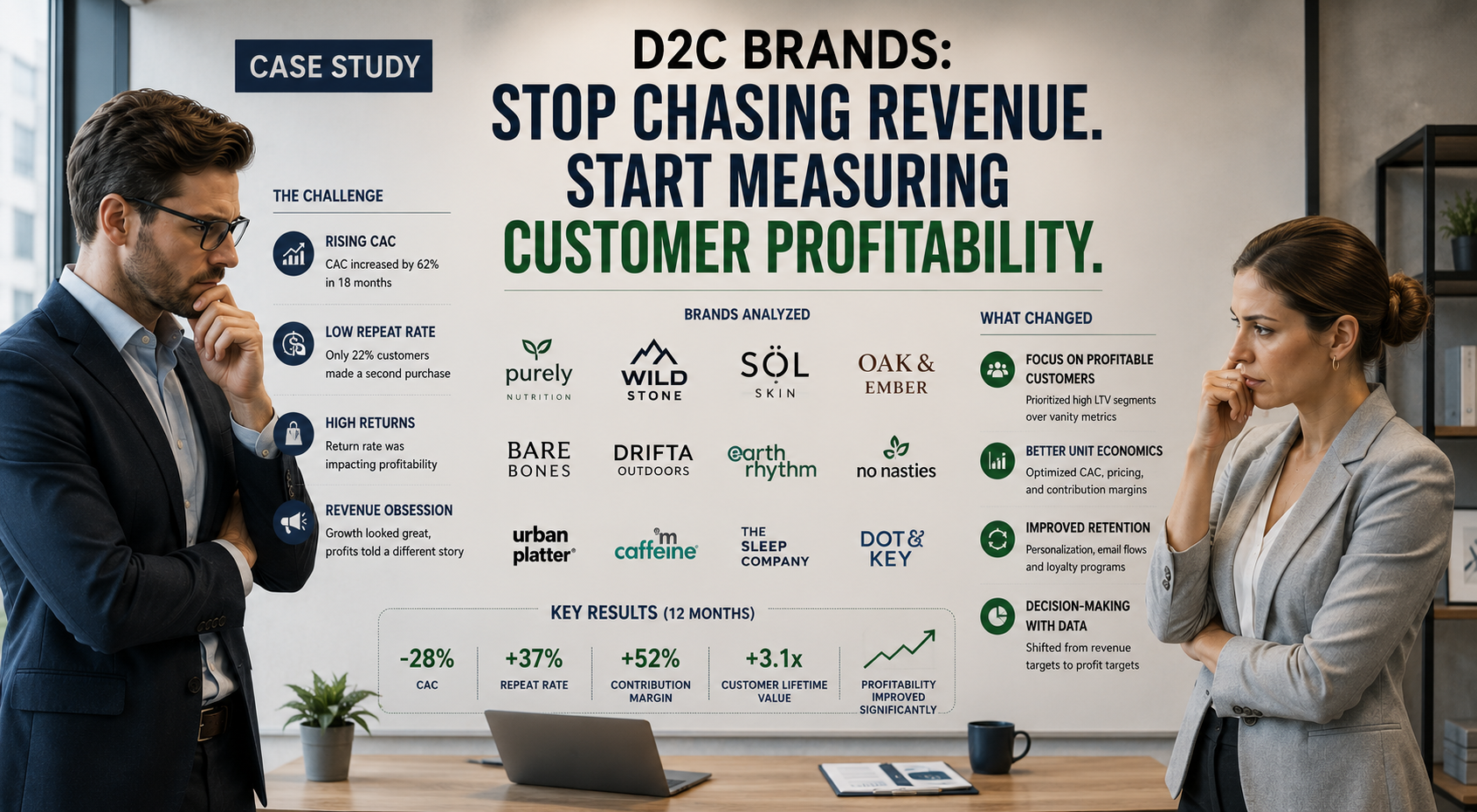
    D2C Brands: Stop Chasing Revenue. Start Measuring Customer Profitability.

    For years, D2C has been presented as the smarter way to build a consumer brand.

    Go directly to the customer. Avoid expensive stores. Build your own digital identity. Use social media to acquire customers. Scale quickly.

    It sounds simple.

    But the reality is very different today.

    D2C Brands: Stop Chasing Revenue. Start Measuring Customer Profitability.

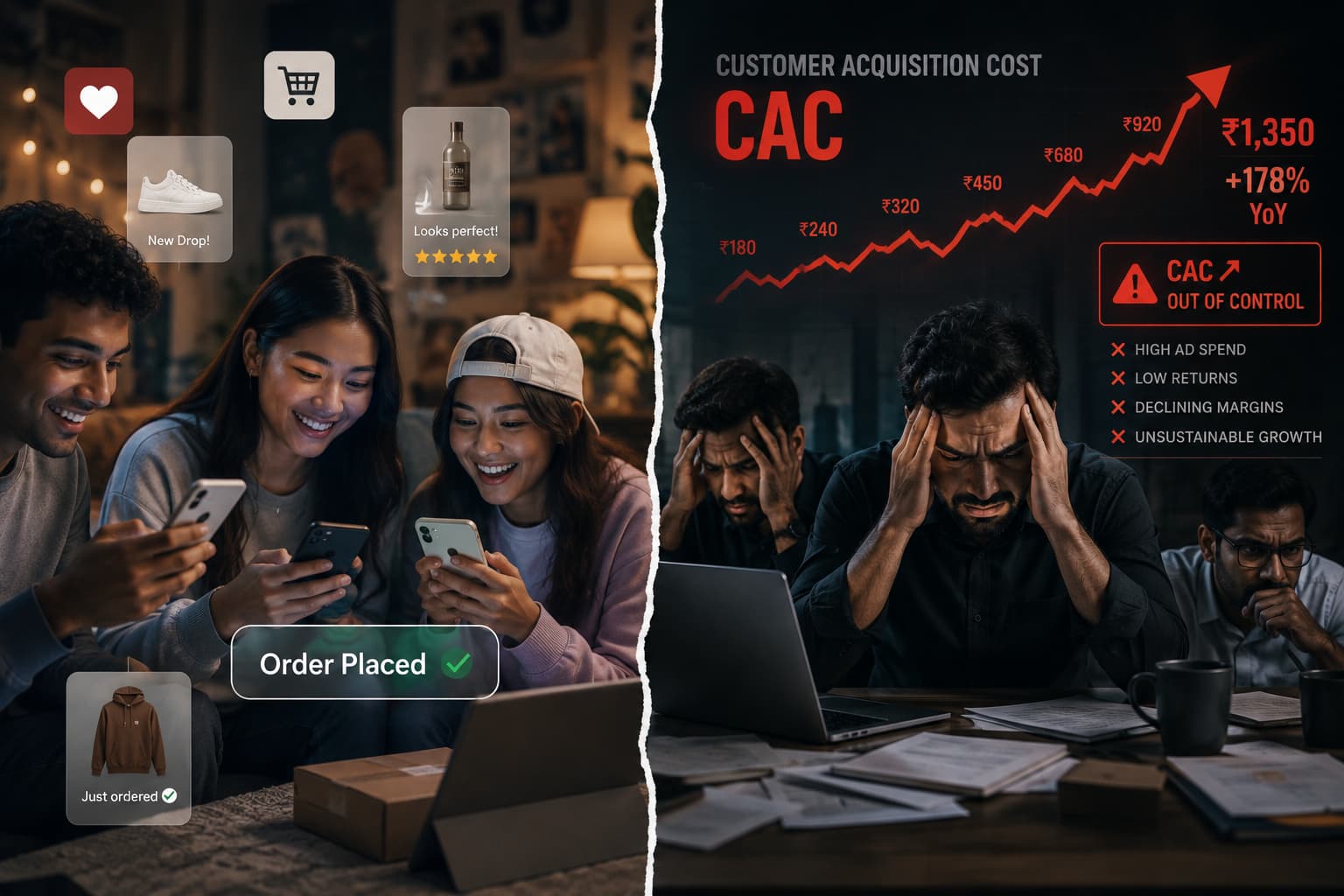
    Customer acquisition costs are rising. Competition is increasing. Online marketplaces are crowded. Consumers have endless choices. And customer loyalty is becoming harder to earn.

    So the real question for a D2C brand today is not:

    “How do I sell more online?”

    It is:

    “How does my customer actually make a purchase decision, and where should I be available when that decision happens?”

    That requires looking beyond the D2C label.


    The D2C customer is not one customer

    One of the biggest mistakes brands make is treating their online customer as a single segment.

    India has very different consumer groups—from affluent consumers to upper-middle-class, middle-income and value-conscious households.

    But income alone does not determine behaviour.

    Category determines behaviour.

    A consumer may be extremely price-sensitive when buying groceries but may pay a premium for skincare.

    The same person may compare five furniture brands before buying a sofa but purchase a familiar FMCG product almost automatically.

    That is why customer behaviour has to be understood category by category, occasion by occasion and need by need.

    Consider a few examples.

    Fruits & vegetables

    Freshness, availability, convenience and price can dominate the decision.

    Furniture

    Durability, finish, design, comfort, quality, price and confidence in the product become important.

    Beauty & cosmetics

    Product efficacy, ingredients, packaging, reviews, colour, price, trust and brand image can all influence the decision.

    There is therefore no universal D2C customer.

    There are category-specific customers with different reasons to buy.


    The customer knows more—but not necessarily enough

    The digital consumer today has extraordinary access to information.

    With a few clicks, customers can compare:

    • Prices
    • Reviews
    • Features
    • Competitors
    • Offers
    • Influencer opinions
    • Product demonstrations
    • Customer experiences

    But information availability does not automatically create understanding.

    The customer may see ten products but still struggle to decide which one is right.

    That is where trust, reviews, brand credibility, product experience and availability become critical.

    And this is where physical retail still has an important role.

    A customer can touch a product.

    See its finish.

    Try it.

    Speak to someone.

    Understand the difference between two products.

    And sometimes, simply seeing the brand in a physical environment creates confidence.


    The biggest D2C problem today: Customer acquisition

    Digital platforms have made customer access easier.

    They have also made competition much more intense.

    A D2C brand is competing for attention on the same platforms as hundreds or thousands of other brands.

    Meta, Instagram, YouTube, Google and marketplaces can generate enormous reach.

    But reach comes at a price.

    As more brands compete for the same audience:

    Customer acquisition becomes more expensive.

    And if the customer makes one purchase and never returns, the economics become even more difficult.

    This creates a dangerous cycle:

    Higher advertising spend → higher acquisition cost → lower contribution → greater dependence on repeat purchases.

    Therefore, the real question is not how much you spend to acquire a customer.

    It is:

    How much value can you generate from that customer over time?


    D2C and retail: Are the costs really that different?

    This is where I believe many D2C entrepreneurs should take a closer look at their numbers.

    Retail has obvious costs:

    Rent + people + inventory + utilities + operations.

    D2C has a different-looking cost structure:

    Technology + digital marketing + customer acquisition + fulfilment + returns/refunds + inventory + customer service.

    The cost heads are different.

    But the underlying economics are surprisingly similar.

    Both businesses have to:

    • Hold inventory
    • Acquire customers
    • Fulfil orders
    • Manage returns
    • Build trust
    • Provide customer service
    • Maintain technology/processes
    • Generate repeat purchases

    So the assumption that “D2C is automatically cheaper than retail” needs to be challenged.

    It depends entirely on the category, ticket size, margins, repeat rate, geography, assortment and customer acquisition economics.


    So should D2C brands enter retail?

    In many cases, yes—but not blindly.

    Retail can provide something that digital advertising cannot always provide:

    Physical discovery and local trust.

    Suppose a brand establishes a profitable store in a particular catchment.

    It understands the local customer.

    It gets the assortment right.

    Its pricing works.

    Its people are trained.

    Its product mix generates healthy margins.

    And it builds repeat customers within a 3–4 km radius.

    Now the brand has something extremely valuable:

    A proven local business model.

    The next opportunity is to replicate that model in another geography.

    Then another.

    Then another.

    That is very different from simply opening stores because the brand wants a physical presence.


    The future may not be D2C versus retail

    I believe the more relevant question is:

    Why choose one when the customer is using both?

    A consumer may discover your brand on Instagram.

    Read reviews on Google.

    Compare prices on a marketplace.

    See the product in a store.

    Order it through quick commerce.

    Buy again from your website.

    And recommend it to a friend on social media.

    The customer does not think in channels.

    The customer thinks:

    “I want the right product, at the right price, with minimum effort and maximum confidence.”

    Brands need to think the same way.


    But there is a warning for D2C brands

    Do not rush into retail simply because everyone else is doing it.

    Before opening a store, ask:

    Do I have enough SKUs?

    Is my assortment strong enough?

    Can I create a meaningful store proposition?

    Are my margins sufficient?

    Can the store generate repeat business?

    Do I understand the catchment?

    Can I train people to sell the product properly?

    A store cannot become a physical warehouse for your online products.

    It needs a reason to exist.

    The assortment, store experience, pricing, visual merchandising and customer interaction must come together as one proposition.


    The next competitive advantage: Operational excellence

    For D2C brands, the next phase will not be won simply by having a better Instagram campaign.

    It will be won through better execution.

    Brands need systems that tell them:

    Where is the customer dropping off?

    Why is the customer not completing the purchase?

    Why are returns increasing?

    Which SKU is generating repeat purchases?

    Which geography is profitable?

    Which channel is acquiring the best customers?

    Which customers are worth retaining?

    Where is inventory getting stuck?

    And most importantly:

    What does it cost to serve each customer?

    Technology will play a major role here.

    But technology alone is not the answer.

    Data + process + people + execution have to work together.


    My advice to D2C brands

    Before spending the next ₹1 crore on customer acquisition, stop and calculate the economics.

    Compare:

    D2C economics vs Retail economics vs Marketplace economics vs Quick Commerce economics.

    Look at the complete picture—not just revenue.

    Measure:

    CAC Customer Lifetime Value Contribution Margin Repeat Purchase Rate Return Rate Inventory Turns Gross Margin Cost-to-Serve Store Productivity GMROF

    Then decide where your customer should find you.

    Because the future is unlikely to belong to brands that are only D2C.

    It will belong to brands that can move seamlessly across D2C + retail + marketplaces + quick commerce, while maintaining healthy unit economics.


    The final thought

    The D2C opportunity in India is still enormous.

    But the easy growth phase is getting harder.

    Consumers have more choices.

    Advertising is more expensive.

    Competition is intense.

    Loyalty has to be earned repeatedly.

    And profitability can disappear very quickly behind attractive revenue numbers.

    So don’t ask:

    “How fast can I acquire customers?”

    Ask:

    “How profitably can I acquire, serve and retain them?”

    And don’t ask:

    “Should I be D2C or retail?”

    Ask:

    “Where does my customer want to buy from me—and which combination of channels creates the strongest business?”

    D2C may have started the journey by removing the middleman.

    The next stage is about removing the friction between the customer, the brand and a profitable transaction.

    That is where the real scale will come from.

    #D2C #Retail #Ecommerce #ConsumerBehaviour #CustomerAcquisition #QuickCommerce #RetailStrategy #BusinessTransformation #OperationalExcellence #CustomerExperience #Profitability #IndianRetail

  • India’s FDI Puzzle: Record Money In, Very Little Staying Back

    India’s FDI Puzzle: Record Money In, Very Little Staying Back

    India’s FDI Puzzle: Record Money In, Very Little Staying Back

    A simple, data-backed look at what’s really happening to foreign investment in India.

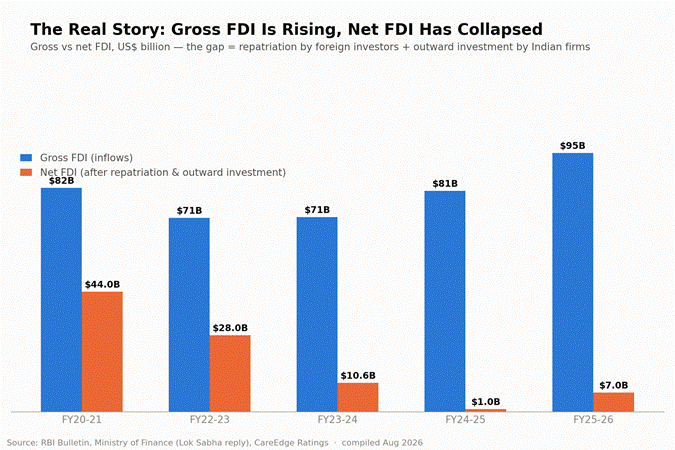
    Picture this: India just received its biggest-ever foreign investment cheque — $94.8 billion in FY 2025-26. Worth celebrating, right? But once the dust settled, only $7 billion of that actually stayed back to build something in India. The rest walked right back out. And this isn’t a one-off — it’s been the pattern for four years running. Here’s the simple version of what’s happening, why, and what India can do about it.

    1. Where Things Stand Today

    Two numbers matter here, and once you know the difference, the whole story becomes clear. Gross FDI is every dollar of foreign money that lands in India in a year. Net FDI is what’s left after two things get subtracted: money foreign investors pull back out (called repatriation — they sell their stake, take dividends, or exit), and money Indian companies send abroad to invest in their own overseas ventures. Net FDI is the honest number. It’s the capital that’s actually staying and creating jobs and factories here.

    YearGross FDI InNet FDI (Actually Stayed)% That Stayed
    FY 2020-21$82 Bn$44.0 Bn54%
    FY 2022-23$71 Bn$28.0 Bn39%
    FY 2023-24$71 Bn$10.6 Bn15%
    FY 2024-25$81 Bn$1.0 Bn1%
    FY 2025-26$95 Bn$7.0 Bn7%

    Source: RBI Bulletin; Ministry of Finance (Lok Sabha reply); CareEdge Ratings.

    Notice the trend: gross FDI is sitting near an all-time high, while net FDI collapsed to almost nothing in FY24-25 and has only partly recovered since. That gap — not the headline number — is the real story of Indian FDI right now.

    2. Why Are Outflows So High?

    Two things are pulling money back out, and both are simpler than they sound.

    • Repatriation: Investors who put money in years ago are now cashing out — selling their stake, taking profits, or exiting the business entirely. In FY23-24 alone, $44 billion was repatriated out of $71 billion that came in.
    • Outward investment: Indian companies are investing more abroad themselves, in their own overseas units and acquisitions. That counts as money leaving too — nearly $65 billion of it between FY24 and FY26.

    Together, these two are eating up almost all the new FDI that arrives. It’s a bit like a bucket with a big hole near the top — you can keep pouring water in, but the level barely rises.

    3. External Reasons — Forces India Doesn’t Control

    • Global money got expensive: Higher interest rates worldwide for much of this decade made investors more cautious and more eager to book profits early.
    • Geopolitical shocks: A conflict in early 2026 triggered a broad “risk-off” mood across emerging markets, India included — investors pulled back everywhere, not just here.
    • Trade tensions: Tighter US trade policy created uncertainty for investors weighing India exposure.
    • Tough competition: Vietnam, Thailand, Taiwan and Malaysia are actively out-marketing India with faster approvals and sharper incentives for the same pool of global capital.
    • A natural exit cycle: A lot of India’s FDI over the last decade came from private equity and venture capital, which is built to exit in 4-7 years by design. Many of those funds are simply reaching maturity at the same time.

    4. Internal Reasons — What’s In India’s Own Hands

    • Land is still hard to acquire: Getting industrial land cleared and ready remains one of the biggest headaches for a company trying to set up operations in India.
    • Labour reforms are stuck: The 2020 labour codes still haven’t been fully implemented — six years on, that delay itself signals unpredictability to investors.
    • Clearances are slow and scattered: Investors dealing with multiple states and departments face a much slower, less predictable path than in Vietnam or Thailand’s single-window systems.
    • Manufacturing FDI is still thin: Real, factory-building manufacturing investment is only about 10.6% of effective inflows — most FDI still goes into services and IT, which don’t need to “stay put” the way a factory does.
    • Domestic capital markets aren’t deep enough: When a foreign investor wants to exit, there often isn’t enough Indian institutional money ready to buy them out — so the money leaves the country instead of just changing hands within it.

    5. What Should India Do to Lift Net FDI?

    • Fast-track approvals with fixed timelines — a genuine time-bound single-window clearance for priority projects, not just a policy promise.
    • Finish the labour code rollout — closing a six-year-old gap matters as much for investor confidence as the content of the codes themselves.
    • Make industrial land ready in advance — pre-cleared land banks and plug-and-play parks, the way parts of Gujarat and Tamil Nadu already do it, need to become the norm across states.
    • Put real muscle behind manufacturing, not FDI in general — sharper, PLI-style incentives specifically for semiconductors, electronics and clean-energy manufacturing.
    • Deepen India’s own capital markets — so that when foreign investors exit, Indian institutions can absorb the stake instead of the money leaving the country.
    • Make Centre-State coordination visible — one senior point of accountability per big project, so approvals don’t get lost between jurisdictions.

    The Bottom Line

    India doesn’t have an attraction problem — the last decade of record gross FDI proves that. What it has is a retention problem: turning a strong “come invest here” pitch into an equally strong “stay and build here” outcome. Fix the handful of structural issues above, and the gap between the $95 billion headline and the $7 billion reality starts closing on its own.

    Sources: DPIIT FDI Factsheets · RBI Bulletin · PIB · Ministry of Finance (Lok Sabha reply) · Economic Survey 2025-26 · CareEdge Ratings · IBEF. Figures compiled and cross-checked as of 22 August 2026.

  • Bread, Rice, Sugar, Oil: A Ten-Year Price Reality Check for Indian Retail

    Bread, Rice, Sugar, Oil: A Ten-Year Price Reality Check for Indian Retail

    What if the biggest inflation story in your kitchen isn’t rice, milk or sugar — but bread?

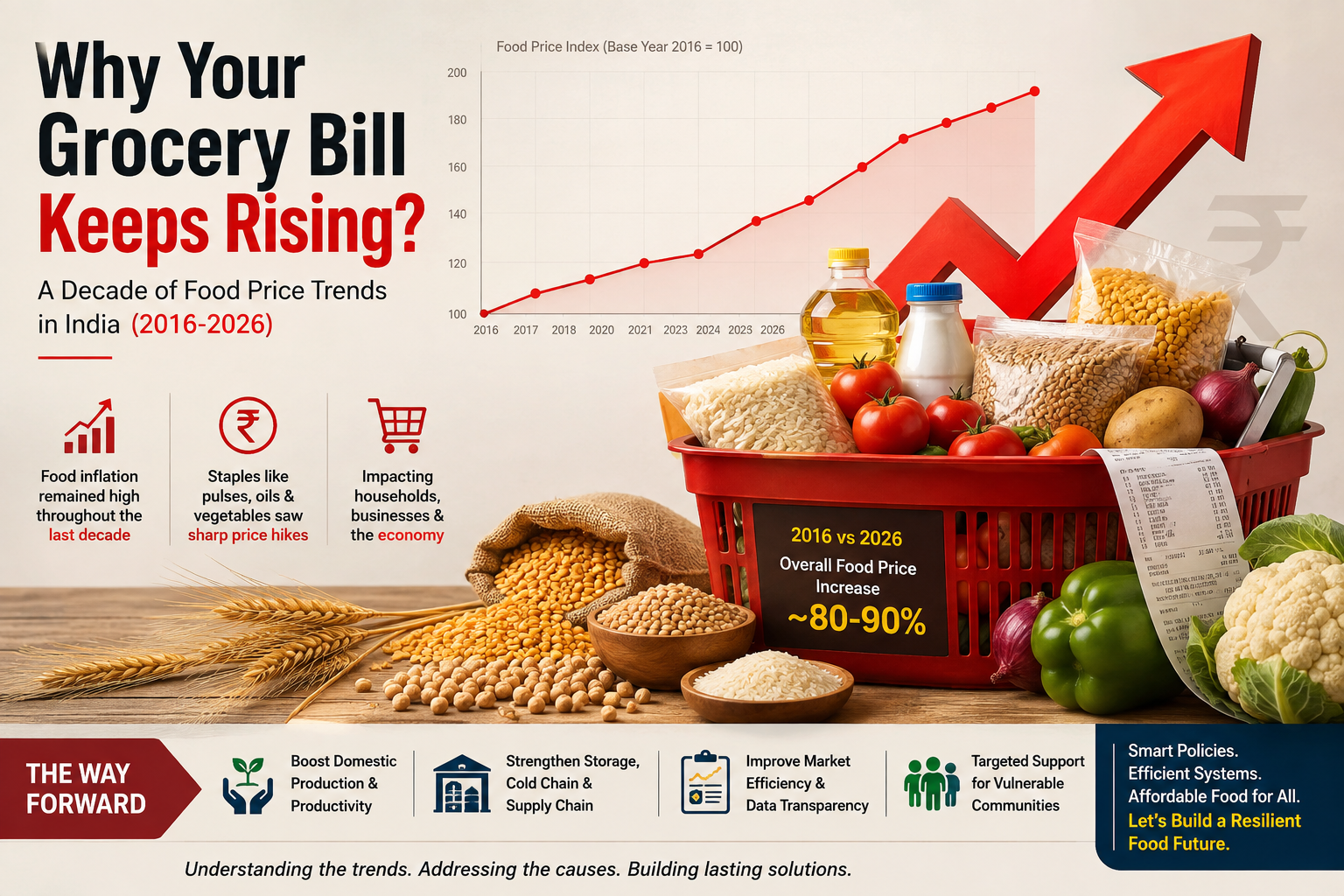
    Over the last decade, India’s everyday food basket has changed dramatically.

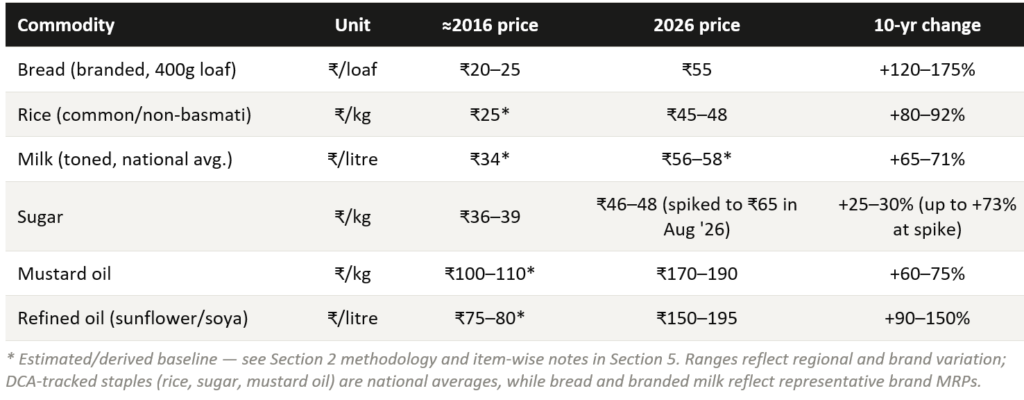
    A standard branded 400g bread loaf that cost roughly ₹20–25 around 2016 can now sell for around ₹55.

    Rice has moved from roughly ₹25/kg to ₹45–48/kg.

    Refined cooking oil has experienced even more dramatic volatility.

    Milk has climbed steadily.

    And sugar, after years of relatively moderate movement, has suddenly become a major concern in 2026.

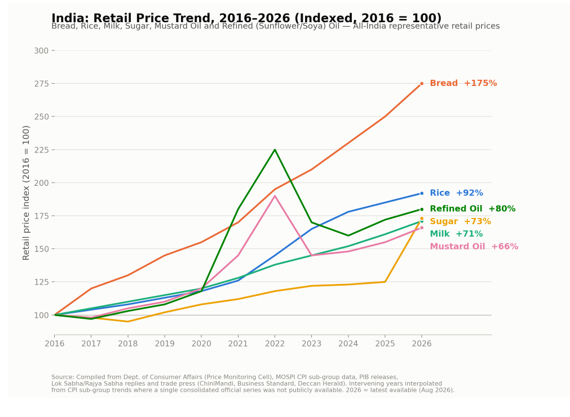
    The supplied 2016–2026 study estimates cumulative increases of approximately 175% for bread, 92% for rice, 80% for refined oil, 73% for sugar, 71% for milk and 66% for mustard oil.

    The numbers are striking.

    But the real story is not the number.

    The real story is what is causing it.


    The 10-year picture

    These are indicative national/representative figures, with some estimated historical baselines and brand/regional differences.


    But food inflation is not one story

    Look at the graph carefully.

    Bread follows a relatively persistent upward trajectory.

    Rice takes a major step upward.

    Edible oils experience a huge shock and then partially correct.

    Sugar remains comparatively controlled for years before suddenly moving sharply.

    Milk rises more steadily.

    That tells us something important: different foods require different inflation-control strategies.


    What is behind the increase?

    Six forces repeatedly appear across these categories.

    1. Higher agricultural support prices

    MSP for crops and FRP for sugarcane provide farmers greater price certainty and income support.

    But higher farm-gate prices can eventually move through procurement, processing and retail.

    The Economic Survey notes that India fixed MSP at 1.5 times the all-India weighted average cost of production, providing farmers greater price certainty.

    The challenge is therefore not whether MSP should exist.

    The question is:

    How do we increase farmer income without creating excessive consumer-price pressure?


    2. India’s dependence on imported edible oils

    This may be the biggest structural vulnerability in this basket.

    India imports a substantial share of its edible-oil requirement.

    That means an event in Indonesia, Malaysia, Argentina, Brazil, Russia or Ukraine can eventually affect the price of cooking oil in an Indian household.

    The 2021–22 global edible-oil shock demonstrated this dramatically.


    3. Global shocks

    The Russia–Ukraine war disrupted sunflower-oil and other commodity supplies.

    Indonesia’s palm-oil export restrictions created another major shock.

    These events showed that food security is increasingly connected to geopolitical security.


    4. Energy, logistics and packaging

    Bread illustrates this perfectly.

    The consumer sees ₹55 for a loaf.

    But behind that ₹55 are wheat flour, oil, sugar, yeast, packaging film, energy, labour, transportation, distribution and wastage.

    The study identifies these accumulated costs as a major reason for bread’s unusually high long-term increase.


    5. Government trade and supply policies

    India frequently uses:

    • Export restrictions
    • Import-duty changes
    • Buffer stocks
    • Open-market sales
    • Stock limits
    • Procurement
    • Subsidised retail programmes

    These tools can be extremely effective.

    But timing matters.

    A policy designed to stabilise prices can sometimes create unintended market reactions if supply chains and trader behaviour are not considered.

    The 2026 sugar episode is a good example of why policy design and market communication matter.


    So what can the Government do?

    The answer is not simply to impose price controls.

    Price controls can suppress symptoms temporarily while leaving the underlying supply problem unresolved.

    India needs a combination of short-term intervention and long-term productivity improvement.

    1. Build a stronger food-price early-warning system

    The Government already monitors essential commodity prices.

    The next step should be predictive.

    Track simultaneously:

    Weather → crop acreage → yield → mandi prices → stocks → imports/exports → global prices → retail prices.

    This would allow intervention before prices become a consumer crisis.

    The Department of Consumer Affairs already operates a Price Monitoring Division for essential commodities.


    2. Use buffer stocks more dynamically

    Where adequate government stocks exist, calibrated releases can reduce temporary shortages.

    The Government has already used Open Market Sale mechanisms for price stability.

    In 2026, the Government reported substantial wheat and rice stocks and continued monitoring of essential commodities.

    The opportunity is to make intervention earlier, targeted and temporary, rather than reacting after a major price spike.


    3. Increase agricultural productivity

    This is perhaps the most sustainable answer.

    The Economic Survey identifies fragmented landholdings, inadequate storage and marketing infrastructure, limited access to quality inputs, low mechanisation and uneven productivity as continuing constraints.

    Higher productivity means:

    more output without proportionately increasing cost.

    That is the most durable form of food-price control.


    4. Reduce edible-oil import vulnerability

    India needs to accelerate domestic oilseed productivity.

    The Economic Survey highlights the National Mission on Edible Oils–Oilseeds as one of the Government’s initiatives to improve domestic production and productivity.

    Over time, increasing domestic production can reduce India’s exposure to global edible-oil shocks.


    5. Improve storage and cold-chain infrastructure

    A food shortage does not always mean insufficient production.

    Sometimes food exists but cannot move efficiently.

    Better:

    • Warehousing
    • Cold storage
    • Rural roads
    • Packhouses
    • Refrigerated transport
    • Modern mandis
    • Digital market linkages

    can reduce wastage and the gap between farm-gate and retail prices.


    6. Make policy changes more predictable

    Frequent export bans, import-duty changes and stock restrictions can create uncertainty.

    The objective should be:

    Predictable policy + flexible intervention.

    Markets respond better when participants understand the Government’s trigger points and likely response.


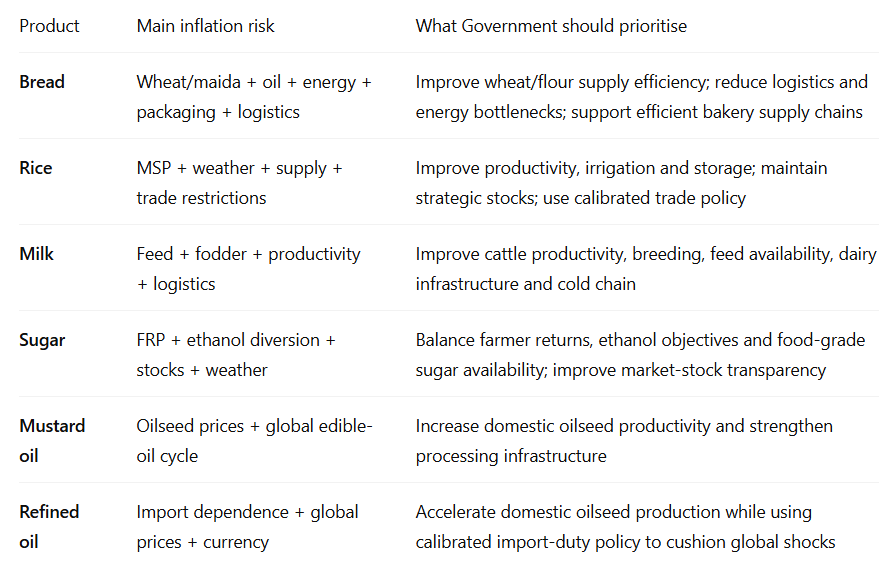
    Product-wise recommendations for Government

    The bigger question for India

    India has made significant progress in food security.

    The next challenge is different.

    It is affordable food security.

    Producing enough food is one objective.

    Producing enough food efficiently, storing it efficiently, moving it efficiently and keeping it affordable is the next.

    And the solution cannot come from one ministry or one policy.

    It requires coordination between:

    Agriculture + Food + Consumer Affairs + Commerce + Finance + Transport + Energy.

    Because the price of a loaf of bread is ultimately influenced by much more than wheat.


    My biggest takeaway

    The last ten years tell us something very clearly:

    Food inflation is becoming increasingly interconnected.

    A war can increase the price of cooking oil.

    A currency movement can increase the landed cost of commodities.

    A weather event can affect rice.

    A feed-price increase can affect milk.

    An ethanol policy can affect sugar.

    And higher packaging and logistics costs can push up the price of bread.

    The consumer sees one number on the shelf.

    Behind that number is an entire economic system.

    India’s next food-policy challenge should therefore move from simply controlling prices after they rise to predicting supply stress before prices rise.

    That is where technology, better agricultural productivity, strategic stocks, predictable trade policy and stronger domestic supply chains can make the biggest difference.

    The goal should not be artificially cheap food.

    The goal should be sustainably affordable food.


    What do you think?

    Should India focus more on price controls, or should the Government invest more aggressively in productivity, storage, domestic oilseed production and supply-chain infrastructure?

    I’d be interested in hearing the views of people working across FMCG, retail, agriculture, food processing and supply chain.

    #IndiaRetail #FoodInflation #FMCG #FoodSecurity #RetailStrategy #SupplyChain #Agriculture #FoodEconomics #ConsumerBusiness #IndiaEconomy #PricingStrategy

  • A case study – D2C 2.0: Digital + Retail

    A case study – D2C 2.0: Digital + Retail

    For more than a decade, D2C meant one thing: go directly to the consumer without traditional retail.

    Build a product.

    Create a digital brand.

    Run Meta and Google campaigns.

    Drive traffic to the website.

    Convert.

    Repeat.

    That model changed how brands were built.

    But the consumer has changed again.

    And this time, Gen Z may force D2C companies to rethink one of their original assumptions: that digital alone is enough.

    The future of D2C is not online versus offline.

    It is online + offline.

    It is Phygital.


    First, understand the Gen Z consumer

    Gen Z does not behave like a purely digital consumer.

    They may discover a product on Instagram, watch a creator explain it on YouTube, compare it online, ask AI for an opinion, visit a store to experience it and finally purchase through whichever channel gives them the best combination of value, trust, convenience and experience.

    Deloitte calls Gen Z the “most authentically omni-shopping generation”—a generation that combines digital discovery with a strong preference for in-person shopping. Its research found that 64% of Gen Z uses social media to research products and 35% uses it to discover products.

    That changes the strategic question for D2C companies.

    The question is no longer:

    “How do we get Gen Z to buy online?”

    It is:

    “How do we make our brand available wherever Gen Z wants to discover, evaluate and buy?”

    That is a very different business model.


    What does Gen Z actually need?

    Gen Z wants value, but value does not simply mean the lowest price.

    They want:

    Good products.

    Fair prices.

    Trust.

    Reviews and proof.

    Personalisation.

    Convenience.

    Speed.

    Experience.

    Identity.

    And increasingly, the ability to move seamlessly between digital and physical channels.

    This matters because Gen Z will become an increasingly important spending force.

    In India, Deloitte estimates that Gen Z will account for 43% of total consumption in 2025, with direct spending power of around US$250 billion. A newer Google-Deloitte report projects Gen Z could command 45% of India’s online spend by 2030.

    This is not a niche customer segment.

    This is the next consumer economy.


    Where are D2C companies going wrong?

    The problem is not that D2C companies went digital.

    The problem is that many of them stopped there.

    They built businesses around paid digital acquisition rather than building a complete consumer ecosystem.

    The model became:

    Advertising → Website → Purchase

    That model becomes vulnerable when:

    • customer acquisition becomes expensive,
    • competitors sell similar products,
    • consumers become promotion-sensitive,
    • marketplaces capture demand,
    • algorithms change,
    • and the consumer has too many alternatives.

    A D2C brand can have millions of impressions and still have very little consumer loyalty.

    It can have excellent ROAS and weak profitability.

    It can have a strong online following and weak physical presence.

    And it can have a great product that consumers still want to touch, try, compare or experience before buying.

    This is where retail re-enters the story.


    Retail is not disappearing. It is changing.

    The old argument was:

    Digital will replace stores.

    The evidence increasingly suggests something different.

    Digital and physical are converging.

    India’s retail sector is expected to grow from approximately US$1.06 trillion in 2024 to US$1.93 trillion by 2030, while online retail is projected to increase from US$75 billion to US$260 billion during the same period.

    Online is growing rapidly.

    But even by 2030, it would represent only around 14% of total Indian retail according to the Deloitte-FICCI projection.

    That means something very important for D2C founders:

    The digital opportunity is enormous—but the physical retail opportunity remains enormous too.

    Ignoring either one limits the addressable market.


    India is already showing the direction

    The retail market is not waiting for D2C brands to decide whether they like physical retail.

    D2C brands are already moving there.

    CBRE reported that D2C brands accounted for approximately 27% of India’s retail leasing activity in 2025. In H1 2026, D2C players accounted for approximately 28% of retail absorption.

    That is a significant signal.

    D2C brands are becoming retail occupiers.

    Why?

    Because physical stores can provide something digital cannot fully replicate:

    Trust.

    Trial.

    Touch.

    Demonstration.

    Experience.

    Visibility.

    Immediate gratification.

    And sometimes, simply:

    “I want to see it before I buy it.”


    Look at what is happening globally

    The transition is not uniquely Indian.

    In the US, digitally born brands such as Oura expanded into physical retail through major retailers including Best Buy and Target.

    Beauty brand Glossier, which built its reputation through digital communities, expanded through Sephora.

    The lesson is not that these companies abandoned D2C.

    They didn’t.

    They expanded the definition of D2C.

    They realised that direct relationships can exist through multiple channels.

    The store does not necessarily weaken the brand’s relationship with the consumer.

    If managed correctly, it can strengthen it.


    Europe is taking this even further

    Europe is showing how technology can actually make physical retail more relevant.

    Deloitte’s 2026 European research found that 56% of European consumers have already used AI for shopping, with product comparison among the leading uses.

    This creates an interesting future.

    Imagine a consumer walking into a store.

    They scan a product.

    AI understands their preferences.

    It compares products.

    The store provides the physical experience.

    The digital layer provides intelligence.

    The transaction can happen either physically or digitally.

    That is not traditional retail.

    That is Phygital retail.


    Southeast Asia provides another lesson

    Southeast Asia has demonstrated the power of social commerce.

    The consumer can discover a product through a creator, interact with the seller, research the product and complete the purchase without following the traditional retail funnel.

    The lesson for India is important:

    Consumers no longer recognise the boundaries between marketing, commerce and retail.

    A video can become a store.

    A creator can become a salesperson.

    A marketplace can become a discovery engine.

    A physical store can become a content studio.

    And an app can become a loyalty programme.

    The channels are merging.


    India has an additional advantage

    India has something many mature markets do not have at the same scale:

    Digital growth + physical retail growth + young consumers + Tier II/III consumption.

    Deloitte reports that Tier II and III cities already account for more than 60% of India’s e-commerce transactions.

    CBRE’s latest retail data shows Delhi-NCR, Chennai and Mumbai accounted for approximately 66% of retail leasing activity in H1 2026, while D2C brands represented around 28% of absorption.

    The opportunity therefore extends beyond the metros.

    A D2C company that builds digital demand in a Tier II city may eventually discover that the same city can support a physical presence.

    Digital can identify where retail should go.

    That is a major strategic advantage.


    The future D2C company will look different

    The first generation of D2C companies asked:

    “How can we bypass retail?”

    The next generation should ask:

    “How can we use digital to build demand and retail to expand the relationship?”

    That changes the role of the store.

    The store is no longer merely a place to generate billing.

    It can become:

    A brand experience centre.

    A consumer acquisition point.

    A product trial centre.

    A content engine.

    A community hub.

    A fulfilment point.

    A customer-service point.

    A physical expression of a digital brand.

    And digital remains equally important.

    It can drive:

    Discovery.

    Personalisation.

    Reviews.

    Community.

    Data.

    Convenience.

    Repeat purchase.

    So the relationship becomes circular:

    Digital → Store → Digital → Store → Digital

    rather than:

    Digital OR Store


    And this is where India becomes particularly interesting

    India does not need to copy the US, Europe or Southeast Asia.

    It can combine the best elements of all three.

    From the US:

    Brand building + D2C + retail partnerships

    From Europe:

    AI + personalisation + experience

    From Southeast Asia:

    Social commerce + creator-led discovery

    From India:

    Digital scale + physical retail + quick commerce + Tier II/III consumption

    That combination can create something much bigger.


    The strategic opportunity for Indian D2C brands

    The real question is no longer:

    “Should a D2C company open stores?”

    That is too simplistic.

    The better question is:

    “Where does physical presence create incremental consumer value and incremental business value?”

    A D2C company should look at retail when physical presence can:

    • increase trust,
    • improve discovery,
    • allow product trial,
    • reduce dependence on paid acquisition,
    • increase customer lifetime value,
    • strengthen brand visibility,
    • open new geographies,
    • improve consumer understanding,
    • and create an integrated online-offline relationship.

    Not every D2C brand needs 500 stores.

    Not every brand needs a flagship.

    Some may need a shop-in-shop.

    Some may need kiosks.

    Some may need experience centres.

    Some may need selective retail partnerships.

    Some may need franchise expansion.

    The format should follow the consumer and economics—not the other way around.


    The next D2C battle will not be fought only on Meta

    It will be fought across the entire consumer journey.

    Who discovers the consumer?

    Who earns their trust?

    Who gives them the best experience?

    Who makes the purchase easiest?

    Who understands them best?

    Who gets the second purchase?

    Who builds the strongest relationship?

    That is why I believe the next phase of D2C will be less about direct-to-consumer commerce and more about direct-to-consumer relationships.

    And those relationships will exist across screens, stores, marketplaces, creators, communities and AI.


    D2C has reached its next crossroads

    The first D2C revolution asked brands to leave traditional retail.

    The next one will ask them to re-enter retail intelligently.

    Not because digital failed.

    But because the consumer has become omnichannel.

    Gen Z is proving that point faster than any other generation.

    They may discover online.

    They may validate through a creator.

    They may ask AI.

    They may visit a store.

    They may purchase online.

    They may return offline.

    And they may recommend the product through social media.

    The consumer sees one brand.

    The company must stop seeing separate channels.

    That is the real meaning of Phygital.

    And for India’s D2C companies, the next phase of growth may not come from spending another ₹10 crore on digital advertising.

    It may come from asking a much bigger question:

    “Where should our digital brand meet our consumer physically?”

    That is where D2C meets Retail Expansion.

    And that is where the next generation of Indian consumer brands can be built.

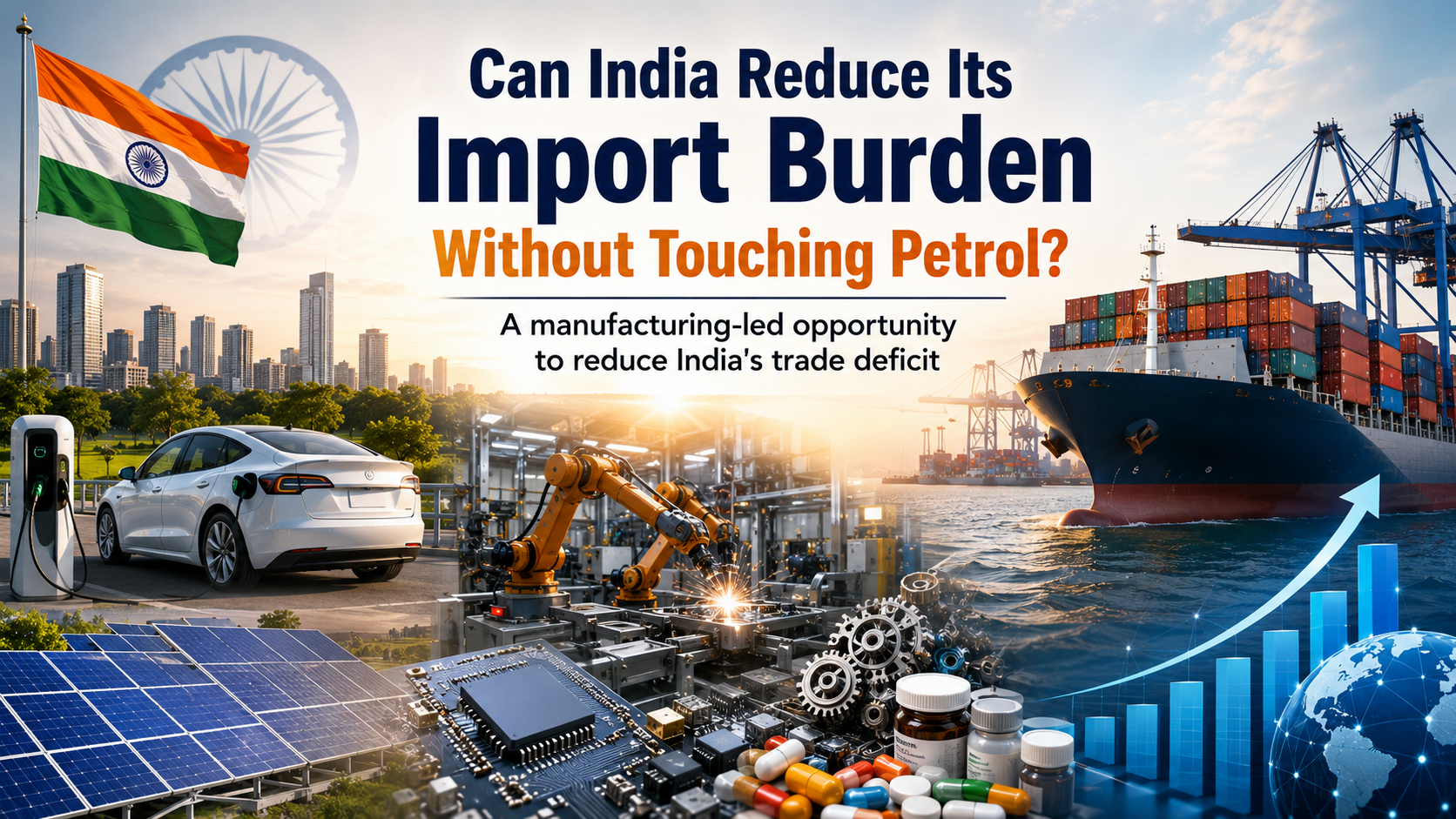
  • Case Study: Can India Reduce Its Import Burden Without Touching Petrol? A manufacturing-led opportunity to reduce India’s trade deficit- Gaurang Govind

    Case Study: Can India Reduce Its Import Burden Without Touching Petrol? A manufacturing-led opportunity to reduce India’s trade deficit- Gaurang Govind

    LinkedIn article | Critical-thinking scenario model

    The hook

    What if India’s import burden is not just a problem—but one of India’s biggest manufacturing opportunities?

    India imported US$721.2 billion of merchandise in FY2024-25, while merchandise exports stood at about US$437.7 billion, leaving a merchandise trade deficit of roughly US$283.5 billion.

    But we need to ask a more intelligent question:

    How much of these imports can India realistically replace through domestic manufacturing—and how much can the resulting manufacturing ecosystem add to exports?

    The challenge: every import is not a bad import

    The answer is not 100% replacement. India imports crude oil because of resource constraints. India imports gold because domestic jewellery manufacturing does not eliminate the need for gold. India imports advanced machinery because some of that machinery actually increases India’s productive capacity and future exports. India imports semiconductors and advanced components because developing the entire upstream ecosystem requires technology, capital and time.

    Therefore, ‘Make everything in India’ is not the right strategy.

    The better objective is: reduce avoidable imports, increase domestic value addition and build industries that can eventually export.

    Where is the real opportunity?

    OpportunityPotential domestic substitutionWhy?
    Pulses & selected agricultural products40–60%India already has the agricultural base.
    Edible / vegetable oils40–55%Productivity and processing opportunity.
    Toys, footwear, consumer goods & finished plastics50–80%Existing manufacturing capability and lower technology barriers.
    Electronics & components25–50%Large opportunity, but imported inputs remain important.
    Telecom equipment40–60%Domestic engineering capability, but high-end components remain constrained.
    Computer hardware30–50%Assembly is easier than deep component localisation.
    Specialty chemicals20–40%Technology, feedstock and scale constraints.
    Selected capital goods20–40%Build domestic capability selectively; productive imports can be beneficial.

    The interesting point is that some of the best opportunities are not necessarily India’s largest import categories. There are hundreds of smaller products where India could potentially achieve 50–90% domestic value addition.

    Three scenarios

    Using the FY2024-25 merchandise import base of US$721.2 billion, I have modelled three scenarios for non-petroleum import substitution.

    ScenarioGross import substitutionApprox. share of imports
    ConservativeUS$42 bn5.9%
    Base / realisticUS$63 bn8.7%
    Strong transformationUS$88 bn12.2%

    But there is an important correction. If India manufactures something domestically, it may still import raw materials, components, technology and machinery. Therefore, US$63 billion of gross import substitution does not mean US$63 billion of net foreign-exchange saving.

    In the base scenario, the estimated net foreign-exchange retention is approximately US$42 billion.

    Then comes the second opportunity: exports

    If India manufactures only for its domestic market, imports fall but exports do not necessarily change. If these new industries become globally competitive, India gets both import substitution and export growth.

    Suppose the new manufacturing ecosystem increases merchandise exports by approximately 7%. On the FY2024-25 export base, that represents roughly US$30.6 billion of additional exports.

    Again, this is not treated as a free benefit. The model allows approximately 30% of incremental export value for imported inputs, so the trade benefit is not overstated.

    And then we have the EV opportunity

    This is a separate lever. India’s petrol and diesel consumption is enormous. If EV adoption reaches 25%, the impact should not be modelled as a simple 25% reduction in oil imports.

    Vehicle mix, kilometres travelled, two-wheelers versus cars, buses and trucks, charging availability and petroleum’s non-road uses all matter. India also exports refined petroleum products, while batteries and EV components can themselves create imports.

    Base EV assumption: 25% EV adoption → approximately 20% displacement of petrol + diesel demand.

    Under this model, that could translate into approximately US$14.9 billion of annual crude-import-value saving.

    This is separate from the manufacturing saving. And EV adoption should ideally be accompanied by domestic battery, motor, power-electronics and charging-equipment manufacturing so that the oil saving is not partly replaced by a new EV import bill.

    Put the three levers together

    ContributionImpactComment
    Manufacturing import savingUS$64.9 bnBase non-petroleum manufacturing scenario
    EV petroleum-import savingUS$14.9 bn25% EV adoption / base fuel-displacement scenario
    TOTAL DIRECT IMPORT SAVINGUS$79.8 bnManufacturing + EV
    Additional merchandise exportsUS$30.6 bnApprox. 7% export increase
    Imported inputs for additional exports~US$9.2 bn30% analytical allowance
    Indicative trade-deficit improvement~US$110 bnCombined scenario
    IndicatorFY2024-25 OLDCentral scenario / NEW
    Merchandise importsUS$721.2 bnApproximately US$641.4 bn
    Merchandise exportsUS$437.7 bnApproximately US$468.3 bn
    Merchandise trade deficitUS$283.5 bnApproximately US$173.1 bn

    Central scenario: approximately US$110 billion improvement in the merchandise trade deficit, or roughly 39% of the FY2024-25 deficit.

    But here is the most important point

    India should not stop at assembly.

    Take electronics. If India assembles a ₹100 product but imports ₹70 worth of components, the foreign-exchange benefit is limited.

    The real opportunity is: Assembly → Components → Materials → Technology → Scale → Exports.

    The same principle applies to EVs: EVs → batteries → cells → power electronics → motors → components.

    And to chemicals: chemicals → intermediates → specialty chemicals → global exports.

    Where India should NOT spend maximum effort

    • Crude oil — a resource constraint. EVs, energy efficiency and alternative energy matter more.
    • Gold — domestic jewellery manufacturing does not remove the underlying gold import.
    • Advanced semiconductors — a long-term strategic opportunity, but not a quick import-substitution solution.
    • Advanced machinery — productive capital-goods imports can strengthen domestic output and exports; blanket substitution can reduce competitiveness.

    Top 5 focus areas

    1. Domestic value addition — measure how much of the product’s value is actually created in India.
    2. Import substitution where resources already exist — oilseeds, pulses, food processing, footwear, toys, consumer goods and selected plastics.
    3. Electronics & components — move beyond assembly into components and materials.
    4. Export-oriented manufacturing — every major import-substitution programme should ask: ‘Can we eventually export this product?’
    5. EV + domestic component ecosystem — combine lower petroleum demand with Indian battery, motor, electronics and charging capability.

    The real question for India

    India does not need to become an import-free economy. That would be neither practical nor economically desirable.

    India needs to become a high-domestic-value-add economy.

    If India can simultaneously reduce avoidable imports, increase domestic manufacturing, increase exports, reach 25% EV adoption over time and build the domestic EV/electronics supply chain, the merchandise trade deficit could potentially fall dramatically.

    The central scenario suggests a possible ~US$110 billion improvement.

    But the real prize is much bigger than that number. It is the creation of Indian capability—jobs, technology, suppliers, investment, productivity, exports and recurring foreign-exchange earnings.

    So perhaps the question India should ask is no longer: ‘How much can we stop importing?’

    ‘How much value can India create from every dollar it currently imports—and how much of that value can we ultimately sell to the world?’

    Data & methodology note

    FY2024-25 merchandise trade figures are from Government of India Department of Commerce/DGCI&S data. The Department reports merchandise imports of US$721.20 billion, exports of US$437.70 billion and a merchandise trade deficit of US$283.50 billion.

    The substitution percentages, export-growth assumption, imported-input allowance and EV savings are analytical scenario assumptions, not Government forecasts. The model should be upgraded to HS-code-level BOM/input-output analysis before being used as a formal policy estimate.

    Primary references: Government of India, Department of Commerce Annual Report 2025-26; Department of Commerce TradeStat; PPAC petroleum data; Government of India agriculture and chemicals data.

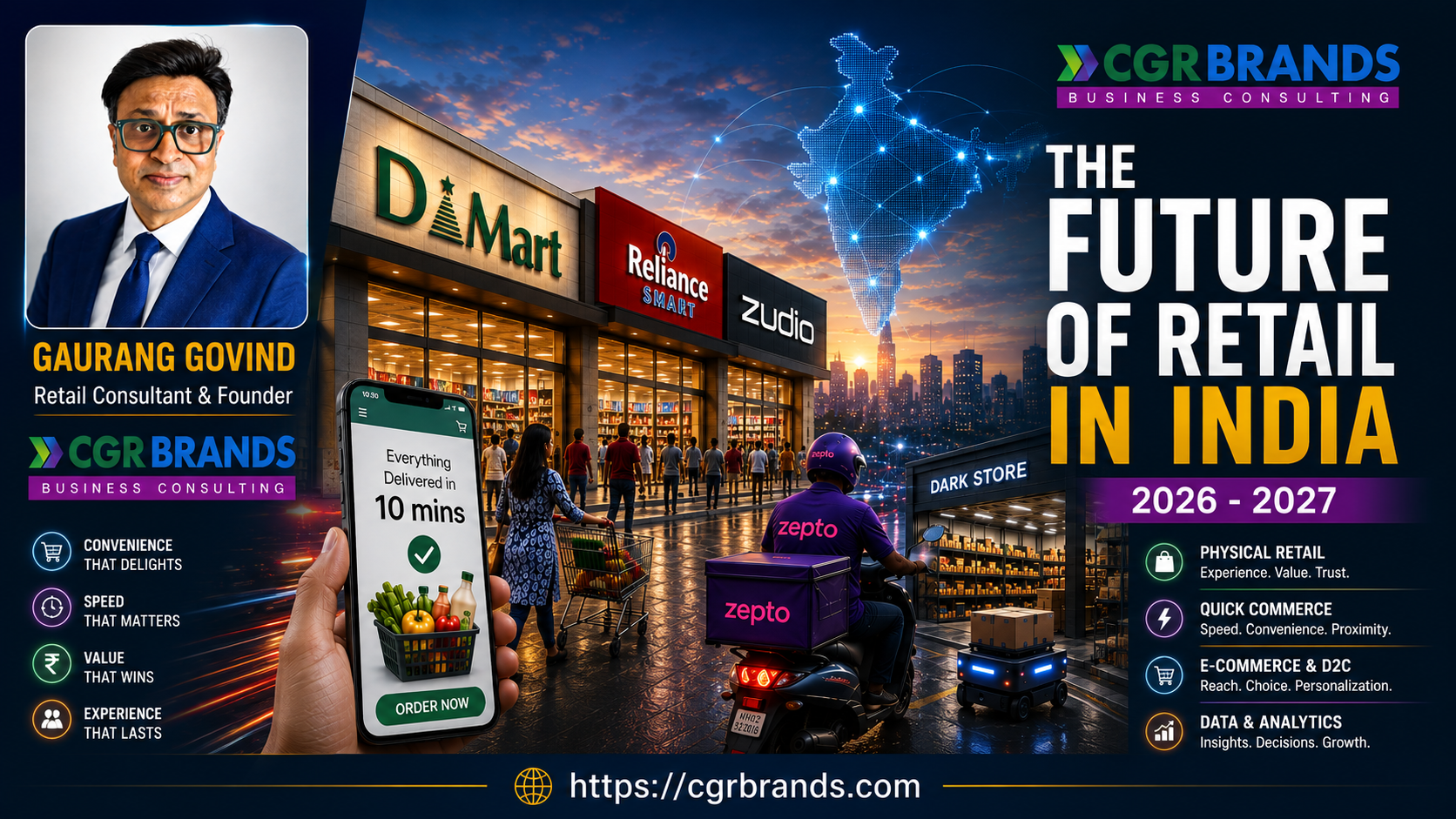
  • India Retail 2024–2027: From Store Expansion to Intelligent Retail Expansion I A retail case study on what changed, what is coming next, and what ret

    India Retail 2024–2027: From Store Expansion to Intelligent Retail Expansion I A retail case study on what changed, what is coming next, and what ret

    The Hook

    India’s retail expansion story is entering its next phase.

    The question is no longer:

    “How many stores can we open?”

    The question is:

    “How intelligently can we expand while protecting productivity, profitability and customer relevance?”

    Post banner

    Between 2024 and 2026, India’s leading retailers significantly increased their physical footprints while quick commerce simultaneously created a completely different retail proposition: availability at the doorstep within minutes.

    Now the real battle is moving towards Tier 2, Tier 3 and emerging consumption centres.

    And I believe the next two years will be less about the race for store count and more about the race for better retail economics.

    What happened between 2024 and 2026?

    Three examples illustrate the direction.

    Reliance Retail

    Reliance Retail increased its store network from 19,340 stores in FY2025 to 20,160 stores in FY2026, while gross revenue increased from ₹3.31 lakh crore to approximately ₹3.71 lakh crore. Its Smart Bazaar network crossed 1,000 stores, with a significant part of that network serving Tier 2 and smaller markets.

    More importantly, Reliance is combining physical stores, digital commerce and hyperlocal commerce rather than treating them as separate businesses.

    Trent’s Zudio

    Zudio reached 963 stores across 313 cities by FY2026, compared with 765 stores in FY2025 and 545 stores in FY2024. The company’s own reporting highlights accessibility, sharp price points, in-house merchandise and rapid expansion as key elements of the model.

    Avenue Supermarts

    Avenue Supermarts, the operator of the DMart chain, moved from 365 stores in FY2024 to 415 in FY2025 and 500 in FY2026.

    The FY2026 expansion is particularly interesting: 85 stores were added, including 45 stores in Tier 2+ markets, while the company entered 39 new cities, 34 of them Tier 2+. It also entered Uttar Pradesh, Haryana, Odisha, Uttarakhand and Goa.

    The message from these examples is clear:

    India’s organised retail opportunity is moving deeper into the country. This we all know.

    But there is another force changing the game.

    The Quick-Commerce Challenge

    Quick commerce has changed the consumer’s definition of convenience.

    The customer no longer thinks:

    “I need to visit a store.”

    The customer increasingly thinks:

    “I need it now.”

    Blinkit, Swiggy Instamart and Zepto have built large dark-store networks, while Amazon and Flipkart are now increasing their investments in rapid delivery.

    In June 2026, Reuters reported that Amazon planned to expand its rapid-delivery service to 300 Indian cities, while Flipkart was targeting approximately 1,500 quick-commerce locations.

    This creates an interesting future scenario.

    Traditional retailers will increasingly have stores.

    Quick-commerce companies will increasingly have dark stores.

    E-commerce companies will increasingly combine warehouses, marketplaces and rapid fulfilment.

    The consumer will simply choose whichever channel delivers the best combination of:

    Price + availability + speed + trust + assortment + experience.

    My Forecast for 2026–2027

    1. Tier 2 and Tier 3 will become the primary expansion laboratory

    I expect retailers to become more aggressive in smaller cities—but also more selective.

    The next phase will not be:

    “Let’s enter every Tier 2 city.”

    It will be:

    “Let’s identify the right micro-markets inside the right Tier 2 cities.”

    Population alone will not be sufficient.

    Retailers will increasingly evaluate:

    – Catchment population

    – Household income

    – Consumer spending

    – Competition

    – Footfall potential

    – Real-estate cost

    – Logistics cost

    – Delivery density

    – Digital adoption

    – Category potential

    – Store productivity potential

    This means location analytics will become a board-level expansion capability.

    —

    2. Cluster expansion will become more important than isolated expansion

    The next winning model may not be one store in 20 cities.

    It may be five to ten stores in one carefully selected cluster.

    Why?

    Because clustering can improve:

    Supply-chain efficiency → inventory availability → marketing efficiency → management supervision → brand awareness → customer familiarity.

    Retailers should therefore stop measuring expansion only by the number of stores opened.

    They should measure:

    Revenue per cluster.

    Profit per cluster.

    Inventory turns per cluster.

    Supply-chain cost per cluster.

    Customer acquisition cost per cluster.

    This is where retail analytics can transform expansion decisions.

    —

    3. Quick commerce will not kill physical retail—but it will change its role

    This is perhaps the most important prediction.

    Physical stores will increasingly need to answer:

    “Why should the customer visit me?”

    For grocery, the answer could be:

    Better value + larger assortment + monthly shopping + fresh produce + discovery.

    For fashion:

    Trial + experience + instant gratification + newness.

    For electronics:

    Demonstration + advice + service + installation.

    For lifestyle:

    Discovery + experience + social shopping.

    The physical store therefore needs to become more than a transaction point.

    It needs to become a customer-experience and fulfilment asset.

    —

    4. Dark stores will face an operational-quality test

    There is another issue that I believe deserves far greater attention.

    A dark store is still a retail operation.

    Technology can manage orders.

    Technology can generate inventory alerts.

    Technology can optimise delivery routes.

    But people still have to manage:

    Expiry → FEFO → hygiene → temperature → receiving → storage → pest control → picking → product handling.

    Recent food-safety enforcement in Maharashtra illustrates the risk. Authorities inspected quick-commerce establishments and suspended permits at 12 warehouses after identifying issues including cockroach infestations, rodent droppings and other sanitation problems.

    This should not be viewed only as a quick-commerce problem.

    It is an industry-wide retail operations lesson.

    As the network expands, retailers need stronger:

    Retail audits + SOP compliance + training + accountability + store-level ownership.

    —

    5. E-commerce and direct-to-consumer brands will push deeper into smaller cities

    This is another major structural change.

    Smaller-city consumers are not waiting for physical stores.

    They are discovering brands online.

    According to Unicommerce data reported by the India Brand Equity Foundation, Tier 2 and Tier 3 cities were expected to contribute around 66% of new direct-to-consumer orders in FY2026.

    This changes the expansion equation.

    A brand can now enter a city digitally before opening a physical store.

    That creates an important consulting opportunity:

    Digital-first → Data validation → Pilot store → Cluster expansion

    Instead of:

    Store first → Hope for demand → Correct later

    This can significantly reduce expansion risk.

    —

    What should retailers do now?

    Action 1: Build a micro-market expansion model

    Don’t approve a new store only because the city looks attractive.

    Create a scoring model covering:

    Demand + competition + rent + catchment + logistics + digital demand + store economics.

    —

    Action 2: Establish a 12–24 month store maturity dashboard

    Every new store should be tracked against:

    Sales per sq. ft./ GMROF

    Gross margin.

    GMROI.

    Inventory turns.

    Inventory cycle

    Conversion.

    Average basket value.

    Shrinkage.

    Manpower productivity.

    Contribution margin.

    This allows management to distinguish between a temporary maturity issue and a fundamentally weak location.

    —

    Action 3: Design the store and dark store together

    The future will increasingly require omnichannel operating models.

    A physical store may serve:

    Walk-in customers + online orders + click-and-collect + local fulfilment.

    Retailers should therefore redesign:

    Inventory → picking → replenishment → manpower → technology → customer journey

    as one integrated process.

    —

    Action 4: Create independent operational audits- audits are crucial specially third party remove bias

    Expansion multiplies risk.

    Every additional location creates another opportunity for:

    Expiry leakage + shrinkage + poor hygiene + inventory inaccuracies + SOP deviation + manpower inefficiency.

    Retailers should therefore create a structured audit framework covering:

    People + Process + Product + Place + Technology + Compliance.

    —

    Action 5: Treat Tier 2 and Tier 3 as different markets—not smaller metros

    This is critical.

    Consumers in smaller cities may have different:

    Price sensitivities, pack-size preferences, fashion choices, shopping missions, credit behaviour and local brand preferences.

    Retailers should analyse local behaviour before standardising the assortment.

    —

    The Biggest Prediction for 2027

    I believe the retail industry will gradually move from:

    “Expansion at scale”

    to

    “Intelligent expansion at scale.”

    The winners will not necessarily have the largest number of stores.

    They will have the best store economics, supply chain, data systems, customer understanding and execution discipline.

    The next competitive advantage will come from connecting:

    Physical retail + e-commerce + direct-to-consumer + quick commerce + data + supply chain.

    And this will create a new retail equation:

    Right Market × Right Format × Right Assortment × Right Inventory × Right Execution = Profitable Growth

    —

    Final Recap

    The last two years proved that physical retail is not disappearing.

    It is changing.

    Reliance Retail has crossed 20,000 stores.

    Zudio has reached nearly 1,000 stores.

    Avenue Supermarts has reached 500 stores and is pushing deeper into Tier 2+ markets.

    At the same time, quick commerce and e-commerce are moving rapidly into smaller markets.

    So the next two years will not be about choosing between stores and digital.

    They will be about building the right combination.

    For retailers, my recommendation is straightforward:

    Analyse before expanding.

    Pilot before multiplying.

    Cluster before spreading.

    Measure productivity before celebrating footprint.

    Audit operations before scaling.

    And most importantly:

    Build the organisation’s capability at the same speed as you build its footprint.

    Because in the next phase of Indian retail, opening the store may be easy. Running 500 or 5,000 stores consistently will be the real competitive advantage.

    Sources and further reading

    – “Reliance Industries — FY2025–26 Retail Business Overview” (https://reference-url-citation.invalid/7)

    – “Reliance Industries — FY2025–26 Integrated Annual Report” (https://reference-url-citation.invalid/8)

    – “Trent Limited — FY2025–26 Integrated Annual Report” (https://reference-url-citation.invalid/9)

    – “Trent Limited — Annual Reports and Company Filings” (https://reference-url-citation.invalid/10)

    – “Avenue Supermarts — FY2024–25 Annual Report” (https://reference-url-citation.invalid/11)

    – “Motilal Oswal — Avenue Supermarts FY2026 expansion analysis” (https://reference-url-citation.invalid/12)

    – “Reuters — Amazon and Flipkart quick-commerce expansion” (https://reference-url-citation.invalid/13)

    – “Reuters — Food-safety enforcement at quick-commerce warehouses” (https://reference-url-citation.invalid/14)

    – “India Brand Equity Foundation — Tier 2/3 direct-to-consumer growth” (https://reference-url-citation.invalid/15)

    #RetailIndia #RetailStrategy #RetailExpansion #RetailOperations #QuickCommerce #DarkStores #Ecommerce #DirectToConsumer #Tier2Cities #Tier3Cities #OmnichannelRetail #RetailAnalytics #SupplyChain #StoreProductivity #FMCG #RetailConsulting #CustomerExperience #InventoryManagement #GMROI

    Gaurang Govind

    Business Consulting firm