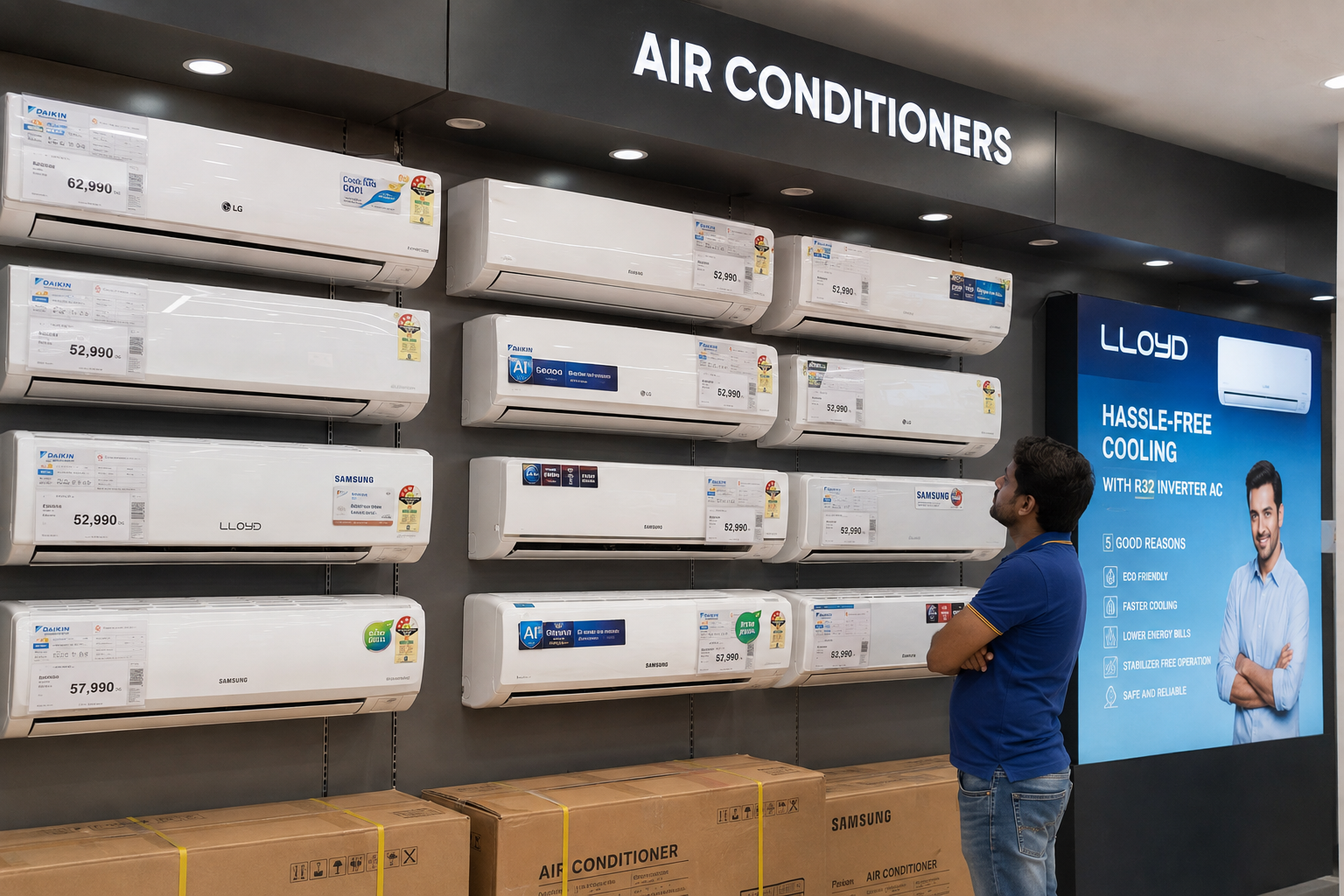
The AC sitting on your wall may say “Made in India”. But how much of it is actually made in India?
That is perhaps the most interesting question emerging from India’s rapidly expanding consumer-durable market.
India’s air-conditioner industry is no longer simply a story about rising summer temperatures. It is becoming a story about manufacturing, localisation, technology, imports, component ecosystems and increasingly intense competition among global and Indian brands.
And the numbers are already significant.
₹35,500 crore—and growing
According to Blue Star’s FY2025–26 annual report, India’s overall air-conditioning industry was valued at approximately ₹35,500 crore in FY26.
Of this, around ₹30,000 crore came from Room Air Conditioners (RACs), while approximately ₹5,500 crore came from central air-conditioning systems, including central plants, packaged and ducted systems and VRF systems.
The room-AC market is expected to expand dramatically. Industry projections cited by Blue Star indicate that annual room-AC demand could reach 30 million units by FY30. India’s room-AC penetration is still only around 10% of households, leaving enormous headroom for future growth.
But there is an important distinction.
Room AC is not synonymous with residential AC.
Split and window ACs are overwhelmingly household products, but they are also extensively used in small offices, shops, clinics, restaurants and other establishments. Therefore, a clean public-data split between “residential RAC” and “commercial RAC” is not currently available.
For a market study, it is better to treat RAC as one category and separately analyse the broader commercial HVAC market.
The window is closing—on window ACs
The Indian consumer has overwhelmingly chosen the split AC.
Window ACs remain relevant, particularly in price-sensitive markets and replacement demand, but the market has shifted decisively towards split systems.
The bigger structural trend is therefore:
Window AC → Split AC → Inverter Split AC → Smart, connected and energy-efficient ACs
Energy efficiency is increasingly becoming a purchasing consideration, while smart features and premiumisation are also influencing value growth. Euromonitor identifies split ACs as the dominant category and highlights localisation as an important future trend.
Who is winning the battle?
The organised branded market is highly competitive—but surprisingly concentrated at the top.
Euromonitor’s February 2026 India report, using 2025 retail-volume data, puts the leading brands at:
Voltas – 19%
LG – 17%
Daikin – 13%
The top three therefore account for approximately 49% of retail volume sales.
Blue Star is another major force. The company reported a room-AC market share close to 14% in FY25, and entered FY26 targeting a 14.3% share.
This creates a fascinating competitive structure:
Voltas → LG → Daikin → Blue Star → Samsung, Lloyd, Panasonic, Hitachi, Carrier, O General and others
But commercial air conditioning is a different game.
In VRF, ducted systems, packaged systems and chillers, engineering capability, project execution and after-sales service become far more important than mass retail distribution. Blue Star, Voltas, Daikin, Carrier, Johnson Controls-Hitachi, Mitsubishi Electric, Trane and others compete strongly across these segments.
Blue Star itself reported 9% growth in India’s commercial air-conditioning market during FY26, driven by industrial, hospitality, healthcare, government and infrastructure demand.
Now comes the more interesting question: What is actually inside an AC?
A modern split AC is not simply a compressor inside a metal box.
Historically, some of the most technologically important components—particularly compressors and electronics—have had significant import dependence.
And this is where India’s AC story gets much more interesting.
From “assembled in India” to “made in India”
The Government of India is actively trying to change the component equation.
The White Goods PLI programme has supported domestic manufacturing of critical AC components including compressors, motors, copper tubes and other parts. The government now targets domestic value addition of 75–80% by 2028–29.
The scale of change is already visible.
Government data released in July 2026 says India’s compressor manufacturing capacity increased from approximately 1 million units in 2021 to 10 million units in 2025–26. It also reports substantial localisation of PCB assemblies and cross-flow fans.
That is a major structural shift.
The question is no longer simply:
“Which AC brand sells the most?”
It is becoming:
“Who controls the component ecosystem?”
Daikin is making a big bet on compressors
Daikin provides an excellent example of this transition.
Daikin and Taiwan-based Rechi Precision have established Daikin-Rechi India, and construction of a rotary-compressor manufacturing facility at Sri City, Andhra Pradesh, commenced in March 2026.
This is strategically important because the compressor is one of the most critical and historically import-dependent components in an AC.
Localising the compressor can reduce supply-chain vulnerability while increasing domestic value addition.
But “Made in India” still does not automatically mean 100% Indian BOM.
Semiconductors, specialised electronic components, sensors and other high-technology inputs can still come from global supply chains.
And then there is Amber—the company consumers rarely see
Perhaps one of the most important companies in the Indian AC ecosystem is Amber Enterprises.
Why?
Because consumers may not see the Amber name on their AC, but Amber operates extensively as an OEM/ODM manufacturer and component supplier.
Its FY25 annual report says the group can cater to approximately 70% of an AC’s bill of materials, and it reported a 26–27% share of India’s RAC manufacturing footprint by value.
This changes how we should look at the industry.
A consumer may buy a Voltas, Panasonic, Blue Star or another branded AC, but the manufacturing and component ecosystem behind that product can involve multiple companies.
Brand ownership, manufacturing and component ownership are not necessarily the same thing.
The next battleground is localisation
The Government’s latest PLI initiatives are targeting exactly this gap.
In January 2026, five additional companies were selected under the White Goods PLI scheme to manufacture AC components such as compressors, copper tubes, control assemblies, heat exchangers and BLDC motors.
So India’s AC industry is undergoing two transformations simultaneously.
The first is on the consumer side:
Low penetration → mass adoption → premiumisation → smart and energy-efficient ACs
As India’s RAC market moves towards 30 million units annually by FY30, the companies supplying these components could become some of the biggest beneficiaries of the cooling revolution.
So the next time you see an AC advertised as “Made in India”, perhaps the better question is not:
“Where was the AC assembled?”
Ask instead:
“How much of the AC was actually made in India?”
That is where the next chapter of India’s consumer-durable story is likely to be written.
Choosing a business consultant is not about finding the person with the most impressive presentation. It is about finding the person who can understand your numbers, challenge your assumptions, work with your team, and deliver measurable improvement.
You may spend three weeks comparing laptops, negotiate for days before buying equipment, and evaluate multiple suppliers before committing to a major purchase.
Yet many businesses spend only one or two meetings choosing the consultant who may influence their supply chain, margins, organisation structure, operations and growth strategy.
That asymmetry can be expensive.
India’s management consulting services market is projected to grow from approximately USD 9.36 billion in 2026 to USD 17.01 billion by 2031, representing a CAGR of about 12.69%, according to Mordor Intelligence. More businesses are therefore looking for external expertise — but a growing consulting market also means more choice and more noise.
Almost every consultant’s profile now includes words such as strategy, transformation, growth, digitalisation and operational excellence.
The more important question is:
Can this consultant demonstrate what actually changed after the strategy was approved?
That is the difference between consulting as advice and consulting as business improvement.
What You Will Learn
By the end of this article, you will know how to:
Define the business problem before approaching a consultant
Evaluate a consultant’s industry and functional expertise
Assess whether their methodology is evidence-based
Verify references beyond testimonials
Structure a consulting contract around measurable outcomes
Identify common business consulting red flags
Ask the right questions in your first consultant meeting
Decide whether you need a strategy consultant, operations consultant, retail consultant, supply chain consultant or business transformation consultant
Why Choosing the Right Business Consultant Matters
Consulting outcomes are not always as predictable as the proposal suggests.
For example, BCG’s research involving more than 850 companies found that only 35% achieved their digital transformation objectives.
Gartner’s research similarly found that only 48% of digital initiatives met or exceeded their business outcome targets.
Bain’s 2024 research reported that 88% of business transformations failed to achieve their original ambitions.
These studies are not directly comparable. They examine different types of transformation, populations and definitions of success.
The important lesson is therefore not to repeat a generic “70% of transformations fail” statistic.
The lesson is simpler:
Business transformation is difficult, and consultant selection is one of the decisions you can control before the project begins.
The 5-Part Framework for Choosing a Business Consultant
1. Scope: Define the Business Problem as a Number
The first mistake many companies make is approaching consultants with a vague problem.
For example:
Weak brief:
“Our operations are inefficient.”
Better brief:
“Our gross margin has declined from 34% to 29% over the last six quarters, and we cannot identify the major drivers.”
Or:
“Inventory has increased by 18%, while sales have grown only 5%.”
Or:
“Fresh-product damage is 2.7% of sales, compared with our target of 1.8%.”
Numbers change the conversation.
Before selecting a management consultant in India, define:
Current performance
Desired performance
Time period
Financial impact
Operational impact
Available data
Decision that needs to be made
If you cannot define the problem quantitatively, you may actually need a diagnostic consulting assignment first.
That is perfectly legitimate.
But buy the diagnosis as a clearly defined phase rather than allowing diagnosis to become an invisible part of a six-month retainer.
A useful principle:
If the problem cannot be measured, the solution cannot be properly evaluated.
2. Industry Fit: Sector Depth Beats a Big Brand Name
A consultant who understands your industry can often identify issues that a generalist may miss.
Retail is not simply “another business.”
Retail has its own operating economics:
Sales per square foot
Gross margin
GMROI
Inventory turns
Shrinkage
Conversion
Average basket value
Replenishment
Stock availability
Category productivity
Store manpower productivity
Likewise, quick commerce has its own economics around:
Dark-store productivity
Picking efficiency
Order density
Fill rate
Last-mile economics
Inventory availability
FMCG manufacturing, warehousing, D2C and supply chain businesses have completely different operating constraints.
Therefore, don’t simply ask:
“Do you work with retail companies?”
Ask:
“Have you solved this specific problem in my sub-sector?”
There is a significant difference between:
“We have retail experience.”
and
“We have implemented inventory optimisation in grocery retail and measured the impact on inventory turns, availability and working capital.”
Ask for specificity.
If you operate a retail, FMCG, D2C, manufacturing or supply chain business, ask the consultant:
Which companies have you worked with?
Which specific function did you improve?
What was the baseline?
What changed?
Over what period?
What did the client team implement?
What was the measurable result?
Industry experience is useful. Relevant problem-solving experience is better.
3. Methodology: Ask the Consultant to Show Their Working
A polished PowerPoint is not methodology.
Before hiring a consultant, ask:
“Show me an example of a baseline you personally developed.”
Then ask:
What data did you collect?
How did you validate it?
What assumptions did you make?
What hypothesis did you test?
What did the data prove?
What did the data disprove?
What action followed the analysis?
How was the result measured?
This is where structured approaches such as DMAIC, value-stream mapping, root-cause analysis, hypothesis testing, process mapping and Pareto analysis can become useful.
But methodologies should not become decoration.
A Six Sigma certification, for example, does not automatically make someone an effective consultant.
The more important question is:
Can the consultant use structured thinking to solve your specific business problem?
One of the strongest signals is when a consultant can tell you about a hypothesis they initially got wrong — and explain how the data changed their conclusion.
That demonstrates something more valuable than confidence:
intellectual honesty.
4. References: Don’t Ask Only for the Happy Client
Most consultants can provide a successful reference.
That tells you something.
But it does not tell you everything.
Ask for a more difficult reference:
“Can you give me the contact details of a client where the project did not perform as expected?”
Then ask that client:
“What actually happened after the first few weeks?”
More specifically:
Was the consultant actually involved?
Did they spend time with the operating team?
Did they understand the frontline problem?
Did they challenge management assumptions?
Did they help implement the recommendations?
What happened after the initial presentation?
Who was available when problems appeared?
What changed by month three?
What remained unchanged?
Listen carefully to the answer.
There is a major difference between:
“They were there and worked with our team.”
and:
“We mostly saw the senior partner during review meetings.”
Both may be technically successful consulting engagements.
But they represent very different consulting models.
5. Contract: Name the People and Define the Exit
One of the most overlooked parts of selecting a business consulting company is the contract.
Your proposal should not simply say:
“Strategic advisory and transformation support.”
That is difficult to measure.
Instead, define tangible deliverables.
For example:
Current-state process map
Baseline KPI dashboard
SOPs
Training material
Trained supervisors
Store audit framework
Inventory analysis
Cost-reduction initiatives
Implementation tracker
Monthly performance report
Signed-off process improvements
Also define:
Who will actually do the work?
Your contract should identify the people responsible for delivery.
The senior consultant who impresses you during the pitch may not be the person working with your organisation every week.
But how can anyone accurately calculate savings before understanding:
Current cost
Volume
Process
Constraints
Existing contracts
Manpower
Technology
Quality requirements
No baseline = no credible savings estimate.
🚩 3. The Senior Name Disappears After the Pitch
You meet the partner.
You are impressed.
You sign.
Then you discover that the project is being delivered almost entirely by junior resources.
This is the classic bait-and-switch problem.
Ask for the delivery team before signing.
🚩 4. The Deliverables Are Only “Strategy” and “Roadmap”
Strategy has value.
But strategy without execution can become an expensive document.
Ask:
“What physical or digital artefacts will we have at the end?”
A good answer might include:
SOP + dashboard + process map + training + implementation tracker + measurable KPI improvement.
🚩 5. Success Cannot Be Clearly Measured
If the consultant cannot explain:
What will change
How it will be measured
When it will be measured
Who will measure it
then you may be buying activity rather than outcomes.
The Consultant Selection Scorecard
Before making your final decision, score each consultant from 1–10.
Selection Factor
Weight
Industry experience
20%
Relevant problem-solving experience
20%
Methodology
15%
On-ground execution capability
15%
Team quality
10%
References
10%
Measurement & accountability
10%
Then calculate the weighted score.
This prevents a common mistake:
Choosing the consultant you liked most in the meeting rather than the consultant who is most capable of solving the problem.
Strategy Consultant or Execution Consultant?
This distinction is particularly important.
Some businesses need a strategy consultant.
Others need an operations consultant.
Some need a retail consultant.
Others need a supply chain consultant, cost-reduction consultant, process-improvement consultant or business transformation consultant.
The right choice depends on the problem.
If your problem is:
“Where should we go?”
You may need strategy consulting.
If your problem is:
“Why isn’t our current operation delivering?”
You may need operations consulting.
If your problem is:
“We know what needs to change but cannot implement it.”
You need an implementation-oriented consultant.
If your problem is:
“Our costs are too high and margins are falling.”
You may need a cost optimisation or operational excellence consultant.
The key is to match the consultant’s capability to the business problem, not simply to the consultant’s title.
What Good Consulting Should Leave Behind
At the end of a successful consulting engagement, your organisation should have more than a presentation.
It should have greater capability.
Ideally, the project should leave behind:
Better processes
Better data
Better KPIs
Better-trained people
Better decision-making
Better accountability
Better financial performance
And most importantly:
Your team should be capable of sustaining the improvement after the consultant leaves.
That is one of the clearest differences between consulting that creates dependency and consulting that creates capability.
The CGRBrands Perspective
At CGRBrands, we believe consulting should move beyond recommendations.
Our approach combines business analysis, process mapping, data analysis, operational improvement and on-ground execution.
Depending on the requirement, this can include:
Retail consulting
FMCG consulting
D2C consulting
Quick commerce consulting
Supply chain consulting
Warehouse and distribution improvement
Cost reduction
Waste and damage reduction
Process re-engineering
Manpower optimisation
SOP development
KPI and performance management
Store and operational audits
Training and capability building
Business transformation
The objective is not simply to tell a client what to do.
It is to work with the organisation to understand:
What is happening → Why it is happening → What should change → How it should change → Who will implement it → How the result will be measured.
That is where consulting becomes measurable business improvement.
Final Recap: The 5 Rules for Choosing a Business Consultant
Before you sign your next consulting contract, remember five things:
1. Quantify the problem.
Don’t start with “we need transformation.” Start with the number that needs to change.
2. Test industry depth.
Don’t ask whether the consultant knows your industry. Ask whether they have solved your specific problem in your specific environment.
3. Examine the methodology.
Ask the consultant to show how they built a baseline, tested hypotheses and reached conclusions.
4. Speak to the difficult reference.
Don’t only ask who loved the consultant. Ask who struggled — and why.
5. Put measurement into the contract.
Define people, deliverables, KPIs, measurement methodology and review gates.
The Bottom Line
Choosing a business consultant should be treated as a business decision — not a personality decision.
The consultant with the most impressive presentation is not necessarily the consultant who will deliver the best result.
Look for someone who can:
Understand the numbers. Understand the industry. Understand the frontline. Challenge assumptions. Work with your people. Measure the baseline. Implement the solution. And stay accountable for the outcome.
Because ultimately, your business does not need another presentation.
It needs measurable improvement.
About CGRBrands
CGRBrands works with businesses across retail, D2C, quick commerce, FMCG, franchising, manufacturing and supply chain, in India and international markets.
Our consulting philosophy is simple:
Analyse the problem. Build the solution. Work with the team. Measure the result.
To explore how CGRBrands can support your business transformation, operational improvement or growth agenda, visit cgrbrands.com.
SEO Keyword Set
Primary keyword:
How to choose a business consultant in India
Secondary keywords:
Business consultant in India
Management consultant in India
Business consulting services
Management consulting in India
Best business consultant in India
How to hire a business consultant
Business consultant selection
Business transformation consultant
Operations consultant in India
Retail consultant in India
Supply chain consultant in India
FMCG consultant in India
Cost reduction consultant
Process improvement consultant
Operational excellence consultant
Long-tail SEO keywords:
How to select a business consultant for your company
What to look for in a management consultant
Questions to ask a business consultant before hiring
How to evaluate a consulting company in India
How to choose a retail consultant
How to choose a supply chain consultant
How to evaluate business consulting services
What makes a good business consultant
Business consultant selection framework
Consultant evaluation checklist for businesses
Suggested SEO Metadata
SEO Title: How to Choose a Business Consultant in India | Expert Framework
Meta Description: Learn how to choose a business consultant in India using a practical 5-part framework covering industry expertise, methodology, references, KPIs, contracts and execution.
Suggested H1: How to Choose a Business Consultant in India: An Expert Selection Framework
Suggested Featured Snippet: Choosing a business consultant starts with five checks: quantify the problem, verify industry expertise, examine methodology, speak to difficult references and put measurable outcomes into the contract.
Sources
Mordor Intelligence — India Management Consulting Services Market: USD 9.36 billion in 2026, projected to reach USD 17.01 billion by 2031.
Boston Consulting Group — research involving 850+ companies found 35% achieved their digital transformation objectives.
Gartner — survey of more than 3,100 CIOs and technology executives and more than 1,100 business leaders found 48% of digital initiatives met or exceeded business outcome targets.
Bain & Company — 2024 transformation research reporting that 88% of business transformations did not achieve their original ambitions.
Eight years ago, a customer cost you ₹100. Today the same customer costs ₹322 — and converts no better. Globally, CAC has climbed roughly 222% over eight years, and 60% in the last five alone. Shopify’s 2026 data across 4.8 million merchants puts average CAC at $318, up 16% in a single year. In India, Meta-sourced CAC for D2C brands jumped from about ₹380 to ₹502 — 32% in twelve months.
Here is the uncomfortable part: nobody is buying more customers. They are simply paying more for the same ones.
Why the meter keeps running
1. The auction got crowded — and richer. Ad inventory is finite; bidders are not. Google CPCs rose ~12.9% and Meta CPMs ~20% in 2025. Globally, deep-pocketed marketplaces bid on the same keywords as a 30-crore D2C brand. In India, every funded brand in skincare, coffee, supplements and fashion is buying the same 200 keywords and the same three lookalike audiences. Auction inflation is not a marketing problem — it is a supply-and-demand problem.
2. Signal loss made targeting expensive. Post-ATT, only about a quarter of iOS users allow tracking. Cookies are dying. Platforms now need far more spend to learn who your buyer is, and you pay for that learning phase every single campaign.
3. Search stopped sending traffic. Zero-click searches are now ~65% of all queries, and ~93% inside Google’s AI Mode. The free top-of-funnel that subsidised paid acquisition for a decade has quietly shut. Brands that were cited inside AI answers, however, saw 35% more organic clicks and 91% more paid clicks — visibility moved, it did not vanish.
4. Quick commerce became a paid channel. Uniquely acute in India. Visibility on Blinkit, Zepto or Instamart can consume 10–15% of GMV in platform advertising and fees. Brands that entered q-commerce to escape Meta’s CAC discovered they had simply changed landlords.
5. Retention neglect. When repeat rate is weak, every month starts at zero. High CAC is often a symptom, not the disease.
What actually works
Fix LTV before you fix CAC. CAC is only expensive relative to what a customer is worth. Doubling second-order rate does more for unit economics than a 10% CPM saving ever will. Measure CAC payback in months, not ROAS in a day.
Rebuild the channel mix. Brands that moved to roughly 35–40% paid, 30% email/WhatsApp, 20% organic and community, 10% affiliate held CAC flat while LTV improved 12–18%. In India, target a blended CAC 30–40% below paid CAC. If your blended and paid CAC are the same number, you have no owned channel.
Own the WhatsApp layer. Automated abandoned-cart recovery on WhatsApp recovers 30–40% of carts at ₹0.50–₹1.50 per message. Compare that to ₹502 to re-acquire the same person. This is the single highest-ROI intervention available to an Indian D2C brand today.
Build for citation, not clicks. Structure content so AI engines quote you: clear entity definitions, comparison tables, FAQs, original data. Being the source inside an AI answer is the new page-one ranking.
Use referral and community deliberately. Referred customers show 16% higher LTV and 37% better retention. Communities lift repeat purchase 40–60%. Both convert customers into an unpaid acquisition channel.
Apply Six Sigma to the funnel. Most CAC problems are variation problems. Run a Pareto on CAC by SKU, geography and creative — typically 20% of campaigns burn 60% of waste. Kill them. Then attack conversion rate: a move from 1.4% to 2.1% cuts CAC by a third without touching ad spend.
Negotiate q-commerce like a trade term, not a media buy. Tie visibility spend to guaranteed share-of-shelf and data access. Treat it as vendor negotiation, because it is.
Case study: a personal care brand in NCR
(Composite of client work, figures disguised.)
A ₹42-crore ARR personal care D2C brand ran 78% of revenue through Meta and Google. CAC had gone from ₹410 to ₹640 in eighteen months. Contribution margin was negative on first order; the business survived on Series A cash.
Diagnosis, not campaign tinkering:
Pareto on 340 campaigns — 22% of spend produced 71% of profitable orders. The rest was switched off in week two.
Repeat rate was 11% against a category benchmark of 26%. The leak was retention, not acquisition.
A WhatsApp lifecycle engine was built: cart recovery, day-21 replenishment nudges, restock alerts.
Assortment cut from 61 SKUs to 28, concentrating spend behind three hero products with the best AOV and repeat behaviour.
Referral programme launched to existing buyers only.
Nine months later: paid CAC ₹598 (barely moved — the auction was never going to be kind), but blended CAC ₹386, down 40%. Repeat rate 24%. LTV:CAC moved from 1.4:1 to 3.1:1. Contribution margin turned positive in month five.
They did not win the auction. They stopped needing to.
The lesson: in 2026, you cannot out-bid rising CAC. You can only out-retain it.
Sources: Shopify Global Commerce Report 2026 (via Focus Digital), Indian D2C benchmark data 2026, zero-click search statistics 2026, q-commerce fee analysis 2026.
Franchising in India spans food service (QSR), retail, education, wellness and services, and has become a preferred low-capital-risk expansion route for both Indian and international brands, particularly into Tier-II and Tier-III cities. Note: franchising is a less centrally tracked category than retail or e-commerce, so market-size estimates vary more widely by source than in other sectors covered in this report.
Market Size & 2030 Outlook
The Indian franchise industry is currently estimated at approximately ₹800 billion (~US$ 9.6 billion), with a reported annual growth rate of 30–35%.
The QSR segment alone is expected to reach over ₹2.5 lakh crore (~US$ 30 billion) by 2030.
Some industry estimates place total India franchise-sector economic activity considerably higher (US$ 140–150 billion range) when including all franchised retail, services and food formats at system-wide sales level — the large variance versus the ₹800 billion estimate reflects differing scope (royalty/fee market vs. total franchisee system sales).
Nearly 50% of new franchise expansion in 2024–25 took place in smaller cities (Tier-II, III and IV), a trend expected to continue through 2030.
Current Growth Trends
Tier-II and Tier-III cities have become the primary growth engine for franchise expansion, driven by rising disposable incomes and a shift toward organised/branded retail over unbranded alternatives.
FOCO (Franchisee-Owned, Company-Operated) models are gaining share alongside traditional FOFO (Franchisee-Owned, Franchisee-Operated), as brands seek tighter operational control while still using franchisee capital to fund expansion.
Sectors seeing the strongest franchise growth include food & beverage/QSR, electronics, furniture, footwear, home décor and automotive accessories.
AI-enabled operations (demand forecasting, inventory, rostering) are increasingly used to standardise performance across large multi-unit franchise networks.
Outlook Toward 2030
Franchise expansion is expected to keep outpacing overall retail growth through 2030, as brands prioritise capital-light, franchisee-funded expansion over company-owned stores in a higher-interest-rate environment.
Consolidation among franchise operators (multi-unit and multi-brand operators buying out smaller single-unit franchisees) is likely to increase as the market matures.
International brands entering India, and Indian brands expanding abroad or into master-franchise structures, are both expected to grow, mirroring the global shift toward master-franchise agreements.
Key Learnings for Businesses & Consultants
Unit-level profitability and payback period — not brand story — is what sophisticated franchise investors now underwrite; franchisors need transferable, well-documented operating systems (SOPs) to close deals faster.
Franchise success in Tier-II/III markets depends on localisation of format, pricing and even menu/assortment — not a direct copy of the metro flagship model.
Franchisee selection and operational consistency (via strong SOPs and audits) is consistently cited as the single biggest determinant of network-wide brand equity or damage.
Key Challenges
Selecting the right franchise partners and maintaining consistent operational standards across a growing, geographically dispersed network remains the sector’s most persistent challenge.
Ensuring strong unit-level profitability amid rising real estate and manpower costs, especially in Tier-II/III cities where footfall patterns are less predictable than metros.
Supply chain robustness — particularly for food and FMCG-linked franchises — is harder to maintain as networks scale into smaller, more dispersed markets.
Data on the true size and health of the sector is fragmented compared to retail or e-commerce, making benchmarking and investment decisions harder without on-ground due diligence.
Sources: Franchise India / FranchiseTv; FranchiseBazar; Francorp India; The Franchising Association of India (FAI); Technavio Franchise Market Analysis 2026–2030; EconMarketResearch.
India’s quick-commerce, D2C and e-commerce ecosystem entered July 2026 in the middle of three simultaneous storylines: a scramble by Amazon and Walmart-owned Flipkart to muscle into 10-15 minute delivery, a wave of public-market listings led by Zepto’s imminent IPO, and a regulatory reckoning over dark-store food safety. Globally, the European Union closed its duty-free loophole on low-value parcels, directly hitting Shein, Temu and AliExpress. This update compiles verified developments reported and dated within July 2026, with the underlying data points and figures needed for planning and client conversations.
A report released by Equirus on July 7, 2026 confirmed that quick commerce will continue to outpace overall digital commerce growth through 2026, expanding at more than double the rate of the broader online retail market as operators keep pouring capital into dark-store networks and rapid-delivery infrastructure.
India digital commerce market size (2026 est.): ₹8 lakh crore
Combined dark stores — Blinkit + Instamart + Zepto (May 2026): 5,026 locations, up from 3,405 a year earlier
Top seasonal growth categories: Ice cream, beverages, face-care products
Emerging repeat-purchase categories: Personal care, beauty, electronics accessories, medicines, gifts, pet supplies
Flagged risk factor: 46% rainfall deficit and potential food-inflation pressure on consumer demand
Separately, Bain & Company’s outlook — cited widely in July coverage — projects India’s quick-commerce market will grow to $65-70 billion by 2030, contributing 45-50% of incremental e-retail gross merchandise value over the next five years, after roughly doubling annually over the past two years.
• Equirus report via ANI News, July 7, 2026 — aninews.in
• NewKerala, Quick Commerce Growth 2026 summary
• Business Standard, “Why quick commerce has become a battle no retailer can afford to lose,” July 6, 2026
2. Zepto’s IPO Moves Closer as the Top-Three Battle Intensifies
Zepto is racing toward what would be the largest quick-commerce listing in Indian history. Having received SEBI’s formal observation-letter approval on May 8, 2026, the company filed an updated Draft Red Herring Prospectus (U-DRHP) on June 8, 2026, and multiple financial trackers reported through early July that Zepto is targeting a listing within the July-September 2026 quarter, though an exact date has not been announced.
Fresh issue size: ₹8,010 crore
Offer for sale (OFS): 11.35 crore equity shares from existing shareholders (Nexus Ventures, Contrary, Razor Ventures, Kaiser Permanente Group Trust and others)
Total estimated issue size: ₹11,000-12,000 crore (~$1 billion)
FY26 revenue from operations: ₹22,624 crore
Average daily orders (FY26): 17.5 lakh
Store count (as of March 31, 2026): 1,139 dark stores; 48 million users
Lead bankers: Goldman Sachs, Morgan Stanley, JM Financial, Axis Capital, HSBC, IIFL Securities, Motilal Oswal
The listing push comes as the competitive order in India’s quick-commerce top three continues to shift. Blinkit still leads on scale, processing 91.6 crore orders in FY26 (roughly 25 lakh orders a day) from a dark-store network of 2,243 stores as of March 31, 2026 — nearly double its closest rivals. Zepto overtook Swiggy Instamart on order volumes in the January-March FY26 quarter. Instamart itself posted FY26 revenue of ₹3,859 crore (up 81.2% YoY) but carried an adjusted EBITDA loss of ₹3,511 crore, trailing both peers on profitability. Together, Blinkit, Zepto and Instamart control roughly 85% of the quick-commerce market.
• Kotak Neo, “Zepto Files Updated IPO Papers,” July 2026
• Upstox / Storyboard18, Zepto vs Blinkit vs Instamart operating-metrics comparison, 2026
3. Amazon and Flipkart Go All-In on the “Minutes” War
The most consequential shift in July 2026 is the entry of India’s two e-commerce giants into quick commerce at full scale. CNBC and Business Standard reported on July 2, 2026 that Amazon and Walmart-backed Flipkart are both accelerating delivery-in-minutes operations to defend their core online-retail base against Blinkit, Zepto and Instamart.
Amazon’s new India investment: An additional $13 billion in AI and cloud infrastructure, taking total committed investment to $48 billion between 2026 and 2030
Amazon’s quick-commerce ambition: To become the “largest delivery-in-minutes network” in India, with plans to expand to 300 cities
Flipkart Minutes network: 1,000 micro-fulfillment centers built in under two years; targeting 1,500 centers by end-2026
The escalation is playing out in real time through sale-season competition. Flipkart’s “Goat Sale” and Amazon’s own July sale event both launched on July 4, 2026, each offering 24 hours of early access to loyalty members (Flipkart Plus/Black) ahead of the general public — a direct contest for wallet share as quick-commerce blurs the line with traditional e-commerce shopping events.
• CNBC, “Amazon, Walmart-owned Flipkart get ready to shake up India’s delivery-in-minutes sector,” July 2, 2026
• Business Standard, “Amazon Now, Flipkart Minutes go full throttle in India’s qcom space,” July 2, 2026
• TechCrunch, “Walmart-backed Flipkart expands quick-commerce push as Amazon ramps up in India,” June 23, 2026
• The Tech Outlook / Desidime, Flipkart Goat Sale coverage, July 4, 2026
4. Regulators Turn Up the Heat on Dark-Store Food Safety
July brought the sharpest regulatory action yet on quick commerce’s dark-store model. On July 11, 2026, the Food Safety and Standards Authority of India (FSSAI) issued nine separate notices to Swiggy Instamart following consumer complaints of expired, spoiled and contaminated food being delivered through the platform. Days earlier, on July 4, 2026, FSSAI’s Northern Regional Office raided a food business operator in South-West Delhi, uncovering fraudulent re-labelling and unauthorized storage; more than 50,000 compromised food packs were seized and an FIR was registered.
FSSAI notices to Swiggy Instamart: 9 notices issued July 11, 2026, citing FSS Act, 2006 violations
Delhi enforcement raid: July 4, 2026 — over 50,000 food packs seized for fraudulent re-labelling and improper storage
Regulatory direction: Government signalling a move toward risk-based dark-store inspection, with facilities that have poor compliance histories to be inspected more frequently
Currently, dark stores are regulated under the same Food Safety and Standards (Licensing and Registration of Food Businesses) Regulations, 2011 that apply to conventional food businesses — there is no inspection checklist tailored to facilities processing thousands of rapid-fire orders daily. That gap is now central to the policy debate around India’s roughly 5,000-plus dark-store network.
• Barristery, “FSSAI Issues Nine Notices to Swiggy Instamart,” July 2026
• The News Mill / Lokmat Times, FSSAI Delhi raid coverage, July 4-5, 2026
• Business Standard, “Who inspects India’s dark stores as quick commerce expands rapidly?,” June 25, 2026
5. Retail Real Estate: Leasing Momentum Holds Through Q2
On the brick-and-mortar side, Cushman & Wakefield’s Q2 2026 India retail report (published July 2026) showed continued strength in mall and high-street leasing despite a thin supply pipeline.
Q2 2026 gross retail leasing (top 8 cities): 2.4 million sq ft — up 23.2% QoQ and 17.6% YoY
H1 2026 total leasing: 4.35 million sq ft, up 3.1% over H1 2025
Mall share of leasing: 51.3% (1.23 msf), up 33.4% QoQ and 21.9% YoY
New Grade-A mall supply: Nil for a second consecutive quarter
Supply pipeline (2026-2028): ~12.7 msf, of which ~1.6 msf due in H2 2026 (Delhi NCR to account for over half)
• Cushman & Wakefield, “India’s Retail Sector Growth in Q2 2026,” July 2026
• Business Standard, “India’s Q2 2026 retail leasing grows 17.6% YoY,” July 1, 2026
6. Walmart Fires the First Shot in a Summer Price War
In the US, Walmart and Sam’s Club announced on July 6, 2026 that they are cutting prices across thousands of products — groceries, household essentials, toys and clothing — in a move analysts read as the opening salvo of a broader grocery price war. A Walmart representative indicated the rollback would run roughly 90 days, and industry watchers expect Kroger, Albertsons, Costco and Dollar Tree to respond with their own price investments through the second half of 2026. The move also lands as both Walmart and Target operate under new chief executives this year — John Furner at Walmart and Michael Fiddelke at Target — as the two chains jockey for position against Amazon.
• TheStreet / MarketWatch, Walmart price rollback coverage, July 2026
• Review-Journal, “Walmart says it has cut prices on thousands of products,” July 2026
• WWD, “Walmart & Target Name New CEOs: Retail Giants’ 2026 Outlook”
7. EU Closes the Duty-Free Loophole on Shein, Temu and AliExpress
The single biggest global e-commerce policy shift of the month: a flat €3 customs duty took effect across the European Union on July 1, 2026, ending years of tax-free entry for low-value parcels. The EU scrapped its long-standing exemption for parcels under €150 and replaced it with the flat per-item duty — a direct hit to the ultra-low-cost, high-volume model that Shein, Temu and AliExpress depend on for the European market.
New duty: Flat €3 per parcel, effective July 1, 2026
Previous exemption removed: Duty-free treatment for parcels valued under €150
Early market impact: Temu’s ad visibility on Google Shopping has roughly halved; Shein is reported to be nearing a full exit from markets where border fees now apply
For Indian D2C and export-oriented sellers watching the ultra-low-cost Chinese platforms, this is a live case study in how fast a favorable cross-border tax regime can close — and a reminder that landed-cost economics, not just price, will increasingly decide category winners in Europe.
• Euronews, “EU slaps €3 duty fee on SHEIN, Temu and AliExpress imports,” July 1, 2026
• Smarter Ecommerce, “Europe’s New Tariffs on Temu & Shein: What Google Shopping Data Reveals,” July 2026
8. D2C Funding: Discipline Over Growth-at-All-Costs
Coverage through July 2026 confirms the D2C funding environment has continued its multi-year shift away from growth-at-any-cost. Investors are now underwriting to a 3:1 LTV:CAC ratio, 40%+ gross margins and demonstrated cohort retention before committing capital, with 6-12 months of repeat-purchase data increasingly treated as a baseline requirement rather than a nice-to-have. Large-ticket consolidation continues to be led by strategic acquirers rather than venture rounds, as established CPG groups look to acquire data-rich, already-profitable D2C brands rather than fund unproven ones.
Bottom Line for Retail, D2C and Quick-Commerce Operators
Three threads matter most heading into August 2026. First, the delivery-speed war has stopped being a quick-commerce-only fight — Amazon and Flipkart’s move into minutes-delivery will pressure Blinkit, Zepto and Instamart on cost per order well before Zepto’s IPO prices. Second, dark-store compliance is no longer a background risk; with FSSAI actively issuing notices and conducting raids in July, operators without audit-ready SOPs and traceability are exposed. Third, the EU’s parcel-duty change is a preview of how quickly a favorable trade regime can be unwound — a useful data point for any D2C brand building an export or cross-border strategy on thin-margin, high-volume assumptions.
For many growing companies, expansion into new regions can unlock significant opportunity, but it also introduces complexity. Entering India or expanding into international markets requires more than ambition. It demands a clear understanding of customer behavior, competitive positioning, regulatory realities, and operational readiness.
At CGRBRANDS BUSINESS CONSULTING, we work with businesses that want to grow with confidence. Our focus is on helping clients make informed decisions, reduce uncertainty, and build practical strategies for sustainable expansion across India and global markets.
Common Challenges Businesses Face
Unclear market entry priorities
Weak brand positioning in new regions
Limited understanding of local business environments
Difficulty aligning growth plans with available resources
Inconsistent execution across domestic and international markets
These issues often slow growth and increase risk. A structured consulting approach helps businesses move from assumptions to evidence-based planning.
What Effective Consulting Should Deliver
Strong consulting support should provide clarity, direction, and measurable business value. This includes identifying the right markets, refining the brand message, evaluating competitive conditions, and building a realistic path to expansion.
Successful expansion is not only about entering a market. It is about entering with the right strategy, the right positioning, and the right execution plan.
How CGRBRANDS BUSINESS CONSULTING Helps
Market entry consulting for India and international opportunities
Brand strategy to strengthen market relevance and differentiation
Expansion planning that connects business goals with practical execution
As a small consulting firm, we offer focused, hands-on guidance tailored to each client’s objectives. We understand that every business has different growth ambitions, and we help translate those ambitions into actionable plans.
A Smart First Step
If your business is evaluating growth in India or looking beyond current markets, the first step is a clear strategic assessment. With the right insight and planning, expansion can become a disciplined growth opportunity rather than a costly guess.
CGRBRANDS BUSINESS CONSULTING is committed to helping businesses navigate complexity and pursue growth with greater confidence. Thoughtful strategy creates stronger decisions, and stronger decisions create better outcomes.
Manage Consent
To provide the best experiences, we use technologies like cookies to store and/or access device information. Consenting to these technologies will allow us to process data such as browsing behavior or unique IDs on this site. Not consenting or withdrawing consent, may adversely affect certain features and functions.
Functional
Always active
The technical storage or access is strictly necessary for the legitimate purpose of enabling the use of a specific service explicitly requested by the subscriber or user, or for the sole purpose of carrying out the transmission of a communication over an electronic communications network.
Preferences
The technical storage or access is necessary for the legitimate purpose of storing preferences that are not requested by the subscriber or user.
Statistics
The technical storage or access that is used exclusively for statistical purposes.The technical storage or access that is used exclusively for anonymous statistical purposes. Without a subpoena, voluntary compliance on the part of your Internet Service Provider, or additional records from a third party, information stored or retrieved for this purpose alone cannot usually be used to identify you.
Marketing
The technical storage or access is required to create user profiles to send advertising, or to track the user on a website or across several websites for similar marketing purposes.