Category: Retail

  • The Real Challenge in Fashion Retail: Turning Inventory into Profitable Sales

    The Real Challenge in Fashion Retail: Turning Inventory into Profitable Sales

    In fashion retail, the biggest problem is rarely buying merchandise.

    The real problem is what happens after the merchandise arrives.

    A retailer can have experienced buyers, strong vendor relationships, detailed market research, carefully planned ranges and significant seasonal budgets. Yet, at the end of the season, the same retailer may still find itself sitting on unsold inventory and offering deep discounts to clear it.

    That is the fundamental challenge of fashion retail.

    The question is not simply:

    “Did we buy the right merchandise?”

    The more important question is:

    “How efficiently did we convert the merchandise we bought into profitable sales?”

    Because in fashion retail, inventory does not just represent stock. It represents committed capital, planned gross margin, future markdown risk and, ultimately, the quality of merchandising decisions.

    Fashion Buying Is a High-Stakes Commitment

    A fashion buyer or merchandiser does not wake up every morning and purchase inventory based on yesterday’s sales.

    Fashion buying works very differently.

    Merchandising teams make commitments well in advance of the season. They study trends, review vendor presentations, analyse previous performance, understand customer preferences and build product ranges across categories.

    Typically, the merchandise portfolio contains three broad layers.

    The first is core merchandise. These are products that customers expect to find throughout the year. They may not always create excitement, but they provide consistency and predictable demand.

    The second is seasonal or festival merchandise. These products are designed around specific periods—festivals, weather changes, weddings or other demand peaks.

    The third and most challenging category is fashion merchandise.

    Fashion moves quickly. Consumer preferences shift. Colours, silhouettes, fabrics and styles can suddenly become desirable—or lose relevance.

    Retailers cannot ignore fashion because customers expect freshness. However, fashion buying involves significantly higher risk.

    And then comes another complex variable: size.

    The same product may perform differently across geographies because customer body profiles and size preferences differ. A size mix that works extremely well in Punjab may not work in the Northeast. A retailer operating across multiple regions cannot simply apply one universal size curve everywhere.

    Therefore, before the season even begins, the merchandising team has already made a series of critical decisions:

    What categories should we buy?

    Which designs should we select?

    How many options should we carry?

    How much inventory should we commit?

    What should be the size ratio?

    When should deliveries arrive?

    And how much of the budget should we allocate to each product category?

    Everything may appear perfectly planned.

    But fashion retail rarely follows the plan exactly.

    The Problem Is Not Always Demand Forecasting

    When inventory does not sell, the first solution many people suggest is demand forecasting.

    Better forecasting is certainly useful—but it does not solve the entire problem.

    Fashion retailers often place orders months before the merchandise reaches the store. Production has lead times. Vendors require advance commitments. Seasonal products may only be available during a specific manufacturing window.

    A retailer cannot simply wait until the season begins, observe customer demand and then immediately replenish the winning products.

    By the time the demand becomes clear, the buying decision may already have been made.

    Vendor capability also plays a major role.

    If a vendor can manufacture and replenish products frequently, the retailer can operate with greater flexibility. The retailer can test the market, identify winning styles and reorder them.

    But many seasonal and fashion products do not offer that luxury.

    They are produced for a particular season, ordered in advance and supplied according to a pre-decided delivery schedule.

    That means fashion retail is not merely a forecasting problem.

    It is a commitment and inventory-risk management problem.

    The quality of the buying decision depends not only on predicting what customers will buy, but also on understanding:

    How much should we commit before demand becomes visible?

    How much flexibility does our supply chain provide?

    How quickly can we react if the product performs differently than expected?

    These questions often matter more than improving the forecasting model by a few percentage points.

    The ₹100 Inventory Question

    Let us simplify the entire challenge.

    Imagine a retailer purchases merchandise worth ₹100.

    The most important question is not simply whether that ₹100 eventually sells.

    The important question is:

    At what price did it sell?

    That ₹100 worth of inventory can move through multiple stages.

    The first portion sells at full price.

    This is the most profitable outcome. The retailer captures the planned margin and validates the quality of the buying and merchandising decisions.

    The second portion sells during a planned festival or promotional period.

    The retailer may offer discounts, but these discounts are already part of the commercial plan. The retailer expects lower percentage margins but anticipates significantly higher sales volumes.

    This is not necessarily a problem.

    In fact, a well-planned festival period can generate substantial gross margin in absolute value because of the higher sales volume.

    The real problem begins with the third layer.

    This is the inventory that remains after the main selling opportunity has passed.

    Perhaps the design did not work.

    Perhaps the colour was wrong.

    Perhaps the fashion trend moved in another direction.

    Perhaps customers bought only certain sizes.

    The retailer may have sold Medium and Large but still be left with significant quantities of Small and Extra Large.

    Or the retailer may have sold one option within a product line while other options remained untouched.

    At this stage, inventory stops behaving like an asset.

    It begins behaving like a liability.

    Unsold Inventory Destroys Gross Margin

    Once merchandise misses its planned selling window, the retailer faces difficult choices.

    The first option is to offer deeper discounts.

    The second is to carry the inventory into the next period.

    The third is to attempt alternative channels to liquidate the stock.

    Each option carries a cost.

    Deep discounting directly affects gross margin.

    Carrying inventory forward blocks working capital and creates additional risk.

    And alternative liquidation channels require careful execution to avoid damaging the brand or cannibalising regular store sales.

    This is why gross-margin performance should never be evaluated only through sales growth.

    A retailer can achieve strong sales and still destroy profitability if too much inventory eventually moves through deep markdowns.

    The merchandising team’s real efficiency lies in its ability to convert committed inventory into sales at the right margin levels.

    A buyer who purchases ₹10 crore worth of merchandise is not necessarily successful because ₹10 crore eventually sells.

    The buyer becomes successful when a high proportion of that merchandise sells at full price or within planned promotional margins—and only a limited portion falls into distress liquidation.

    That is the difference between buying merchandise and managing inventory productivity.

    Every Fashion Retailer Needs a Margin Waterfall

    Retailers should stop looking at inventory as one large number.

    Instead, they should create a weekly inventory and margin waterfall.

    Every week, the merchandising and leadership teams should be able to answer four simple questions.

    How much inventory have we sold at full price?

    How much have we sold at planned festival or promotional prices?

    How much have we sold through additional markdowns?

    How much inventory is still left and at risk?

    This simple framework can dramatically improve decision-making.

    Because the problem becomes visible before the end of the season.

    If the retailer waits until the annual review to discover that gross margin has missed the budget, it is already too late.

    By then, the unsold inventory has accumulated, markdowns have accelerated and the organisation has lost its ability to take corrective action.

    Weekly visibility changes the conversation.

    The buyer no longer says, “Sales are looking good.”

    The organisation asks:

    Are we selling the right inventory at the right margin?

    That is a far more powerful question.

    Predict Gross Margin Before the Quarter Ends

    Once retailers track inventory through these different selling layers, they can begin predicting gross-margin performance much earlier.

    For example, if the retailer notices that a growing proportion of inventory is moving into deeper markdowns, management can immediately estimate the impact on future gross margin.

    Similarly, if full-price sell-through remains strong, the retailer can protect margin expectations even before the season ends.

    This creates a much more dynamic approach to gross-margin management.

    Instead of reviewing profitability after the quarter closes, the retailer can manage profitability while the season is still active.

    The merchandising team can identify slow-moving categories.

    Stores can rebalance inventory.

    Winning products can receive greater visibility.

    Slow-moving sizes can move to geographies where demand is stronger.

    Promotional activity can become targeted rather than broad.

    And management can intervene before the stock reaches the stage of distress liquidation.

    Alternative Channels Can Protect Inventory Value

    Today, fashion retailers also have an advantage that did not exist at the same scale a few years ago.

    They have direct access to customers through digital channels.

    Video commerce and live product selling have become particularly effective tools for inventory liquidation.

    For example, a retailer operating in the Northeast may find itself with merchandise that is not performing strongly in its local stores. Instead of immediately applying deep in-store discounts, the retailer can showcase the merchandise through video-led selling and reach customers beyond the physical catchment area.

    The objective is not simply to clear stock.

    The objective is to clear stock intelligently.

    A retailer should always try to find the highest-value channel available for unsold merchandise before moving to aggressive markdowns.

    Digital selling, live commerce, targeted customer databases and inter-store inventory transfers can all provide additional opportunities to recover value.

    The key is to act early.

    The longer a retailer waits, the fewer options remain.

    The KPI That Fashion Retailers Should Watch Every Week

    Fashion retail leaders need to move beyond traditional sales reporting.

    The most important weekly KPI framework should connect inventory, sell-through and realised margin.

    A merchandising team should know how much of its inventory has moved through:

    • Full-price sales
    • Planned festival or promotional sales
    • Additional markdown sales
    • Unsold and ageing inventory

    This should not remain a year-end analysis.

    It should become a weekly management discipline.

    Because the moment a retailer understands the composition of its sales, it also begins to understand the future composition of its gross margin.

    And that is where better decisions begin.

    The Bottom Line

    Fashion retail will always involve uncertainty.

    Trends will change.

    Customers will surprise buyers.

    Sizes will behave differently across regions.

    Some designs will outperform expectations while others will fail completely.

    No forecasting system can eliminate these realities.

    But retailers can control how quickly they identify risk and how intelligently they respond to it.

    The strongest fashion retailers will not necessarily be the ones that predict every trend perfectly.

    They will be the ones that build a more efficient system for converting inventory into profitable sales.

    Because ultimately, the real measure of merchandising success is not how much merchandise a buyer purchased.

    It is not even how much merchandise the retailer sold.

    The real measure is much more powerful:

    How much of the inventory sold at full price, how much sold within planned promotional margins, how much required additional discounting—and how much was left behind?

    When a retailer starts reviewing these numbers every week, inventory stops being a year-end problem.

    It becomes a business variable that management can actively control.

    And in fashion retail, where every buying decision carries risk, that visibility can be the difference between meeting the gross-margin budget and watching it disappear into markdowns.

  • The Retail Expansion Trap: Why Growth Between 10 and 30 Stores Matters Most

    The Retail Expansion Trap: Why Growth Between 10 and 30 Stores Matters Most

    Expansion is exciting. It gives a company the feeling of spreading its wings into new geographies, reaching new customers and building a stronger brand footprint.

    And that is exactly where the danger often begins.

    A retailer opens its first few stores outside its original market. The initial response is encouraging. Footfalls look healthy, customers appreciate the brand, and a few locations perform better than expected. Confidence rises. Suddenly, the organisation starts thinking bigger: If five stores can work, why not 20? If 20 can work, why not 50?

    The expansion engine accelerates.

    New locations are signed. Store openings become frequent. Teams become busy. The number of stores becomes a symbol of growth.

    Then, three to six months later, reality begins to surface.

    Some stores are performing well. Others are struggling. A few are nowhere close to the business case that justified their opening. Rentals are high, competition is stronger than anticipated, merchandise is not moving as expected, and catchments are behaving very differently from the original assumptions.

    Now imagine this happening not to one store, but to ten or fifteen stores simultaneously.

    The impact on the bottom line can be enormous.

    Expansion Is Not About Opening Stores. It Is About Repeating Success.

    Retail expansion is often mistaken for a real estate exercise. Find a location, negotiate the rent, sign the property and open the store.

    In reality, successful expansion is a far more complex process.

    Every new store represents a combination of several variables:

    • The right geography
    • The right micro-market
    • The right catchment
    • The right customer demographic
    • The right competition landscape
    • The right store size
    • The right merchandise mix
    • The right price points
    • And, of course, the right rental economics

    A mistake in any one of these variables can affect store performance. A mistake in several variables can turn a promising expansion plan into a financial burden.

    Consider a fashion retailer entering a new city. The company may identify a busy market and assume that high footfall will automatically translate into sales. But what if that footfall consists largely of students with lower spending power? What if three established fashion retailers already dominate the market? What if the retailer has selected a 15,000-square-foot store when the catchment can realistically support only an 8,000-square-foot format?

    The store may look impressive. The location may appear busy.

    But the economics may never work.

    That is why expansion should not focus only on where to open. It must focus equally on why that particular store should succeed.

    Catchments Have Changed Dramatically

    Retail catchment behaviour has also changed significantly.

    Earlier, retailers often considered a three- to five-kilometre radius while assessing a store’s potential. Today, particularly in dense urban markets, the effective catchment can be much smaller.

    In many large cities, customers do not want to travel unnecessarily.

    Why should they?

    There are competing brands nearby. Shopping malls are nearby. Local high streets offer alternatives. Online shopping provides another option altogether.

    In many urban markets, the practical catchment for a convenience-oriented fashion or lifestyle store may shrink to one or two kilometres.

    However, this logic cannot simply be copied across India.

    The situation changes dramatically in Tier 2, Tier 3 and Tier 4 towns.

    Many of these markets operate as self-contained ecosystems. Customers may willingly travel three, four or even five kilometres to visit a strong destination store. If the store offers the right combination of assortment, pricing, brand experience and product availability, distance becomes less of a barrier.

    For example, a well-designed value-fashion store in a smaller town may attract customers from several surrounding neighbourhoods because there are limited comparable options. In such a market, the retailer can build a much wider catchment than it could in a highly competitive metropolitan area.

    This is why a standard expansion formula is dangerous.

    The same catchment assumptions cannot work everywhere.

    The First Six Months Can Make or Break the Expansion Strategy

    The real challenge often starts after the store opens.

    The first three to six months are critical.

    During this period, the retailer discovers whether its assumptions were correct. Is the expected customer actually coming? Is the conversion rate healthy? Are customers buying the right categories? Is the average transaction value sufficient? Is the store attracting repeat customers?

    If one new store struggles, the organisation can usually manage the situation.

    But expansion creates a multiplier effect.

    Suppose a retailer opens 15 stores within six months. If ten of those stores underperform during their initial months, the company faces multiple pressures simultaneously: higher fixed costs, inventory requirements, employee expenses, rentals and working capital pressure.

    By the time the management fully understands what went wrong, the financial impact may already be substantial.

    This is one of the biggest differences between opening five stores and opening 30 stores.

    At five stores, mistakes are manageable.

    At 30 stores, mistakes become expensive.

    Retail History Has Already Taught Us This Lesson

    India has seen this pattern before.

    During the retail boom of the mid-to-late 2000s, there was enormous enthusiasm around expansion. Retailers were opening stores across cities and regions at a rapid pace.

    Growth itself became the objective.

    Stores opened everywhere.

    But not every store worked.

    Many retailers eventually had to close stores, withdraw from regions or rethink their formats. The problem was not that expansion was wrong. The problem was that companies expanded faster than they learned.

    A retailer would assume that a particular catchment would perform well. It would not.

    Another store would struggle because the customer profile was different from what the company expected. A third location would suffer because competition changed after the store opened.

    The most successful retailers were not necessarily those who made the fewest mistakes.

    They were the ones who learned from mistakes faster.

    That distinction is crucial.

    East India Is Entering a More Competitive Retail Phase

    This lesson is particularly relevant for East India today.

    The region has witnessed a significant increase in fashion and apparel retail activity. Numerous local and regional retailers have emerged alongside larger national players. Many of these companies have already expanded to 10, 20 or 30 stores, while some have grown much larger.

    Competition is no longer limited to a handful of established brands.

    A retailer entering a new market today must understand that the customer has more choices than ever before.

    This makes processes extremely important.

    A company cannot depend only on the intuition of its promoters or expansion team. It needs a disciplined operating system that continuously evaluates store performance.

    Regular retail audits become essential.

    Merchandise quality must remain consistent.

    Price points must match local purchasing behaviour.

    Data must reveal what is working and what is not.

    Management needs to ask sharper questions:

    Why is one store converting better than another?

    Why is the same merchandise selling in one town but not another?

    Why has footfall increased without a corresponding increase in sales?

    Is the problem the catchment, the merchandise, the price or the store experience?

    The faster a retailer identifies the real issue, the faster it can act.

    The Most Dangerous Phase Is Often Between 10 and 30 Stores

    Moving from 10 stores to 30 stores is one of the most critical stages in a retailer’s journey.

    The company is no longer small enough to manage everything informally.

    But it may not yet be large enough to have mature systems, strong data infrastructure and specialised leadership across every function.

    This is the risky zone.

    The promoter can no longer personally understand every market.

    The expansion team can no longer rely purely on experience.

    Store managers cannot operate without standardised processes.

    And small operational weaknesses begin to multiply.

    Yet this phase is also the gateway to larger scale.

    If a retailer cannot build strong processes between 10 and 30 stores, scaling from 30 to 100 stores becomes extremely difficult.

    The objective, therefore, should not simply be to open more stores.

    The objective should be to build the capability to operate more stores successfully.

    Growth Requires Better Metrics and Faster Action

    The future of retail expansion will belong to companies that combine ambition with discipline.

    Retailers need to track the right metrics, not just top-line sales. They need to understand store productivity, conversion, repeat customers, category performance, inventory movement, rent-to-sales ratios and local competitive changes.

    More importantly, they need to act quickly.

    A problem identified after six months is expensive.

    The same problem identified after four weeks may still be manageable.

    Expansion will always involve uncertainty. No retailer can predict every catchment perfectly. Not every store will succeed exactly as planned.

    But the goal is not to eliminate mistakes.

    The goal is to reduce the cost of mistakes and increase the speed of learning.

    Because in retail, expansion is not ultimately a test of how fast you can open stores.

    It is a test of how fast you can learn, correct and improve while opening them.

  • The ₹100 Crore Retailer: How Much Inventory Should It Actually Carry?

    The ₹100 Crore Retailer: How Much Inventory Should It Actually Carry?

    A retailer tells me:

    “We are now a ₹100 crore business.”

    My next question is usually not about sales.

    I ask:

    “How much inventory are you carrying?”

    The answer can tell us a lot more about the health of the business than the ₹100 crore revenue number itself.

    One retailer may be doing ₹100 crore with ₹6 crore of inventory.

    Another may need ₹18 crore.

    Both can be perfectly healthy.

    Or both can have a serious inventory problem.

    The difference lies in the business model, category, gross margin, inventory velocity, supplier lead time, assortment and, importantly, how much of that inventory is actually saleable.

    So, if you run a ₹100 crore retail business, what should your inventory really look like?

    There is no single answer.

    But let’s look at the economics category by category.


    Start with the basic calculation

    A simple way to think about inventory is:

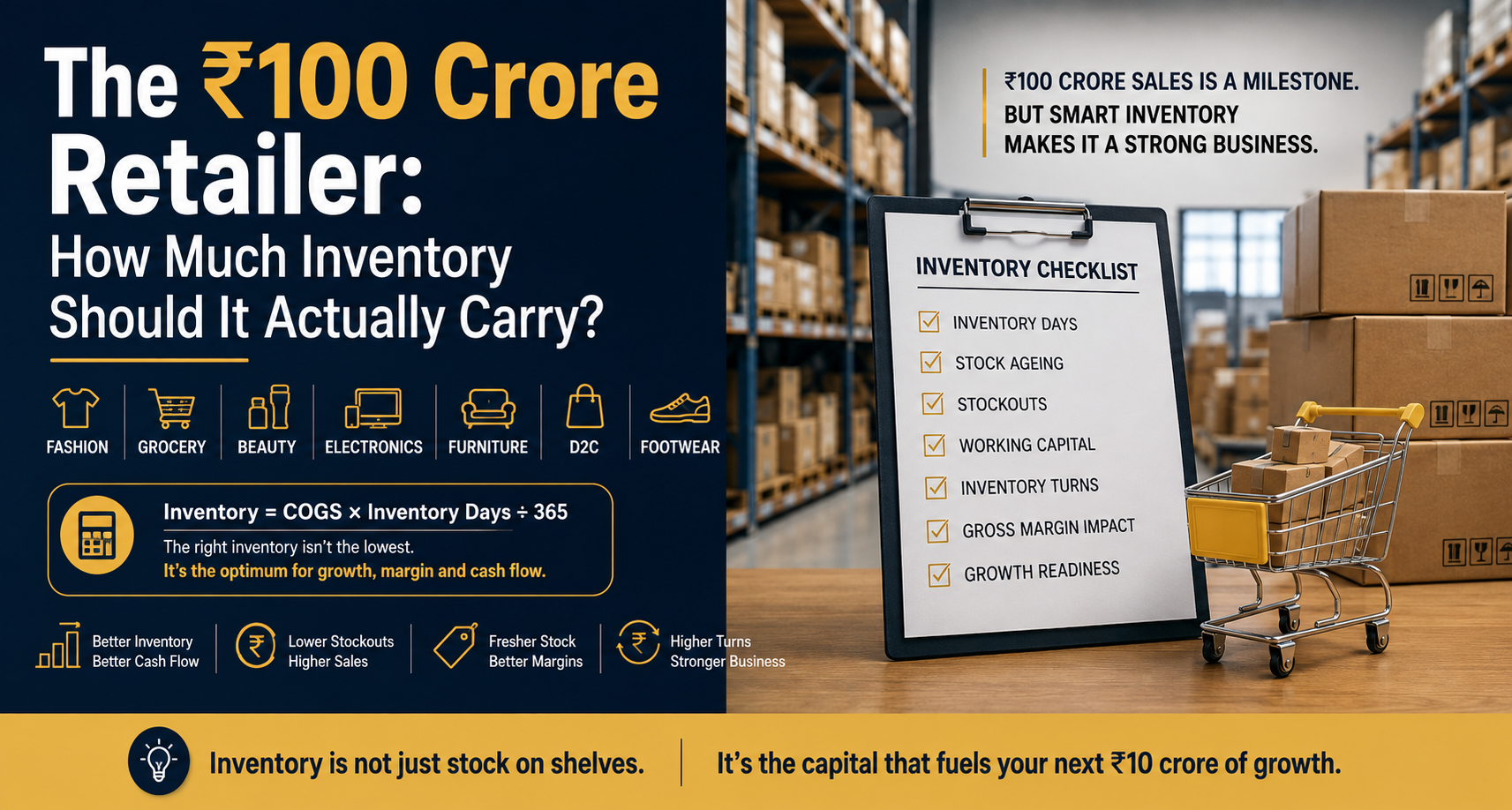
    Inventory = Cost of Goods Sold × Inventory Days ÷ 365

    So, if a retailer has ₹100 crore of sales, a 50% gross margin means its annual COGS is approximately ₹50 crore.

    If the business carries 75 days of inventory:

    ₹50 crore × 75 ÷ 365 = ₹10.3 crore

    That gives us a starting point.

    But the interesting part begins when we apply this to different retail businesses.


    Fashion: ₹9–10 crore may not be unusual

    Consider a ₹100 crore fashion retailer.

    Suppose:

    • Gross margin: 55%
    • COGS: ₹45 crore
    • Inventory: 75 days

    The inventory requirement works out to approximately ₹9.2 crore.

    At first glance, that may look reasonable.

    But I would immediately ask another question:

    How much of that ₹9.2 crore is current and how much is ageing?

    Imagine the inventory looks like this:

    ₹5.5 crore — fast-moving/current ₹1.5 crore — normal-moving ₹1 crore — slow-moving ₹700 lakh — ageing ₹500 lakh — effectively dead

    The balance sheet still says ₹9.2 crore inventory.

    But commercially, it is a very different story.

    This is why fashion retailers should not look only at inventory value.

    They need to look at inventory age, sell-through and expected realisation.

    A ₹10 crore inventory number can be healthy.

    It can also be the beginning of a ₹3 crore markdown problem.


    Grocery: ₹5 crore can support ₹100 crore of sales

    Now take grocery.

    Suppose:

    • Gross margin: 25%
    • COGS: ₹75 crore
    • Inventory: 25 days

    Inventory requirement:

    ₹75 crore × 25 ÷ 365 = ₹5.1 crore

    That’s a completely different inventory structure.

    Why?

    Because grocery moves much faster.

    The retailer buys, sells and replenishes continuously.

    Now imagine this retailer carries 60 days instead of 25.

    Inventory becomes:

    ₹75 crore × 60 ÷ 365 = ₹12.3 crore

    The retailer has not generated one additional rupee of sales.

    But another ₹7.2 crore has become tied up in inventory.

    That is the part of inventory management that often gets missed.

    Inventory is not free.

    Every additional rupee sitting on the shelf is a rupee that cannot be used somewhere else.

    core expertise cgrbrands.com

    Beauty: the ageing problem is different

    Beauty is another interesting example.

    Take:

    • ₹100 crore sales
    • 55% gross margin
    • ₹45 crore COGS
    • 60 inventory days

    Inventory:

    ₹45 crore × 60 ÷ 365 = ₹7.4 crore

    So perhaps ₹7–8 crore of inventory looks reasonable as an illustrative starting point.

    But beauty has another risk:

    expiry and product relevance.

    A product sitting in the warehouse for six months is not necessarily the same economic asset as a product that sells every week.

    And then there are:

    • New formulations
    • Packaging changes
    • Seasonal products
    • Shade variations
    • New launches
    • Consumer preference changes

    So the question isn’t simply:

    “How much inventory do we have?”

    It is:

    “How much of our inventory is likely to convert into cash at the expected margin?”

    That is a much more useful question.


    Electronics: inventory can become obsolete before it becomes slow-moving

    Electronics is even more interesting.

    Assume:

    • ₹100 crore sales
    • 20% gross margin
    • ₹80 crore COGS
    • 60 inventory days

    Inventory:

    ₹80 crore × 60 ÷ 365 = ₹13.2 crore

    So an electronics retailer could be carrying ₹13 crore or more.

    But electronics has a unique risk.

    Technology moves faster than inventory.

    A product can be perfectly saleable today and commercially unattractive six months later.

    A new model arrives.

    The manufacturer reduces prices.

    A competitor launches a better product.

    Customers wait for the next version.

    Suddenly, ₹2 crore of inventory may require discounting.

    This is why I would rather see an electronics retailer carrying ₹14 crore of highly productive inventory than ₹10 crore containing ₹3 crore of ageing stock.

    The lowest inventory number is not necessarily the best inventory position.


    Furniture: ₹18 crore may actually be reasonable

    Furniture creates another interesting contrast.

    Suppose:

    • Gross margin: 45%
    • COGS: ₹55 crore
    • Inventory: 120 days

    Inventory:

    ₹55 crore × 120 ÷ 365 = ₹18.1 crore

    That sounds huge compared with grocery.

    But should we immediately call it inefficient?

    No.

    Furniture has:

    • Longer buying cycles
    • Longer supplier lead times
    • Larger ticket sizes
    • Large display requirements
    • Lower purchase frequency
    • Higher logistics complexity

    So 120 days of inventory may be perfectly understandable for the business.

    This is why comparing a furniture retailer’s inventory days with a grocery retailer’s inventory days is meaningless.

    Inventory benchmarks have to be category-specific.


    Footwear: having inventory doesn’t mean having availability

    Now consider footwear.

    Suppose:

    • ₹100 crore sales
    • 50% gross margin
    • ₹50 crore COGS
    • 75 inventory days

    Inventory:

    ₹50 crore × 75 ÷ 365 = ₹10.3 crore

    Again, roughly ₹10 crore.

    But here’s the problem.

    Footwear doesn’t just have SKU-level inventory.

    It has size-level inventory.

    You may have:

    100 pairs of a particular style.

    But if your customers predominantly want sizes 8, 9 and 10, having 40 pairs in sizes 6 and 7 doesn’t solve the problem.

    You can have:

    ₹10 crore of inventory

    and still tell customers:

    “Sorry, your size is unavailable.”

    This is where inventory productivity becomes much more important than inventory value.


    D2C: the problem often starts with the buying decision

    D2C businesses have another challenge.

    Suppose a ₹100 crore D2C brand has:

    • 60% gross margin
    • ₹40 crore COGS
    • 60 inventory days

    Inventory:

    ₹40 crore × 60 ÷ 365 = ₹6.6 crore

    That looks efficient.

    But now look inside the number.

    Suppose the brand has 100 SKUs.

    10 SKUs generate most of the demand.

    30 are average.

    60 are struggling.

    The overall inventory number may still look perfectly acceptable.

    But the problem is sitting at the SKU level.

    This is where I believe many D2C businesses need to move from:

    “How much inventory do we have?”

    to:

    “Which SKUs are consuming our working capital?”

    Because one bad buying decision repeated across 50 SKUs can quietly lock up crores.


    So, what does a ₹100 crore retailer really need?

    Using the illustrative assumptions above, the picture could look something like this:

    Article content

    These are illustrative calculations, not universal industry targets.

    And that’s exactly the point.

    There is no magic number called:

    “Ideal inventory for a ₹100 crore retailer.”


    The bigger question is inventory productivity

    Let’s say two retailers both have ₹100 crore revenue.

    Retailer A carries:

    ₹8 crore inventory

    Retailer B carries:

    ₹16 crore inventory

    It is tempting to say Retailer A is twice as efficient.

    But we need to know more.

    What if Retailer A is constantly out of stock?

    What if it is losing sales because its best-selling SKUs aren’t available?

    What if Retailer B has higher availability and faster growth?

    Now the answer changes.

    The objective isn’t:

    Minimum inventory.

    The objective is:

    Optimum inventory.

    Enough inventory to maintain availability and support growth.

    But not so much that working capital gets trapped in slow-moving or obsolete stock.


    And this is where I would ask a ₹100 crore retailer five questions

    1. How many inventory days are we carrying?

    Not just at company level, but by category and channel.

    2. What percentage of inventory is older than 90/120/180 days?

    Ageing tells us much more than the total number.

    3. Which SKUs are consuming working capital without producing sufficient sales?

    This is where SKU-level analysis becomes powerful.

    4. Where are we overstocked while another store/channel is out of stock?

    Inventory in the wrong location is almost as problematic as not having inventory.

    5. If sales grow from ₹100 crore to ₹150 crore, how much additional inventory will we need?

    This may be the most important question of all.


    The ₹100 crore → ₹150 crore test

    Suppose a retailer grows from ₹100 crore to ₹150 crore.

    The conventional approach says:

    Sales +50% → Inventory +50%

    So:

    ₹10 crore inventory → ₹15 crore.

    But what if better forecasting, replenishment, transfers and assortment management allow the retailer to reach ₹150 crore with ₹12 crore inventory?

    The business has effectively released ₹3 crore of capital.

    No new store.

    No additional borrowing.

    No additional investor capital.

    Just better inventory productivity.

    That is why inventory management should not sit only with the supply-chain team.

    Inventory is a finance issue.

    Inventory is a merchandising issue.

    Inventory is a buying issue.

    Inventory is a customer-experience issue.

    And ultimately, inventory is a CEO issue.


    The number I would like every retailer to know

    Not:

    “Our inventory is ₹12 crore.”

    But:

    “Every ₹1 of inventory in our business generates ₹X of annual sales and ₹Y of gross margin, and we know exactly where the unproductive inventory is.”

    That is a much more meaningful measure of retail health.

    Because the objective of inventory is not to sit in a warehouse.

    It is not to fill a store.

    It is not even to make the balance sheet look healthy.

    Inventory has only one job: to be converted into sales, margin and ultimately cash.

    And the faster and more profitably you can do that—without compromising availability—the stronger your retail business becomes.

    ₹100 crore of sales is a milestone.

    But ₹100 crore of sales with disciplined inventory is a much stronger business.


    What is your view?

    For a ₹100 crore retailer, what is more dangerous:

    ₹5 crore of excess inventory—or ₹5 crore of lost sales because of stockouts?

    I’d be interested in hearing how retailers and D2C businesses are looking at this today.

    Welcome

  • India Retail 2024–2027: From Store Expansion to Intelligent Retail Expansion I A retail case study on what changed, what is coming next, and what ret

    India Retail 2024–2027: From Store Expansion to Intelligent Retail Expansion I A retail case study on what changed, what is coming next, and what ret

    The Hook

    India’s retail expansion story is entering its next phase.

    The question is no longer:

    “How many stores can we open?”

    The question is:

    “How intelligently can we expand while protecting productivity, profitability and customer relevance?”

    Post banner

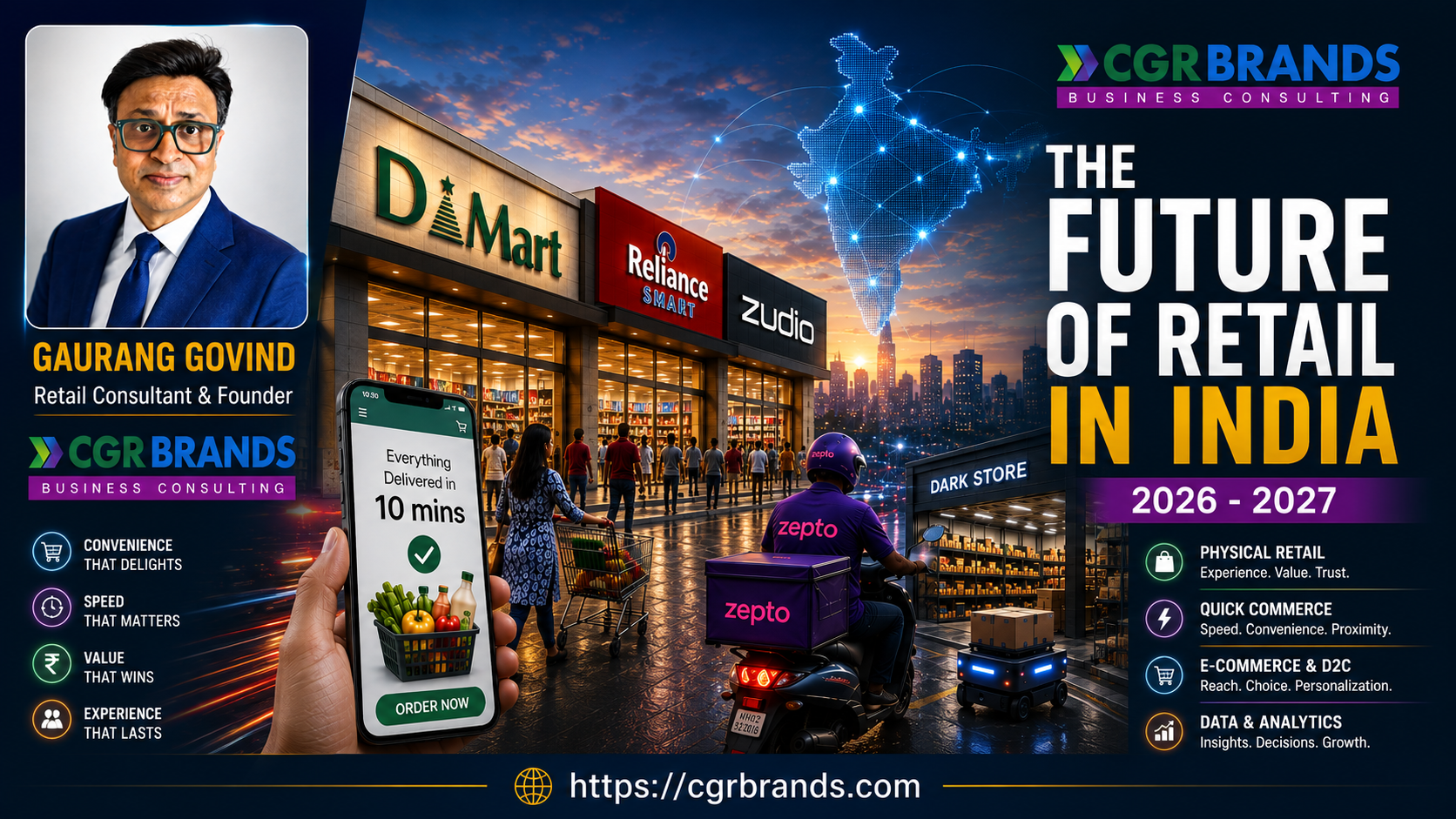
    Between 2024 and 2026, India’s leading retailers significantly increased their physical footprints while quick commerce simultaneously created a completely different retail proposition: availability at the doorstep within minutes.

    Now the real battle is moving towards Tier 2, Tier 3 and emerging consumption centres.

    And I believe the next two years will be less about the race for store count and more about the race for better retail economics.

    What happened between 2024 and 2026?

    Three examples illustrate the direction.

    Reliance Retail

    Reliance Retail increased its store network from 19,340 stores in FY2025 to 20,160 stores in FY2026, while gross revenue increased from ₹3.31 lakh crore to approximately ₹3.71 lakh crore. Its Smart Bazaar network crossed 1,000 stores, with a significant part of that network serving Tier 2 and smaller markets.

    More importantly, Reliance is combining physical stores, digital commerce and hyperlocal commerce rather than treating them as separate businesses.

    Trent’s Zudio

    Zudio reached 963 stores across 313 cities by FY2026, compared with 765 stores in FY2025 and 545 stores in FY2024. The company’s own reporting highlights accessibility, sharp price points, in-house merchandise and rapid expansion as key elements of the model.

    Avenue Supermarts

    Avenue Supermarts, the operator of the DMart chain, moved from 365 stores in FY2024 to 415 in FY2025 and 500 in FY2026.

    The FY2026 expansion is particularly interesting: 85 stores were added, including 45 stores in Tier 2+ markets, while the company entered 39 new cities, 34 of them Tier 2+. It also entered Uttar Pradesh, Haryana, Odisha, Uttarakhand and Goa.

    The message from these examples is clear:

    India’s organised retail opportunity is moving deeper into the country. This we all know.

    But there is another force changing the game.

    The Quick-Commerce Challenge

    Quick commerce has changed the consumer’s definition of convenience.

    The customer no longer thinks:

    “I need to visit a store.”

    The customer increasingly thinks:

    “I need it now.”

    Blinkit, Swiggy Instamart and Zepto have built large dark-store networks, while Amazon and Flipkart are now increasing their investments in rapid delivery.

    In June 2026, Reuters reported that Amazon planned to expand its rapid-delivery service to 300 Indian cities, while Flipkart was targeting approximately 1,500 quick-commerce locations.

    This creates an interesting future scenario.

    Traditional retailers will increasingly have stores.

    Quick-commerce companies will increasingly have dark stores.

    E-commerce companies will increasingly combine warehouses, marketplaces and rapid fulfilment.

    The consumer will simply choose whichever channel delivers the best combination of:

    Price + availability + speed + trust + assortment + experience.

    My Forecast for 2026–2027

    1. Tier 2 and Tier 3 will become the primary expansion laboratory

    I expect retailers to become more aggressive in smaller cities—but also more selective.

    The next phase will not be:

    “Let’s enter every Tier 2 city.”

    It will be:

    “Let’s identify the right micro-markets inside the right Tier 2 cities.”

    Population alone will not be sufficient.

    Retailers will increasingly evaluate:

    – Catchment population

    – Household income

    – Consumer spending

    – Competition

    – Footfall potential

    – Real-estate cost

    – Logistics cost

    – Delivery density

    – Digital adoption

    – Category potential

    – Store productivity potential

    This means location analytics will become a board-level expansion capability.

    —

    2. Cluster expansion will become more important than isolated expansion

    The next winning model may not be one store in 20 cities.

    It may be five to ten stores in one carefully selected cluster.

    Why?

    Because clustering can improve:

    Supply-chain efficiency → inventory availability → marketing efficiency → management supervision → brand awareness → customer familiarity.

    Retailers should therefore stop measuring expansion only by the number of stores opened.

    They should measure:

    Revenue per cluster.

    Profit per cluster.

    Inventory turns per cluster.

    Supply-chain cost per cluster.

    Customer acquisition cost per cluster.

    This is where retail analytics can transform expansion decisions.

    —

    3. Quick commerce will not kill physical retail—but it will change its role

    This is perhaps the most important prediction.

    Physical stores will increasingly need to answer:

    “Why should the customer visit me?”

    For grocery, the answer could be:

    Better value + larger assortment + monthly shopping + fresh produce + discovery.

    For fashion:

    Trial + experience + instant gratification + newness.

    For electronics:

    Demonstration + advice + service + installation.

    For lifestyle:

    Discovery + experience + social shopping.

    The physical store therefore needs to become more than a transaction point.

    It needs to become a customer-experience and fulfilment asset.

    —

    4. Dark stores will face an operational-quality test

    There is another issue that I believe deserves far greater attention.

    A dark store is still a retail operation.

    Technology can manage orders.

    Technology can generate inventory alerts.

    Technology can optimise delivery routes.

    But people still have to manage:

    Expiry → FEFO → hygiene → temperature → receiving → storage → pest control → picking → product handling.

    Recent food-safety enforcement in Maharashtra illustrates the risk. Authorities inspected quick-commerce establishments and suspended permits at 12 warehouses after identifying issues including cockroach infestations, rodent droppings and other sanitation problems.

    This should not be viewed only as a quick-commerce problem.

    It is an industry-wide retail operations lesson.

    As the network expands, retailers need stronger:

    Retail audits + SOP compliance + training + accountability + store-level ownership.

    —

    5. E-commerce and direct-to-consumer brands will push deeper into smaller cities

    This is another major structural change.

    Smaller-city consumers are not waiting for physical stores.

    They are discovering brands online.

    According to Unicommerce data reported by the India Brand Equity Foundation, Tier 2 and Tier 3 cities were expected to contribute around 66% of new direct-to-consumer orders in FY2026.

    This changes the expansion equation.

    A brand can now enter a city digitally before opening a physical store.

    That creates an important consulting opportunity:

    Digital-first → Data validation → Pilot store → Cluster expansion

    Instead of:

    Store first → Hope for demand → Correct later

    This can significantly reduce expansion risk.

    —

    What should retailers do now?

    Action 1: Build a micro-market expansion model

    Don’t approve a new store only because the city looks attractive.

    Create a scoring model covering:

    Demand + competition + rent + catchment + logistics + digital demand + store economics.

    —

    Action 2: Establish a 12–24 month store maturity dashboard

    Every new store should be tracked against:

    Sales per sq. ft./ GMROF

    Gross margin.

    GMROI.

    Inventory turns.

    Inventory cycle

    Conversion.

    Average basket value.

    Shrinkage.

    Manpower productivity.

    Contribution margin.

    This allows management to distinguish between a temporary maturity issue and a fundamentally weak location.

    —

    Action 3: Design the store and dark store together

    The future will increasingly require omnichannel operating models.

    A physical store may serve:

    Walk-in customers + online orders + click-and-collect + local fulfilment.

    Retailers should therefore redesign:

    Inventory → picking → replenishment → manpower → technology → customer journey

    as one integrated process.

    —

    Action 4: Create independent operational audits- audits are crucial specially third party remove bias

    Expansion multiplies risk.

    Every additional location creates another opportunity for:

    Expiry leakage + shrinkage + poor hygiene + inventory inaccuracies + SOP deviation + manpower inefficiency.

    Retailers should therefore create a structured audit framework covering:

    People + Process + Product + Place + Technology + Compliance.

    —

    Action 5: Treat Tier 2 and Tier 3 as different markets—not smaller metros

    This is critical.

    Consumers in smaller cities may have different:

    Price sensitivities, pack-size preferences, fashion choices, shopping missions, credit behaviour and local brand preferences.

    Retailers should analyse local behaviour before standardising the assortment.

    —

    The Biggest Prediction for 2027

    I believe the retail industry will gradually move from:

    “Expansion at scale”

    to

    “Intelligent expansion at scale.”

    The winners will not necessarily have the largest number of stores.

    They will have the best store economics, supply chain, data systems, customer understanding and execution discipline.

    The next competitive advantage will come from connecting:

    Physical retail + e-commerce + direct-to-consumer + quick commerce + data + supply chain.

    And this will create a new retail equation:

    Right Market × Right Format × Right Assortment × Right Inventory × Right Execution = Profitable Growth

    —

    Final Recap

    The last two years proved that physical retail is not disappearing.

    It is changing.

    Reliance Retail has crossed 20,000 stores.

    Zudio has reached nearly 1,000 stores.

    Avenue Supermarts has reached 500 stores and is pushing deeper into Tier 2+ markets.

    At the same time, quick commerce and e-commerce are moving rapidly into smaller markets.

    So the next two years will not be about choosing between stores and digital.

    They will be about building the right combination.

    For retailers, my recommendation is straightforward:

    Analyse before expanding.

    Pilot before multiplying.

    Cluster before spreading.

    Measure productivity before celebrating footprint.

    Audit operations before scaling.

    And most importantly:

    Build the organisation’s capability at the same speed as you build its footprint.

    Because in the next phase of Indian retail, opening the store may be easy. Running 500 or 5,000 stores consistently will be the real competitive advantage.

    Sources and further reading

    – “Reliance Industries — FY2025–26 Retail Business Overview” (https://reference-url-citation.invalid/7)

    – “Reliance Industries — FY2025–26 Integrated Annual Report” (https://reference-url-citation.invalid/8)

    – “Trent Limited — FY2025–26 Integrated Annual Report” (https://reference-url-citation.invalid/9)

    – “Trent Limited — Annual Reports and Company Filings” (https://reference-url-citation.invalid/10)

    – “Avenue Supermarts — FY2024–25 Annual Report” (https://reference-url-citation.invalid/11)

    – “Motilal Oswal — Avenue Supermarts FY2026 expansion analysis” (https://reference-url-citation.invalid/12)

    – “Reuters — Amazon and Flipkart quick-commerce expansion” (https://reference-url-citation.invalid/13)

    – “Reuters — Food-safety enforcement at quick-commerce warehouses” (https://reference-url-citation.invalid/14)

    – “India Brand Equity Foundation — Tier 2/3 direct-to-consumer growth” (https://reference-url-citation.invalid/15)

    #RetailIndia #RetailStrategy #RetailExpansion #RetailOperations #QuickCommerce #DarkStores #Ecommerce #DirectToConsumer #Tier2Cities #Tier3Cities #OmnichannelRetail #RetailAnalytics #SupplyChain #StoreProductivity #FMCG #RetailConsulting #CustomerExperience #InventoryManagement #GMROI

    Gaurang Govind

    Business Consulting firm

  • Franchise INDIA outlook 2030

    Franchise INDIA outlook 2030

    Franchising in India spans food service (QSR), retail, education, wellness and services, and has become a preferred low-capital-risk expansion route for both Indian and international brands, particularly into Tier-II and Tier-III cities. Note: franchising is a less centrally tracked category than retail or e-commerce, so market-size estimates vary more widely by source than in other sectors covered in this report.

    Market Size & 2030 Outlook

    • The Indian franchise industry is currently estimated at approximately ₹800 billion (~US$ 9.6 billion), with a reported annual growth rate of 30–35%.
    • The QSR segment alone is expected to reach over ₹2.5 lakh crore (~US$ 30 billion) by 2030.
    • Some industry estimates place total India franchise-sector economic activity considerably higher (US$ 140–150 billion range) when including all franchised retail, services and food formats at system-wide sales level — the large variance versus the ₹800 billion estimate reflects differing scope (royalty/fee market vs. total franchisee system sales).
    • Nearly 50% of new franchise expansion in 2024–25 took place in smaller cities (Tier-II, III and IV), a trend expected to continue through 2030.

    Current Growth Trends

    • Tier-II and Tier-III cities have become the primary growth engine for franchise expansion, driven by rising disposable incomes and a shift toward organised/branded retail over unbranded alternatives.
    • FOCO (Franchisee-Owned, Company-Operated) models are gaining share alongside traditional FOFO (Franchisee-Owned, Franchisee-Operated), as brands seek tighter operational control while still using franchisee capital to fund expansion.
    • Sectors seeing the strongest franchise growth include food & beverage/QSR, electronics, furniture, footwear, home décor and automotive accessories.
    • AI-enabled operations (demand forecasting, inventory, rostering) are increasingly used to standardise performance across large multi-unit franchise networks.

    Outlook Toward 2030

    • Franchise expansion is expected to keep outpacing overall retail growth through 2030, as brands prioritise capital-light, franchisee-funded expansion over company-owned stores in a higher-interest-rate environment.
    • Consolidation among franchise operators (multi-unit and multi-brand operators buying out smaller single-unit franchisees) is likely to increase as the market matures.
    • International brands entering India, and Indian brands expanding abroad or into master-franchise structures, are both expected to grow, mirroring the global shift toward master-franchise agreements.

    Key Learnings for Businesses & Consultants

    • Unit-level profitability and payback period — not brand story — is what sophisticated franchise investors now underwrite; franchisors need transferable, well-documented operating systems (SOPs) to close deals faster.
    • Franchise success in Tier-II/III markets depends on localisation of format, pricing and even menu/assortment — not a direct copy of the metro flagship model.
    • Franchisee selection and operational consistency (via strong SOPs and audits) is consistently cited as the single biggest determinant of network-wide brand equity or damage.

    Key Challenges

    • Selecting the right franchise partners and maintaining consistent operational standards across a growing, geographically dispersed network remains the sector’s most persistent challenge.
    • Ensuring strong unit-level profitability amid rising real estate and manpower costs, especially in Tier-II/III cities where footfall patterns are less predictable than metros.
    • Supply chain robustness — particularly for food and FMCG-linked franchises — is harder to maintain as networks scale into smaller, more dispersed markets.
    • Data on the true size and health of the sector is fragmented compared to retail or e-commerce, making benchmarking and investment decisions harder without on-ground due diligence.

    Sources: Franchise India / FranchiseTv; FranchiseBazar; Francorp India; The Franchising Association of India (FAI); Technavio Franchise Market Analysis 2026–2030; EconMarketResearch.

  • RETAIL, D2C, QUICK COMMERCE & E-COMMERCE July 2026 Industry Update Compiled July 13, 2026 

    RETAIL, D2C, QUICK COMMERCE & E-COMMERCE July 2026 Industry Update Compiled July 13, 2026 

    India’s quick-commerce, D2C and e-commerce ecosystem entered July 2026 in the middle of three simultaneous storylines: a scramble by Amazon and Walmart-owned Flipkart to muscle into 10-15 minute delivery, a wave of public-market listings led by Zepto’s imminent IPO, and a regulatory reckoning over dark-store food safety. Globally, the European Union closed its duty-free loophole on low-value parcels, directly hitting Shein, Temu and AliExpress. This update compiles verified developments reported and dated within July 2026, with the underlying data points and figures needed for planning and client conversations.

    1. Quick Commerce Remains India’s Fastest-Growing Retail Channel

    A report released by Equirus on July 7, 2026 confirmed that quick commerce will continue to outpace overall digital commerce growth through 2026, expanding at more than double the rate of the broader online retail market as operators keep pouring capital into dark-store networks and rapid-delivery infrastructure.

    India digital commerce market size (2026 est.): ₹8 lakh crore

    Quick commerce market size (2026 est.): ₹1.08 lakh crore, growing 40% YoY

    Combined dark stores — Blinkit + Instamart + Zepto (May 2026): 5,026 locations, up from 3,405 a year earlier

    Top seasonal growth categories: Ice cream, beverages, face-care products

    Emerging repeat-purchase categories: Personal care, beauty, electronics accessories, medicines, gifts, pet supplies

    Flagged risk factor: 46% rainfall deficit and potential food-inflation pressure on consumer demand

    Separately, Bain & Company’s outlook — cited widely in July coverage — projects India’s quick-commerce market will grow to $65-70 billion by 2030, contributing 45-50% of incremental e-retail gross merchandise value over the next five years, after roughly doubling annually over the past two years.

    • Equirus report via ANI News, July 7, 2026 — aninews.in

    • NewKerala, Quick Commerce Growth 2026 summary

    • Business Standard, “Why quick commerce has become a battle no retailer can afford to lose,” July 6, 2026

    2. Zepto’s IPO Moves Closer as the Top-Three Battle Intensifies

    Zepto is racing toward what would be the largest quick-commerce listing in Indian history. Having received SEBI’s formal observation-letter approval on May 8, 2026, the company filed an updated Draft Red Herring Prospectus (U-DRHP) on June 8, 2026, and multiple financial trackers reported through early July that Zepto is targeting a listing within the July-September 2026 quarter, though an exact date has not been announced.

    Fresh issue size: ₹8,010 crore

    Offer for sale (OFS): 11.35 crore equity shares from existing shareholders (Nexus Ventures, Contrary, Razor Ventures, Kaiser Permanente Group Trust and others)

    Total estimated issue size: ₹11,000-12,000 crore (~$1 billion)

    FY26 revenue from operations: ₹22,624 crore

    Average daily orders (FY26): 17.5 lakh

    Store count (as of March 31, 2026): 1,139 dark stores; 48 million users

    Lead bankers: Goldman Sachs, Morgan Stanley, JM Financial, Axis Capital, HSBC, IIFL Securities, Motilal Oswal

    The listing push comes as the competitive order in India’s quick-commerce top three continues to shift. Blinkit still leads on scale, processing 91.6 crore orders in FY26 (roughly 25 lakh orders a day) from a dark-store network of 2,243 stores as of March 31, 2026 — nearly double its closest rivals. Zepto overtook Swiggy Instamart on order volumes in the January-March FY26 quarter. Instamart itself posted FY26 revenue of ₹3,859 crore (up 81.2% YoY) but carried an adjusted EBITDA loss of ₹3,511 crore, trailing both peers on profitability. Together, Blinkit, Zepto and Instamart control roughly 85% of the quick-commerce market.

    • Kotak Neo, “Zepto Files Updated IPO Papers,” July 2026

    • Groww / IPO Central, Zepto SEBI approval coverage, May-July 2026

    • Upstox / Storyboard18, Zepto vs Blinkit vs Instamart operating-metrics comparison, 2026

    3. Amazon and Flipkart Go All-In on the “Minutes” War

    The most consequential shift in July 2026 is the entry of India’s two e-commerce giants into quick commerce at full scale. CNBC and Business Standard reported on July 2, 2026 that Amazon and Walmart-backed Flipkart are both accelerating delivery-in-minutes operations to defend their core online-retail base against Blinkit, Zepto and Instamart.

    Amazon’s new India investment: An additional $13 billion in AI and cloud infrastructure, taking total committed investment to $48 billion between 2026 and 2030

    Amazon’s quick-commerce ambition: To become the “largest delivery-in-minutes network” in India, with plans to expand to 300 cities

    Flipkart Minutes network: 1,000 micro-fulfillment centers built in under two years; targeting 1,500 centers by end-2026

    The escalation is playing out in real time through sale-season competition. Flipkart’s “Goat Sale” and Amazon’s own July sale event both launched on July 4, 2026, each offering 24 hours of early access to loyalty members (Flipkart Plus/Black) ahead of the general public — a direct contest for wallet share as quick-commerce blurs the line with traditional e-commerce shopping events.

    • CNBC, “Amazon, Walmart-owned Flipkart get ready to shake up India’s delivery-in-minutes sector,” July 2, 2026

    • Business Standard, “Amazon Now, Flipkart Minutes go full throttle in India’s qcom space,” July 2, 2026

    • TechCrunch, “Walmart-backed Flipkart expands quick-commerce push as Amazon ramps up in India,” June 23, 2026

    • The Tech Outlook / Desidime, Flipkart Goat Sale coverage, July 4, 2026

    4. Regulators Turn Up the Heat on Dark-Store Food Safety

    July brought the sharpest regulatory action yet on quick commerce’s dark-store model. On July 11, 2026, the Food Safety and Standards Authority of India (FSSAI) issued nine separate notices to Swiggy Instamart following consumer complaints of expired, spoiled and contaminated food being delivered through the platform. Days earlier, on July 4, 2026, FSSAI’s Northern Regional Office raided a food business operator in South-West Delhi, uncovering fraudulent re-labelling and unauthorized storage; more than 50,000 compromised food packs were seized and an FIR was registered.

    FSSAI notices to Swiggy Instamart: 9 notices issued July 11, 2026, citing FSS Act, 2006 violations

    Delhi enforcement raid: July 4, 2026 — over 50,000 food packs seized for fraudulent re-labelling and improper storage

    Regulatory direction: Government signalling a move toward risk-based dark-store inspection, with facilities that have poor compliance histories to be inspected more frequently

    Currently, dark stores are regulated under the same Food Safety and Standards (Licensing and Registration of Food Businesses) Regulations, 2011 that apply to conventional food businesses — there is no inspection checklist tailored to facilities processing thousands of rapid-fire orders daily. That gap is now central to the policy debate around India’s roughly 5,000-plus dark-store network.

    • Barristery, “FSSAI Issues Nine Notices to Swiggy Instamart,” July 2026

    • The News Mill / Lokmat Times, FSSAI Delhi raid coverage, July 4-5, 2026

    • Business Standard, “Who inspects India’s dark stores as quick commerce expands rapidly?,” June 25, 2026

    5. Retail Real Estate: Leasing Momentum Holds Through Q2

    On the brick-and-mortar side, Cushman & Wakefield’s Q2 2026 India retail report (published July 2026) showed continued strength in mall and high-street leasing despite a thin supply pipeline.

    Q2 2026 gross retail leasing (top 8 cities): 2.4 million sq ft — up 23.2% QoQ and 17.6% YoY

    H1 2026 total leasing: 4.35 million sq ft, up 3.1% over H1 2025

    Mall share of leasing: 51.3% (1.23 msf), up 33.4% QoQ and 21.9% YoY

    New Grade-A mall supply: Nil for a second consecutive quarter

    Strongest rental-growth corridors: Mumbai’s Linking Road (+22% YoY), Bengaluru’s Indiranagar 100 Feet Road (+12% YoY), Chennai’s Anna Nagar 2nd Avenue (+11% YoY), Ahmedabad’s CG Road (+11% YoY), Delhi NCR’s Khan Market (+9% YoY)

    Supply pipeline (2026-2028): ~12.7 msf, of which ~1.6 msf due in H2 2026 (Delhi NCR to account for over half)

    • Cushman & Wakefield, “India’s Retail Sector Growth in Q2 2026,” July 2026

    • Business Standard, “India’s Q2 2026 retail leasing grows 17.6% YoY,” July 1, 2026

    6. Walmart Fires the First Shot in a Summer Price War

    In the US, Walmart and Sam’s Club announced on July 6, 2026 that they are cutting prices across thousands of products — groceries, household essentials, toys and clothing — in a move analysts read as the opening salvo of a broader grocery price war. A Walmart representative indicated the rollback would run roughly 90 days, and industry watchers expect Kroger, Albertsons, Costco and Dollar Tree to respond with their own price investments through the second half of 2026. The move also lands as both Walmart and Target operate under new chief executives this year — John Furner at Walmart and Michael Fiddelke at Target — as the two chains jockey for position against Amazon.

    Price-cut announcement date: July 6, 2026

    Categories affected: Groceries, household essentials, toys, clothing

    Expected duration: ~90 days per rollback cycle

    • TheStreet / MarketWatch, Walmart price rollback coverage, July 2026

    • Review-Journal, “Walmart says it has cut prices on thousands of products,” July 2026

    • WWD, “Walmart & Target Name New CEOs: Retail Giants’ 2026 Outlook”

    7. EU Closes the Duty-Free Loophole on Shein, Temu and AliExpress

    The single biggest global e-commerce policy shift of the month: a flat €3 customs duty took effect across the European Union on July 1, 2026, ending years of tax-free entry for low-value parcels. The EU scrapped its long-standing exemption for parcels under €150 and replaced it with the flat per-item duty — a direct hit to the ultra-low-cost, high-volume model that Shein, Temu and AliExpress depend on for the European market.

    New duty: Flat €3 per parcel, effective July 1, 2026

    Previous exemption removed: Duty-free treatment for parcels valued under €150

    Early market impact: Temu’s ad visibility on Google Shopping has roughly halved; Shein is reported to be nearing a full exit from markets where border fees now apply

    For Indian D2C and export-oriented sellers watching the ultra-low-cost Chinese platforms, this is a live case study in how fast a favorable cross-border tax regime can close — and a reminder that landed-cost economics, not just price, will increasingly decide category winners in Europe.

    • Euronews, “EU slaps €3 duty fee on SHEIN, Temu and AliExpress imports,” July 1, 2026

    • Smarter Ecommerce, “Europe’s New Tariffs on Temu & Shein: What Google Shopping Data Reveals,” July 2026

    8. D2C Funding: Discipline Over Growth-at-All-Costs

    Coverage through July 2026 confirms the D2C funding environment has continued its multi-year shift away from growth-at-any-cost. Investors are now underwriting to a 3:1 LTV:CAC ratio, 40%+ gross margins and demonstrated cohort retention before committing capital, with 6-12 months of repeat-purchase data increasingly treated as a baseline requirement rather than a nice-to-have. Large-ticket consolidation continues to be led by strategic acquirers rather than venture rounds, as established CPG groups look to acquire data-rich, already-profitable D2C brands rather than fund unproven ones.

    Investor underwriting bar: 3:1 LTV:CAC minimum, 40%+ gross margin, proven cohort retention

    Diligence window now expected: 6-12 months of verified repeat-purchase data

    Dominant M&A pattern: Strategic/corporate acquirers over pure venture rounds for later-stage D2C brands

    • Tenten.co, “Ecommerce Funding Landscape 2026: What Investors Want from D2C Brands”

    • Ellty, “D2C Investors: 45 Active VCs Funding Consumer Brands 2026”

    Bottom Line for Retail, D2C and Quick-Commerce Operators

    Three threads matter most heading into August 2026. First, the delivery-speed war has stopped being a quick-commerce-only fight — Amazon and Flipkart’s move into minutes-delivery will pressure Blinkit, Zepto and Instamart on cost per order well before Zepto’s IPO prices. Second, dark-store compliance is no longer a background risk; with FSSAI actively issuing notices and conducting raids in July, operators without audit-ready SOPs and traceability are exposed. Third, the EU’s parcel-duty change is a preview of how quickly a favorable trade regime can be unwound — a useful data point for any D2C brand building an export or cross-border strategy on thin-margin, high-volume assumptions.

    — End of July 2026 update —

    Gaurang Govind