
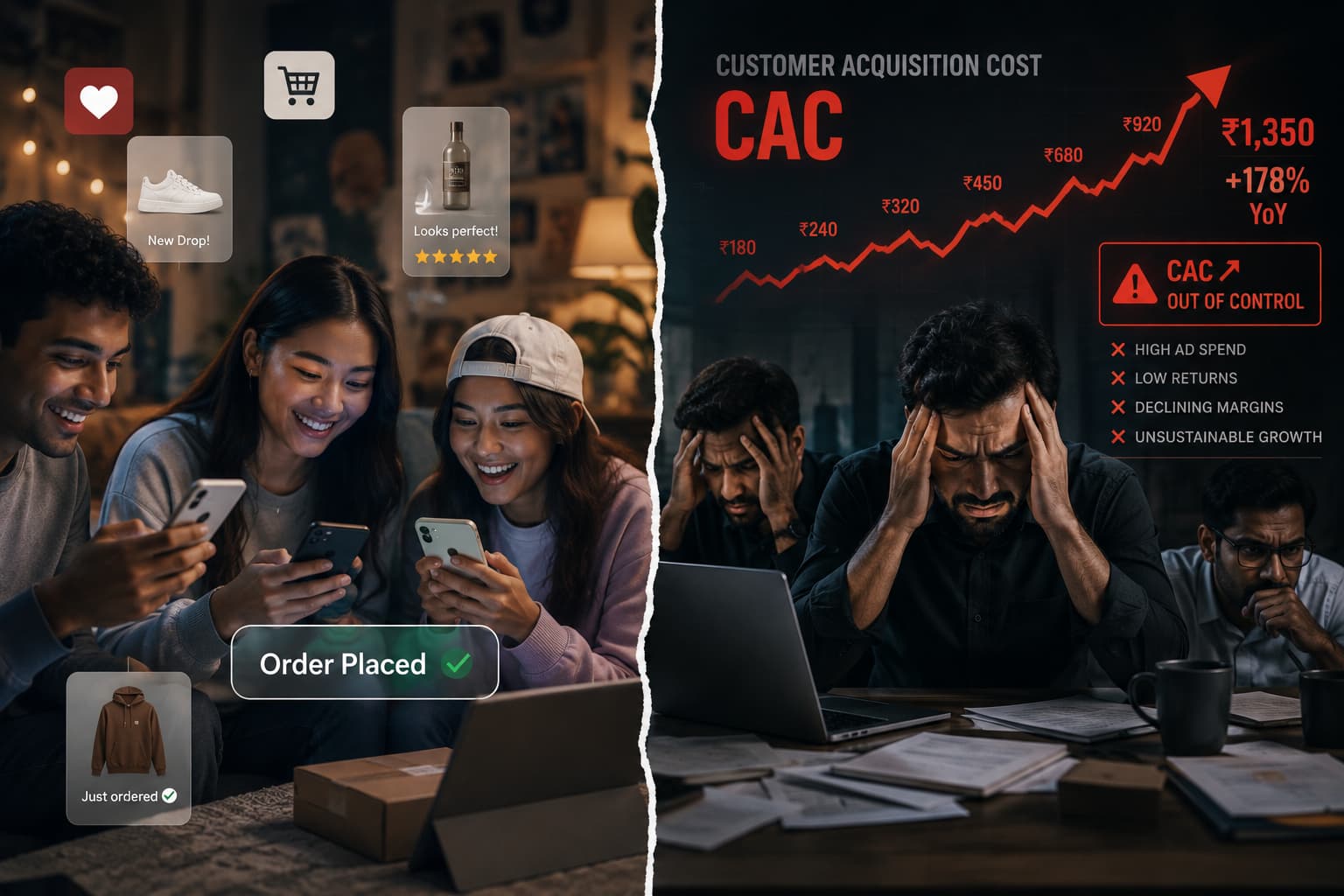
For more than a decade, D2C meant one thing: go directly to the consumer without traditional retail.
Build a product.
Create a digital brand.
Run Meta and Google campaigns.
Drive traffic to the website.
Convert.
Repeat.
That model changed how brands were built.
But the consumer has changed again.
And this time, Gen Z may force D2C companies to rethink one of their original assumptions: that digital alone is enough.
The future of D2C is not online versus offline.
It is online + offline.
It is Phygital.
First, understand the Gen Z consumer
Gen Z does not behave like a purely digital consumer.
They may discover a product on Instagram, watch a creator explain it on YouTube, compare it online, ask AI for an opinion, visit a store to experience it and finally purchase through whichever channel gives them the best combination of value, trust, convenience and experience.
Deloitte calls Gen Z the “most authentically omni-shopping generation”—a generation that combines digital discovery with a strong preference for in-person shopping. Its research found that 64% of Gen Z uses social media to research products and 35% uses it to discover products.
That changes the strategic question for D2C companies.
The question is no longer:
“How do we get Gen Z to buy online?”
It is:
“How do we make our brand available wherever Gen Z wants to discover, evaluate and buy?”
That is a very different business model.
What does Gen Z actually need?
Gen Z wants value, but value does not simply mean the lowest price.
They want:
Good products.
Fair prices.
Trust.
Reviews and proof.
Personalisation.
Convenience.
Speed.
Experience.
Identity.
And increasingly, the ability to move seamlessly between digital and physical channels.
This matters because Gen Z will become an increasingly important spending force.
In India, Deloitte estimates that Gen Z will account for 43% of total consumption in 2025, with direct spending power of around US$250 billion. A newer Google-Deloitte report projects Gen Z could command 45% of India’s online spend by 2030.
This is not a niche customer segment.
This is the next consumer economy.
Where are D2C companies going wrong?
The problem is not that D2C companies went digital.
The problem is that many of them stopped there.
They built businesses around paid digital acquisition rather than building a complete consumer ecosystem.
The model became:
Advertising → Website → Purchase
That model becomes vulnerable when:
- customer acquisition becomes expensive,
- competitors sell similar products,
- consumers become promotion-sensitive,
- marketplaces capture demand,
- algorithms change,
- and the consumer has too many alternatives.
A D2C brand can have millions of impressions and still have very little consumer loyalty.
It can have excellent ROAS and weak profitability.
It can have a strong online following and weak physical presence.
And it can have a great product that consumers still want to touch, try, compare or experience before buying.
This is where retail re-enters the story.
Retail is not disappearing. It is changing.
The old argument was:
Digital will replace stores.
The evidence increasingly suggests something different.
Digital and physical are converging.
India’s retail sector is expected to grow from approximately US$1.06 trillion in 2024 to US$1.93 trillion by 2030, while online retail is projected to increase from US$75 billion to US$260 billion during the same period.
Online is growing rapidly.
But even by 2030, it would represent only around 14% of total Indian retail according to the Deloitte-FICCI projection.
That means something very important for D2C founders:
The digital opportunity is enormous—but the physical retail opportunity remains enormous too.
Ignoring either one limits the addressable market.
India is already showing the direction
The retail market is not waiting for D2C brands to decide whether they like physical retail.
D2C brands are already moving there.
CBRE reported that D2C brands accounted for approximately 27% of India’s retail leasing activity in 2025. In H1 2026, D2C players accounted for approximately 28% of retail absorption.
That is a significant signal.
D2C brands are becoming retail occupiers.
Why?
Because physical stores can provide something digital cannot fully replicate:
Trust.
Trial.
Touch.
Demonstration.
Experience.
Visibility.
Immediate gratification.
And sometimes, simply:
“I want to see it before I buy it.”
Look at what is happening globally
The transition is not uniquely Indian.
In the US, digitally born brands such as Oura expanded into physical retail through major retailers including Best Buy and Target.
Beauty brand Glossier, which built its reputation through digital communities, expanded through Sephora.
The lesson is not that these companies abandoned D2C.
They didn’t.
They expanded the definition of D2C.
They realised that direct relationships can exist through multiple channels.
The store does not necessarily weaken the brand’s relationship with the consumer.
If managed correctly, it can strengthen it.
Europe is taking this even further
Europe is showing how technology can actually make physical retail more relevant.
Deloitte’s 2026 European research found that 56% of European consumers have already used AI for shopping, with product comparison among the leading uses.
This creates an interesting future.
Imagine a consumer walking into a store.
They scan a product.
AI understands their preferences.
It compares products.
The store provides the physical experience.
The digital layer provides intelligence.
The transaction can happen either physically or digitally.
That is not traditional retail.
That is Phygital retail.
Southeast Asia provides another lesson
Southeast Asia has demonstrated the power of social commerce.
The consumer can discover a product through a creator, interact with the seller, research the product and complete the purchase without following the traditional retail funnel.
The lesson for India is important:
Consumers no longer recognise the boundaries between marketing, commerce and retail.
A video can become a store.
A creator can become a salesperson.
A marketplace can become a discovery engine.
A physical store can become a content studio.
And an app can become a loyalty programme.
The channels are merging.
India has an additional advantage
India has something many mature markets do not have at the same scale:
Digital growth + physical retail growth + young consumers + Tier II/III consumption.
Deloitte reports that Tier II and III cities already account for more than 60% of India’s e-commerce transactions.
CBRE’s latest retail data shows Delhi-NCR, Chennai and Mumbai accounted for approximately 66% of retail leasing activity in H1 2026, while D2C brands represented around 28% of absorption.
The opportunity therefore extends beyond the metros.
A D2C company that builds digital demand in a Tier II city may eventually discover that the same city can support a physical presence.
Digital can identify where retail should go.
That is a major strategic advantage.
The future D2C company will look different
The first generation of D2C companies asked:
“How can we bypass retail?”
The next generation should ask:
“How can we use digital to build demand and retail to expand the relationship?”
That changes the role of the store.
The store is no longer merely a place to generate billing.
It can become:
A brand experience centre.
A consumer acquisition point.
A product trial centre.
A content engine.
A community hub.
A fulfilment point.
A customer-service point.
A physical expression of a digital brand.
And digital remains equally important.
It can drive:
Discovery.
Personalisation.
Reviews.
Community.
Data.
Convenience.
Repeat purchase.
So the relationship becomes circular:
Digital → Store → Digital → Store → Digital
rather than:
Digital OR Store
And this is where India becomes particularly interesting
India does not need to copy the US, Europe or Southeast Asia.
It can combine the best elements of all three.
From the US:
Brand building + D2C + retail partnerships
From Europe:
AI + personalisation + experience
From Southeast Asia:
Social commerce + creator-led discovery
From India:
Digital scale + physical retail + quick commerce + Tier II/III consumption
That combination can create something much bigger.
The strategic opportunity for Indian D2C brands
The real question is no longer:
“Should a D2C company open stores?”
That is too simplistic.
The better question is:
“Where does physical presence create incremental consumer value and incremental business value?”
A D2C company should look at retail when physical presence can:
- increase trust,
- improve discovery,
- allow product trial,
- reduce dependence on paid acquisition,
- increase customer lifetime value,
- strengthen brand visibility,
- open new geographies,
- improve consumer understanding,
- and create an integrated online-offline relationship.
Not every D2C brand needs 500 stores.
Not every brand needs a flagship.
Some may need a shop-in-shop.
Some may need kiosks.
Some may need experience centres.
Some may need selective retail partnerships.
Some may need franchise expansion.
The format should follow the consumer and economics—not the other way around.
The next D2C battle will not be fought only on Meta
It will be fought across the entire consumer journey.
Who discovers the consumer?
Who earns their trust?
Who gives them the best experience?
Who makes the purchase easiest?
Who understands them best?
Who gets the second purchase?
Who builds the strongest relationship?
That is why I believe the next phase of D2C will be less about direct-to-consumer commerce and more about direct-to-consumer relationships.
And those relationships will exist across screens, stores, marketplaces, creators, communities and AI.
D2C has reached its next crossroads
The first D2C revolution asked brands to leave traditional retail.
The next one will ask them to re-enter retail intelligently.
Not because digital failed.
But because the consumer has become omnichannel.
Gen Z is proving that point faster than any other generation.
They may discover online.
They may validate through a creator.
They may ask AI.
They may visit a store.
They may purchase online.
They may return offline.
And they may recommend the product through social media.
The consumer sees one brand.
The company must stop seeing separate channels.
That is the real meaning of Phygital.
And for India’s D2C companies, the next phase of growth may not come from spending another ₹10 crore on digital advertising.
It may come from asking a much bigger question:
“Where should our digital brand meet our consumer physically?”
That is where D2C meets Retail Expansion.
And that is where the next generation of Indian consumer brands can be built.
Leave a Reply