
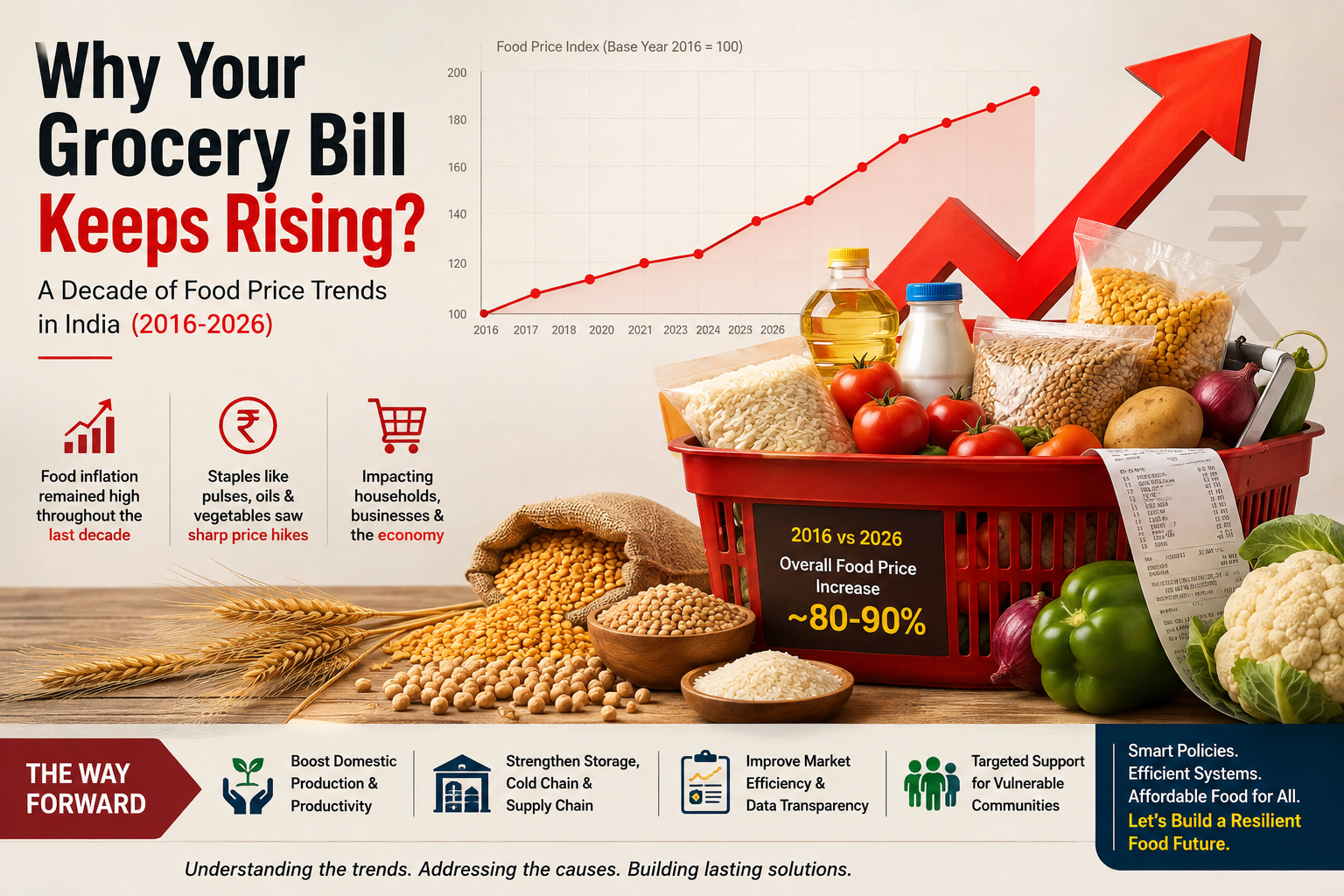
What if the biggest inflation story in your kitchen isn’t rice, milk or sugar — but bread?
Over the last decade, India’s everyday food basket has changed dramatically.
A standard branded 400g bread loaf that cost roughly ₹20–25 around 2016 can now sell for around ₹55.
Rice has moved from roughly ₹25/kg to ₹45–48/kg.
Refined cooking oil has experienced even more dramatic volatility.
Milk has climbed steadily.
And sugar, after years of relatively moderate movement, has suddenly become a major concern in 2026.
The supplied 2016–2026 study estimates cumulative increases of approximately 175% for bread, 92% for rice, 80% for refined oil, 73% for sugar, 71% for milk and 66% for mustard oil.
The numbers are striking.
But the real story is not the number.
The real story is what is causing it.
The 10-year picture
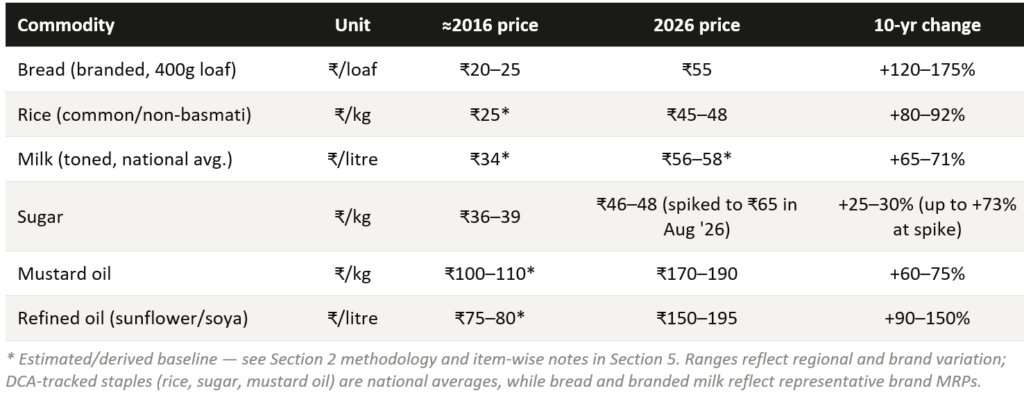
These are indicative national/representative figures, with some estimated historical baselines and brand/regional differences.
But food inflation is not one story
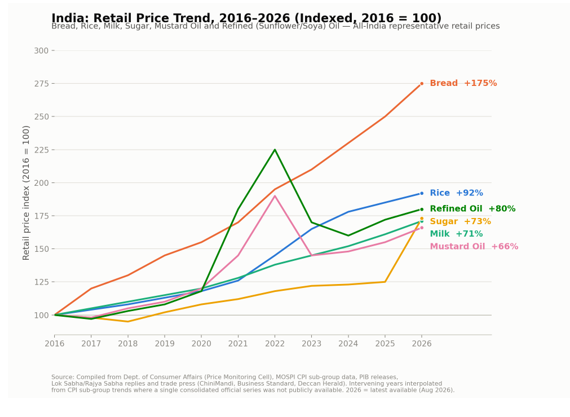
Look at the graph carefully.
Bread follows a relatively persistent upward trajectory.
Rice takes a major step upward.
Edible oils experience a huge shock and then partially correct.
Sugar remains comparatively controlled for years before suddenly moving sharply.
Milk rises more steadily.
That tells us something important: different foods require different inflation-control strategies.
What is behind the increase?
Six forces repeatedly appear across these categories.
1. Higher agricultural support prices
MSP for crops and FRP for sugarcane provide farmers greater price certainty and income support.
But higher farm-gate prices can eventually move through procurement, processing and retail.
The Economic Survey notes that India fixed MSP at 1.5 times the all-India weighted average cost of production, providing farmers greater price certainty.
The challenge is therefore not whether MSP should exist.
The question is:
How do we increase farmer income without creating excessive consumer-price pressure?
2. India’s dependence on imported edible oils
This may be the biggest structural vulnerability in this basket.
India imports a substantial share of its edible-oil requirement.
That means an event in Indonesia, Malaysia, Argentina, Brazil, Russia or Ukraine can eventually affect the price of cooking oil in an Indian household.
The 2021–22 global edible-oil shock demonstrated this dramatically.
3. Global shocks
The Russia–Ukraine war disrupted sunflower-oil and other commodity supplies.
Indonesia’s palm-oil export restrictions created another major shock.
These events showed that food security is increasingly connected to geopolitical security.
4. Energy, logistics and packaging
Bread illustrates this perfectly.
The consumer sees ₹55 for a loaf.
But behind that ₹55 are wheat flour, oil, sugar, yeast, packaging film, energy, labour, transportation, distribution and wastage.
The study identifies these accumulated costs as a major reason for bread’s unusually high long-term increase.
5. Government trade and supply policies
India frequently uses:
- Export restrictions
- Import-duty changes
- Buffer stocks
- Open-market sales
- Stock limits
- Procurement
- Subsidised retail programmes
These tools can be extremely effective.
But timing matters.
A policy designed to stabilise prices can sometimes create unintended market reactions if supply chains and trader behaviour are not considered.
The 2026 sugar episode is a good example of why policy design and market communication matter.
So what can the Government do?
The answer is not simply to impose price controls.
Price controls can suppress symptoms temporarily while leaving the underlying supply problem unresolved.
India needs a combination of short-term intervention and long-term productivity improvement.
1. Build a stronger food-price early-warning system
The Government already monitors essential commodity prices.
The next step should be predictive.
Track simultaneously:
Weather → crop acreage → yield → mandi prices → stocks → imports/exports → global prices → retail prices.
This would allow intervention before prices become a consumer crisis.
The Department of Consumer Affairs already operates a Price Monitoring Division for essential commodities.
2. Use buffer stocks more dynamically
Where adequate government stocks exist, calibrated releases can reduce temporary shortages.
The Government has already used Open Market Sale mechanisms for price stability.
In 2026, the Government reported substantial wheat and rice stocks and continued monitoring of essential commodities.
The opportunity is to make intervention earlier, targeted and temporary, rather than reacting after a major price spike.
3. Increase agricultural productivity
This is perhaps the most sustainable answer.
The Economic Survey identifies fragmented landholdings, inadequate storage and marketing infrastructure, limited access to quality inputs, low mechanisation and uneven productivity as continuing constraints.
Higher productivity means:
more output without proportionately increasing cost.
That is the most durable form of food-price control.
4. Reduce edible-oil import vulnerability
India needs to accelerate domestic oilseed productivity.
The Economic Survey highlights the National Mission on Edible Oils–Oilseeds as one of the Government’s initiatives to improve domestic production and productivity.
Over time, increasing domestic production can reduce India’s exposure to global edible-oil shocks.
5. Improve storage and cold-chain infrastructure
A food shortage does not always mean insufficient production.
Sometimes food exists but cannot move efficiently.
Better:
- Warehousing
- Cold storage
- Rural roads
- Packhouses
- Refrigerated transport
- Modern mandis
- Digital market linkages
can reduce wastage and the gap between farm-gate and retail prices.
6. Make policy changes more predictable
Frequent export bans, import-duty changes and stock restrictions can create uncertainty.
The objective should be:
Predictable policy + flexible intervention.
Markets respond better when participants understand the Government’s trigger points and likely response.
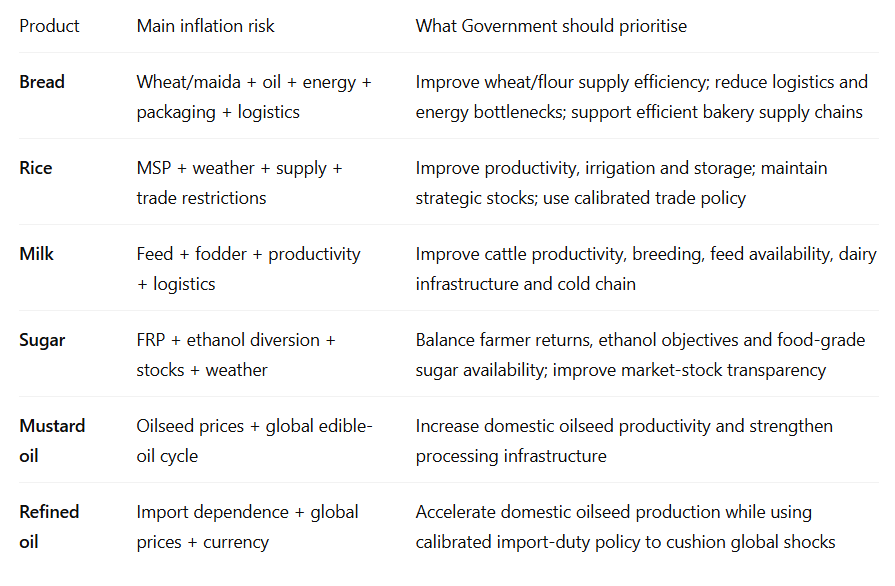
Product-wise recommendations for Government
The bigger question for India
India has made significant progress in food security.
The next challenge is different.
It is affordable food security.
Producing enough food is one objective.
Producing enough food efficiently, storing it efficiently, moving it efficiently and keeping it affordable is the next.
And the solution cannot come from one ministry or one policy.
It requires coordination between:
Agriculture + Food + Consumer Affairs + Commerce + Finance + Transport + Energy.
Because the price of a loaf of bread is ultimately influenced by much more than wheat.
My biggest takeaway
The last ten years tell us something very clearly:
Food inflation is becoming increasingly interconnected.
A war can increase the price of cooking oil.
A currency movement can increase the landed cost of commodities.
A weather event can affect rice.
A feed-price increase can affect milk.
An ethanol policy can affect sugar.
And higher packaging and logistics costs can push up the price of bread.
The consumer sees one number on the shelf.
Behind that number is an entire economic system.
India’s next food-policy challenge should therefore move from simply controlling prices after they rise to predicting supply stress before prices rise.
That is where technology, better agricultural productivity, strategic stocks, predictable trade policy and stronger domestic supply chains can make the biggest difference.
The goal should not be artificially cheap food.
The goal should be sustainably affordable food.
What do you think?
Should India focus more on price controls, or should the Government invest more aggressively in productivity, storage, domestic oilseed production and supply-chain infrastructure?
I’d be interested in hearing the views of people working across FMCG, retail, agriculture, food processing and supply chain.
#IndiaRetail #FoodInflation #FMCG #FoodSecurity #RetailStrategy #SupplyChain #Agriculture #FoodEconomics #ConsumerBusiness #IndiaEconomy #PricingStrategy
Leave a Reply