
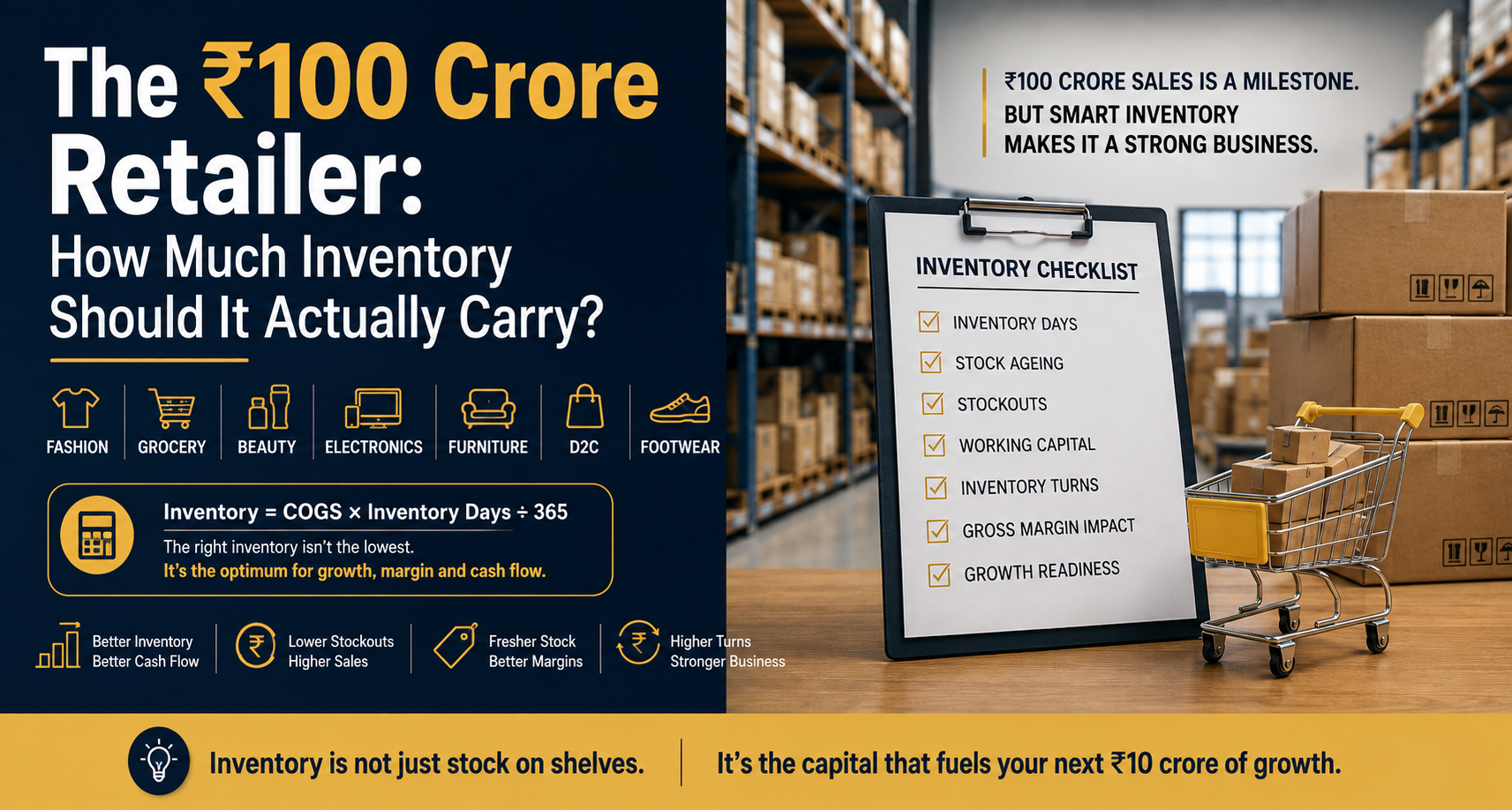
A retailer tells me:
“We are now a ₹100 crore business.”
My next question is usually not about sales.
I ask:
“How much inventory are you carrying?”
The answer can tell us a lot more about the health of the business than the ₹100 crore revenue number itself.
One retailer may be doing ₹100 crore with ₹6 crore of inventory.
Another may need ₹18 crore.
Both can be perfectly healthy.
Or both can have a serious inventory problem.
The difference lies in the business model, category, gross margin, inventory velocity, supplier lead time, assortment and, importantly, how much of that inventory is actually saleable.
So, if you run a ₹100 crore retail business, what should your inventory really look like?
There is no single answer.
But let’s look at the economics category by category.
Start with the basic calculation
A simple way to think about inventory is:
Inventory = Cost of Goods Sold × Inventory Days ÷ 365
So, if a retailer has ₹100 crore of sales, a 50% gross margin means its annual COGS is approximately ₹50 crore.
If the business carries 75 days of inventory:
₹50 crore × 75 ÷ 365 = ₹10.3 crore
That gives us a starting point.
But the interesting part begins when we apply this to different retail businesses.
Fashion: ₹9–10 crore may not be unusual
Consider a ₹100 crore fashion retailer.
Suppose:
- Gross margin: 55%
- COGS: ₹45 crore
- Inventory: 75 days
The inventory requirement works out to approximately ₹9.2 crore.
At first glance, that may look reasonable.
But I would immediately ask another question:
How much of that ₹9.2 crore is current and how much is ageing?
Imagine the inventory looks like this:
₹5.5 crore — fast-moving/current ₹1.5 crore — normal-moving ₹1 crore — slow-moving ₹700 lakh — ageing ₹500 lakh — effectively dead
The balance sheet still says ₹9.2 crore inventory.
But commercially, it is a very different story.
This is why fashion retailers should not look only at inventory value.
They need to look at inventory age, sell-through and expected realisation.
A ₹10 crore inventory number can be healthy.
It can also be the beginning of a ₹3 crore markdown problem.
Grocery: ₹5 crore can support ₹100 crore of sales
Now take grocery.
Suppose:
- Gross margin: 25%
- COGS: ₹75 crore
- Inventory: 25 days
Inventory requirement:
₹75 crore × 25 ÷ 365 = ₹5.1 crore
That’s a completely different inventory structure.
Why?
Because grocery moves much faster.
The retailer buys, sells and replenishes continuously.
Now imagine this retailer carries 60 days instead of 25.
Inventory becomes:
₹75 crore × 60 ÷ 365 = ₹12.3 crore
The retailer has not generated one additional rupee of sales.
But another ₹7.2 crore has become tied up in inventory.
That is the part of inventory management that often gets missed.
Inventory is not free.
Every additional rupee sitting on the shelf is a rupee that cannot be used somewhere else.

Beauty: the ageing problem is different
Beauty is another interesting example.
Take:
- ₹100 crore sales
- 55% gross margin
- ₹45 crore COGS
- 60 inventory days
Inventory:
₹45 crore × 60 ÷ 365 = ₹7.4 crore
So perhaps ₹7–8 crore of inventory looks reasonable as an illustrative starting point.
But beauty has another risk:
expiry and product relevance.
A product sitting in the warehouse for six months is not necessarily the same economic asset as a product that sells every week.
And then there are:
- New formulations
- Packaging changes
- Seasonal products
- Shade variations
- New launches
- Consumer preference changes
So the question isn’t simply:
“How much inventory do we have?”
It is:
“How much of our inventory is likely to convert into cash at the expected margin?”
That is a much more useful question.
Electronics: inventory can become obsolete before it becomes slow-moving
Electronics is even more interesting.
Assume:
- ₹100 crore sales
- 20% gross margin
- ₹80 crore COGS
- 60 inventory days
Inventory:
₹80 crore × 60 ÷ 365 = ₹13.2 crore
So an electronics retailer could be carrying ₹13 crore or more.
But electronics has a unique risk.
Technology moves faster than inventory.
A product can be perfectly saleable today and commercially unattractive six months later.
A new model arrives.
The manufacturer reduces prices.
A competitor launches a better product.
Customers wait for the next version.
Suddenly, ₹2 crore of inventory may require discounting.
This is why I would rather see an electronics retailer carrying ₹14 crore of highly productive inventory than ₹10 crore containing ₹3 crore of ageing stock.
The lowest inventory number is not necessarily the best inventory position.
Furniture: ₹18 crore may actually be reasonable
Furniture creates another interesting contrast.
Suppose:
- Gross margin: 45%
- COGS: ₹55 crore
- Inventory: 120 days
Inventory:
₹55 crore × 120 ÷ 365 = ₹18.1 crore
That sounds huge compared with grocery.
But should we immediately call it inefficient?
No.
Furniture has:
- Longer buying cycles
- Longer supplier lead times
- Larger ticket sizes
- Large display requirements
- Lower purchase frequency
- Higher logistics complexity
So 120 days of inventory may be perfectly understandable for the business.
This is why comparing a furniture retailer’s inventory days with a grocery retailer’s inventory days is meaningless.
Inventory benchmarks have to be category-specific.
Footwear: having inventory doesn’t mean having availability
Now consider footwear.
Suppose:
- ₹100 crore sales
- 50% gross margin
- ₹50 crore COGS
- 75 inventory days
Inventory:
₹50 crore × 75 ÷ 365 = ₹10.3 crore
Again, roughly ₹10 crore.
But here’s the problem.
Footwear doesn’t just have SKU-level inventory.
It has size-level inventory.
You may have:
100 pairs of a particular style.
But if your customers predominantly want sizes 8, 9 and 10, having 40 pairs in sizes 6 and 7 doesn’t solve the problem.
You can have:
₹10 crore of inventory
and still tell customers:
“Sorry, your size is unavailable.”
This is where inventory productivity becomes much more important than inventory value.
D2C: the problem often starts with the buying decision
D2C businesses have another challenge.
Suppose a ₹100 crore D2C brand has:
- 60% gross margin
- ₹40 crore COGS
- 60 inventory days
Inventory:
₹40 crore × 60 ÷ 365 = ₹6.6 crore
That looks efficient.
But now look inside the number.
Suppose the brand has 100 SKUs.
10 SKUs generate most of the demand.
30 are average.
60 are struggling.
The overall inventory number may still look perfectly acceptable.
But the problem is sitting at the SKU level.
This is where I believe many D2C businesses need to move from:
“How much inventory do we have?”
to:
“Which SKUs are consuming our working capital?”
Because one bad buying decision repeated across 50 SKUs can quietly lock up crores.
So, what does a ₹100 crore retailer really need?
Using the illustrative assumptions above, the picture could look something like this:

These are illustrative calculations, not universal industry targets.
And that’s exactly the point.
There is no magic number called:
“Ideal inventory for a ₹100 crore retailer.”
The bigger question is inventory productivity
Let’s say two retailers both have ₹100 crore revenue.
Retailer A carries:
₹8 crore inventory
Retailer B carries:
₹16 crore inventory
It is tempting to say Retailer A is twice as efficient.
But we need to know more.
What if Retailer A is constantly out of stock?
What if it is losing sales because its best-selling SKUs aren’t available?
What if Retailer B has higher availability and faster growth?
Now the answer changes.
The objective isn’t:
Minimum inventory.
The objective is:
Optimum inventory.
Enough inventory to maintain availability and support growth.
But not so much that working capital gets trapped in slow-moving or obsolete stock.
And this is where I would ask a ₹100 crore retailer five questions
1. How many inventory days are we carrying?
Not just at company level, but by category and channel.
2. What percentage of inventory is older than 90/120/180 days?
Ageing tells us much more than the total number.
3. Which SKUs are consuming working capital without producing sufficient sales?
This is where SKU-level analysis becomes powerful.
4. Where are we overstocked while another store/channel is out of stock?
Inventory in the wrong location is almost as problematic as not having inventory.
5. If sales grow from ₹100 crore to ₹150 crore, how much additional inventory will we need?
This may be the most important question of all.
The ₹100 crore → ₹150 crore test
Suppose a retailer grows from ₹100 crore to ₹150 crore.
The conventional approach says:
Sales +50% → Inventory +50%
So:
₹10 crore inventory → ₹15 crore.
But what if better forecasting, replenishment, transfers and assortment management allow the retailer to reach ₹150 crore with ₹12 crore inventory?
The business has effectively released ₹3 crore of capital.
No new store.
No additional borrowing.
No additional investor capital.
Just better inventory productivity.
That is why inventory management should not sit only with the supply-chain team.
Inventory is a finance issue.
Inventory is a merchandising issue.
Inventory is a buying issue.
Inventory is a customer-experience issue.
And ultimately, inventory is a CEO issue.
The number I would like every retailer to know
Not:
“Our inventory is ₹12 crore.”
But:
“Every ₹1 of inventory in our business generates ₹X of annual sales and ₹Y of gross margin, and we know exactly where the unproductive inventory is.”
That is a much more meaningful measure of retail health.
Because the objective of inventory is not to sit in a warehouse.
It is not to fill a store.
It is not even to make the balance sheet look healthy.
Inventory has only one job: to be converted into sales, margin and ultimately cash.
And the faster and more profitably you can do that—without compromising availability—the stronger your retail business becomes.
₹100 crore of sales is a milestone.
But ₹100 crore of sales with disciplined inventory is a much stronger business.
What is your view?
For a ₹100 crore retailer, what is more dangerous:
₹5 crore of excess inventory—or ₹5 crore of lost sales because of stockouts?
I’d be interested in hearing how retailers and D2C businesses are looking at this today.
Welcome
Leave a Reply