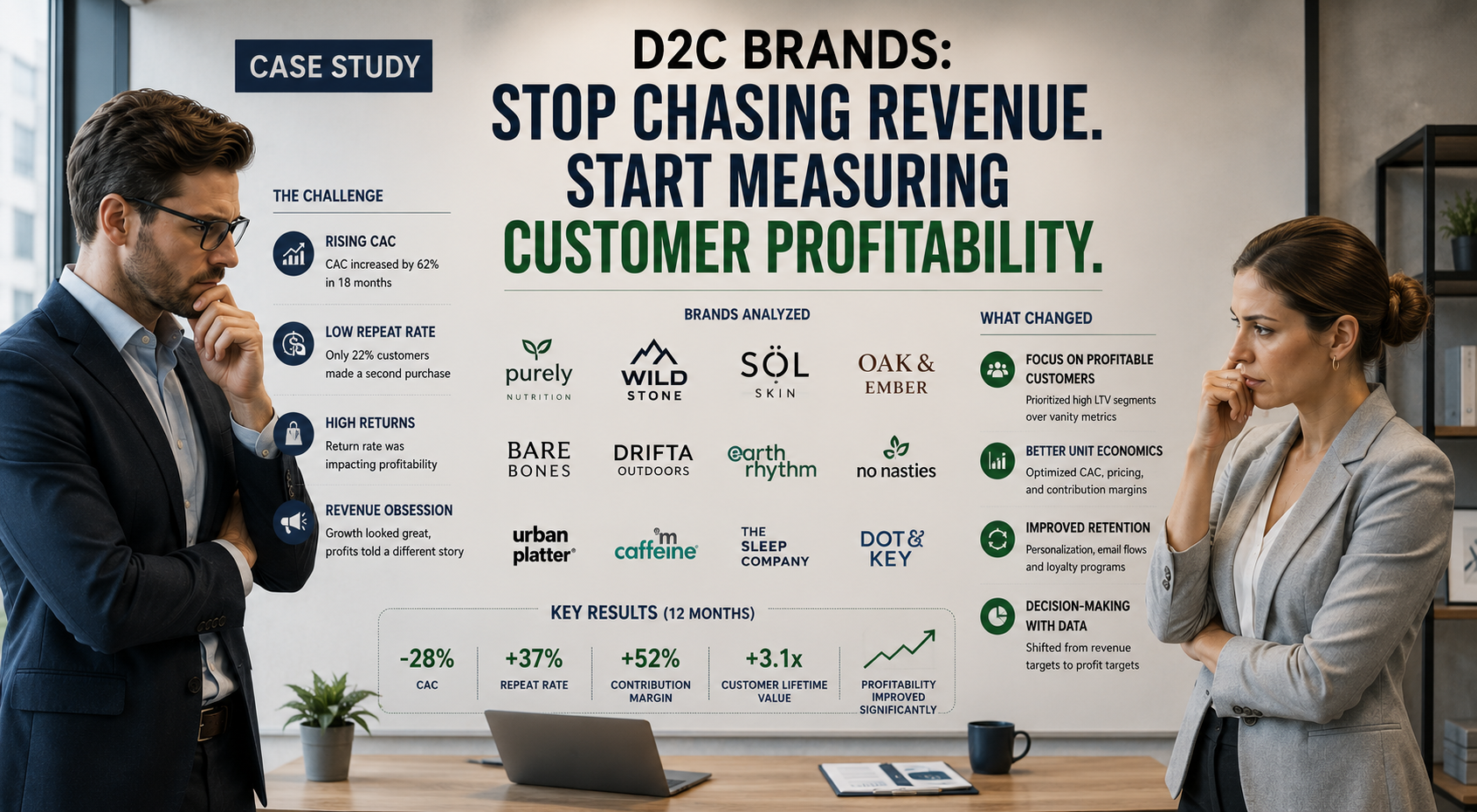
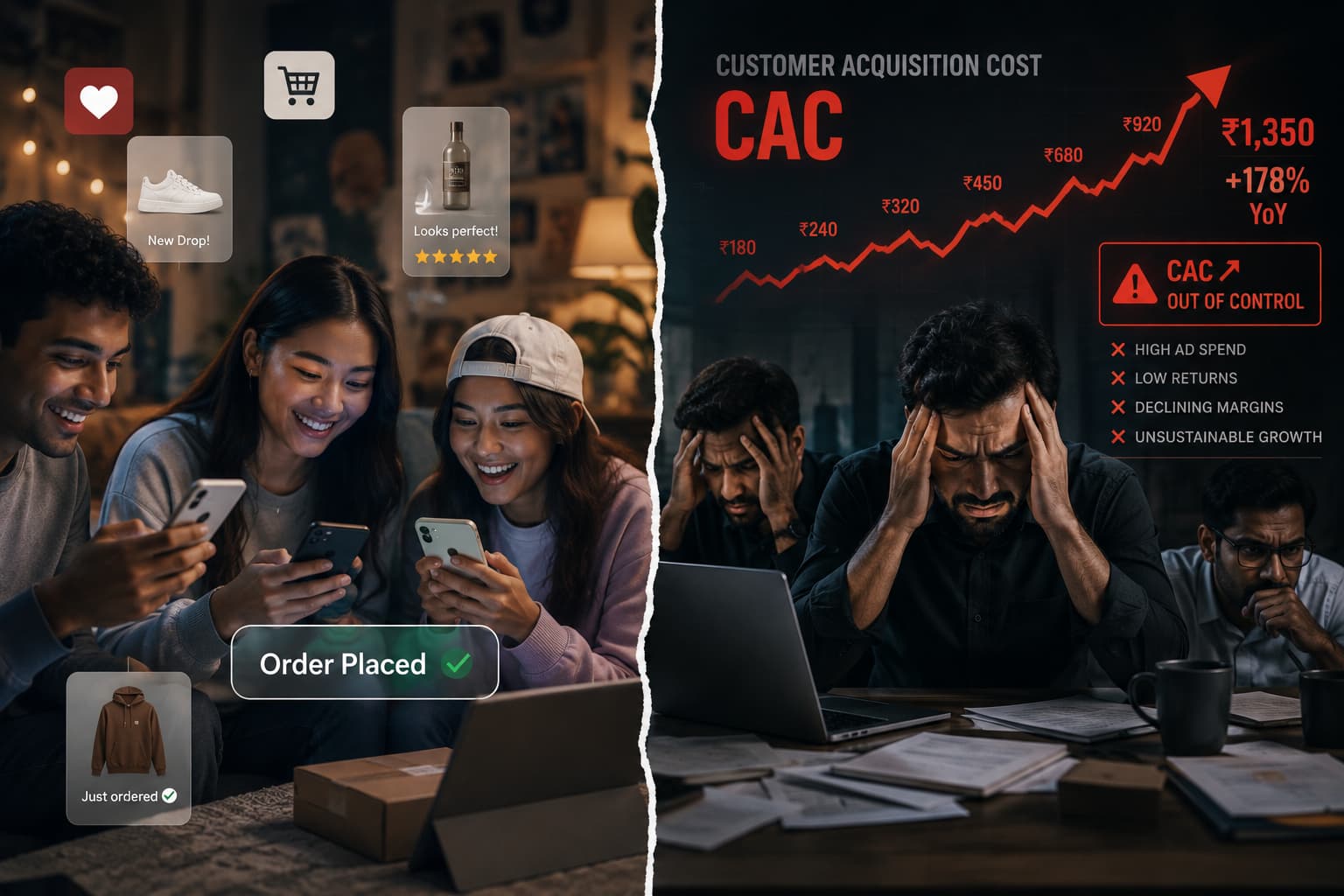
Customer acquisition costs are rising. Competition is increasing. Online marketplaces are crowded. Consumers have endless choices. And customer loyalty is becoming harder to earn.
So the real question for a D2C brand today is not:
“How do I sell more online?”
It is:
“How does my customer actually make a purchase decision, and where should I be available when that decision happens?”
That requires looking beyond the D2C label.
The D2C customer is not one customer
One of the biggest mistakes brands make is treating their online customer as a single segment.
India has very different consumer groups—from affluent consumers to upper-middle-class, middle-income and value-conscious households.
But income alone does not determine behaviour.
Category determines behaviour.
A consumer may be extremely price-sensitive when buying groceries but may pay a premium for skincare.
The same person may compare five furniture brands before buying a sofa but purchase a familiar FMCG product almost automatically.
That is why customer behaviour has to be understood category by category, occasion by occasion and need by need.
Consider a few examples.
Fruits & vegetables
Freshness, availability, convenience and price can dominate the decision.
Furniture
Durability, finish, design, comfort, quality, price and confidence in the product become important.
Beauty & cosmetics
Product efficacy, ingredients, packaging, reviews, colour, price, trust and brand image can all influence the decision.
There is therefore no universal D2C customer.
There are category-specific customers with different reasons to buy.
The customer knows more—but not necessarily enough
The digital consumer today has extraordinary access to information.
With a few clicks, customers can compare:
Prices
Reviews
Features
Competitors
Offers
Influencer opinions
Product demonstrations
Customer experiences
But information availability does not automatically create understanding.
The customer may see ten products but still struggle to decide which one is right.
That is where trust, reviews, brand credibility, product experience and availability become critical.
And this is where physical retail still has an important role.
A customer can touch a product.
See its finish.
Try it.
Speak to someone.
Understand the difference between two products.
And sometimes, simply seeing the brand in a physical environment creates confidence.
The biggest D2C problem today: Customer acquisition
Digital platforms have made customer access easier.
They have also made competition much more intense.
A D2C brand is competing for attention on the same platforms as hundreds or thousands of other brands.
Meta, Instagram, YouTube, Google and marketplaces can generate enormous reach.
But reach comes at a price.
As more brands compete for the same audience:
Customer acquisition becomes more expensive.
And if the customer makes one purchase and never returns, the economics become even more difficult.
For more than a decade, D2C meant one thing: go directly to the consumer without traditional retail.
Build a product.
Create a digital brand.
Run Meta and Google campaigns.
Drive traffic to the website.
Convert.
Repeat.
That model changed how brands were built.
But the consumer has changed again.
And this time, Gen Z may force D2C companies to rethink one of their original assumptions: that digital alone is enough.
The future of D2C is not online versus offline.
It is online + offline.
It is Phygital.
First, understand the Gen Z consumer
Gen Z does not behave like a purely digital consumer.
They may discover a product on Instagram, watch a creator explain it on YouTube, compare it online, ask AI for an opinion, visit a store to experience it and finally purchase through whichever channel gives them the best combination of value, trust, convenience and experience.
Deloitte calls Gen Z the “most authentically omni-shopping generation”—a generation that combines digital discovery with a strong preference for in-person shopping. Its research found that 64% of Gen Z uses social media to research products and 35% uses it to discover products.
That changes the strategic question for D2C companies.
The question is no longer:
“How do we get Gen Z to buy online?”
It is:
“How do we make our brand available wherever Gen Z wants to discover, evaluate and buy?”
That is a very different business model.
What does Gen Z actually need?
Gen Z wants value, but value does not simply mean the lowest price.
They want:
Good products.
Fair prices.
Trust.
Reviews and proof.
Personalisation.
Convenience.
Speed.
Experience.
Identity.
And increasingly, the ability to move seamlessly between digital and physical channels.
This matters because Gen Z will become an increasingly important spending force.
In India, Deloitte estimates that Gen Z will account for 43% of total consumption in 2025, with direct spending power of around US$250 billion. A newer Google-Deloitte report projects Gen Z could command 45% of India’s online spend by 2030.
This is not a niche customer segment.
This is the next consumer economy.
Where are D2C companies going wrong?
The problem is not that D2C companies went digital.
The problem is that many of them stopped there.
They built businesses around paid digital acquisition rather than building a complete consumer ecosystem.
The model became:
Advertising → Website → Purchase
That model becomes vulnerable when:
customer acquisition becomes expensive,
competitors sell similar products,
consumers become promotion-sensitive,
marketplaces capture demand,
algorithms change,
and the consumer has too many alternatives.
A D2C brand can have millions of impressions and still have very little consumer loyalty.
It can have excellent ROAS and weak profitability.
It can have a strong online following and weak physical presence.
And it can have a great product that consumers still want to touch, try, compare or experience before buying.
This is where retail re-enters the story.
Retail is not disappearing. It is changing.
The old argument was:
Digital will replace stores.
The evidence increasingly suggests something different.
Digital and physical are converging.
India’s retail sector is expected to grow from approximately US$1.06 trillion in 2024 to US$1.93 trillion by 2030, while online retail is projected to increase from US$75 billion to US$260 billion during the same period.
Online is growing rapidly.
But even by 2030, it would represent only around 14% of total Indian retail according to the Deloitte-FICCI projection.
That means something very important for D2C founders:
The digital opportunity is enormous—but the physical retail opportunity remains enormous too.
Ignoring either one limits the addressable market.
India is already showing the direction
The retail market is not waiting for D2C brands to decide whether they like physical retail.
D2C brands are already moving there.
CBRE reported that D2C brands accounted for approximately 27% of India’s retail leasing activity in 2025. In H1 2026, D2C players accounted for approximately 28% of retail absorption.
That is a significant signal.
D2C brands are becoming retail occupiers.
Why?
Because physical stores can provide something digital cannot fully replicate:
Trust.
Trial.
Touch.
Demonstration.
Experience.
Visibility.
Immediate gratification.
And sometimes, simply:
“I want to see it before I buy it.”
Look at what is happening globally
The transition is not uniquely Indian.
In the US, digitally born brands such as Oura expanded into physical retail through major retailers including Best Buy and Target.
Beauty brand Glossier, which built its reputation through digital communities, expanded through Sephora.
The lesson is not that these companies abandoned D2C.
They didn’t.
They expanded the definition of D2C.
They realised that direct relationships can exist through multiple channels.
The store does not necessarily weaken the brand’s relationship with the consumer.
If managed correctly, it can strengthen it.
Europe is taking this even further
Europe is showing how technology can actually make physical retail more relevant.
Deloitte’s 2026 European research found that 56% of European consumers have already used AI for shopping, with product comparison among the leading uses.
This creates an interesting future.
Imagine a consumer walking into a store.
They scan a product.
AI understands their preferences.
It compares products.
The store provides the physical experience.
The digital layer provides intelligence.
The transaction can happen either physically or digitally.
That is not traditional retail.
That is Phygital retail.
Southeast Asia provides another lesson
Southeast Asia has demonstrated the power of social commerce.
The consumer can discover a product through a creator, interact with the seller, research the product and complete the purchase without following the traditional retail funnel.
The lesson for India is important:
Consumers no longer recognise the boundaries between marketing, commerce and retail.
A video can become a store.
A creator can become a salesperson.
A marketplace can become a discovery engine.
A physical store can become a content studio.
And an app can become a loyalty programme.
The channels are merging.
India has an additional advantage
India has something many mature markets do not have at the same scale:
Digital growth + physical retail growth + young consumers + Tier II/III consumption.
Deloitte reports that Tier II and III cities already account for more than 60% of India’s e-commerce transactions.
CBRE’s latest retail data shows Delhi-NCR, Chennai and Mumbai accounted for approximately 66% of retail leasing activity in H1 2026, while D2C brands represented around 28% of absorption.
The opportunity therefore extends beyond the metros.
A D2C company that builds digital demand in a Tier II city may eventually discover that the same city can support a physical presence.
Digital can identify where retail should go.
That is a major strategic advantage.
The future D2C company will look different
The first generation of D2C companies asked:
“How can we bypass retail?”
The next generation should ask:
“How can we use digital to build demand and retail to expand the relationship?”
That changes the role of the store.
The store is no longer merely a place to generate billing.
It can become:
A brand experience centre.
A consumer acquisition point.
A product trial centre.
A content engine.
A community hub.
A fulfilment point.
A customer-service point.
A physical expression of a digital brand.
And digital remains equally important.
It can drive:
Discovery.
Personalisation.
Reviews.
Community.
Data.
Convenience.
Repeat purchase.
So the relationship becomes circular:
Digital → Store → Digital → Store → Digital
rather than:
Digital OR Store
And this is where India becomes particularly interesting
India does not need to copy the US, Europe or Southeast Asia.
India’s retail expansion story is entering its next phase.
The question is no longer:
“How many stores can we open?”
The question is:
“How intelligently can we expand while protecting productivity, profitability and customer relevance?”
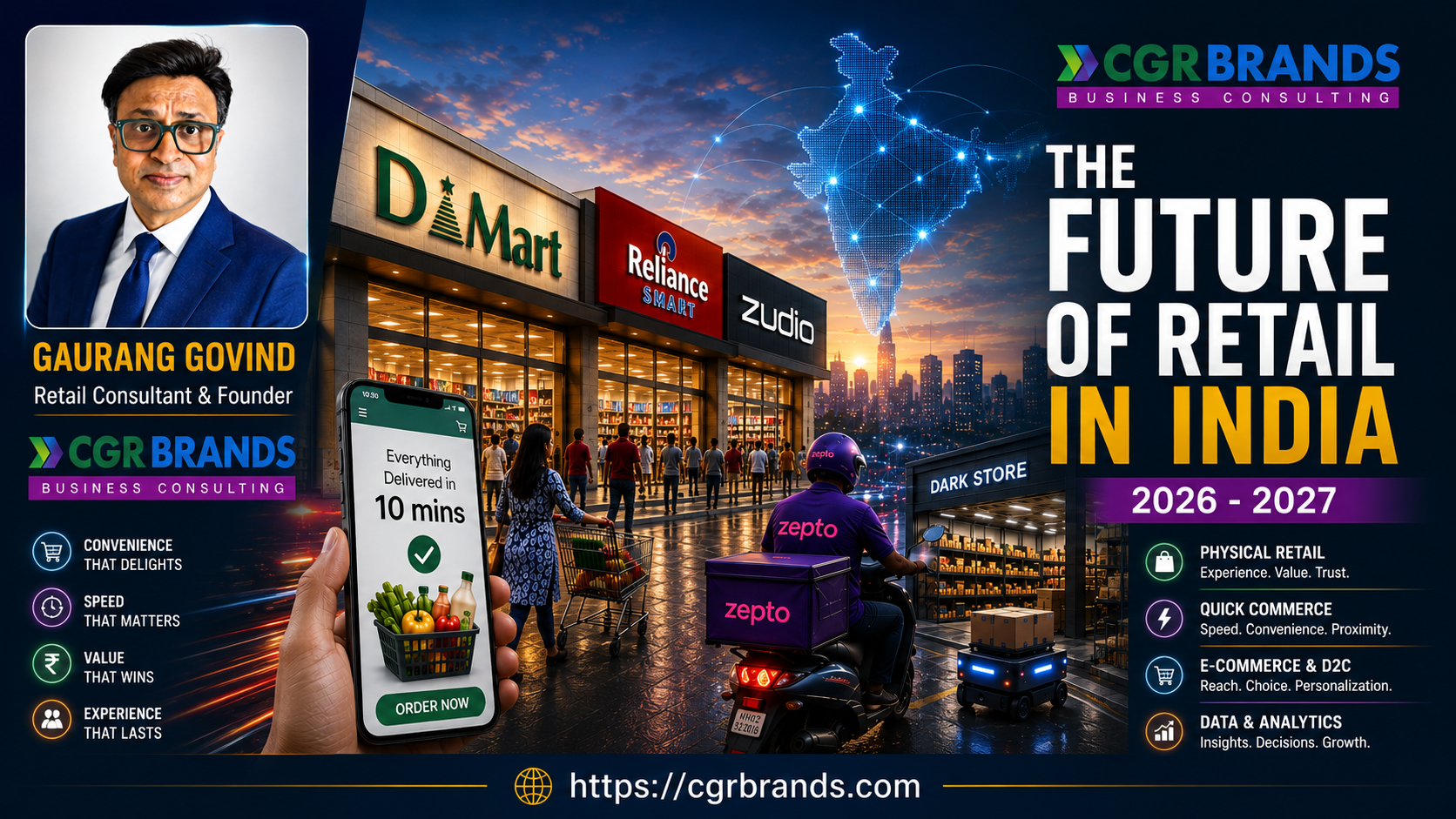
Between 2024 and 2026, India’s leading retailers significantly increased their physical footprints while quick commerce simultaneously created a completely different retail proposition: availability at the doorstep within minutes.
Now the real battle is moving towards Tier 2, Tier 3 and emerging consumption centres.
And I believe the next two years will be less about the race for store count and more about the race for better retail economics.
What happened between 2024 and 2026?
Three examples illustrate the direction.
Reliance Retail
Reliance Retail increased its store network from 19,340 stores in FY2025 to 20,160 stores in FY2026, while gross revenue increased from ₹3.31 lakh crore to approximately ₹3.71 lakh crore. Its Smart Bazaar network crossed 1,000 stores, with a significant part of that network serving Tier 2 and smaller markets.
More importantly, Reliance is combining physical stores, digital commerce and hyperlocal commerce rather than treating them as separate businesses.
Trent’s Zudio
Zudio reached 963 stores across 313 cities by FY2026, compared with 765 stores in FY2025 and 545 stores in FY2024. The company’s own reporting highlights accessibility, sharp price points, in-house merchandise and rapid expansion as key elements of the model.
Avenue Supermarts
Avenue Supermarts, the operator of the DMart chain, moved from 365 stores in FY2024 to 415 in FY2025 and 500 in FY2026.
The FY2026 expansion is particularly interesting: 85 stores were added, including 45 stores in Tier 2+ markets, while the company entered 39 new cities, 34 of them Tier 2+. It also entered Uttar Pradesh, Haryana, Odisha, Uttarakhand and Goa.
The message from these examples is clear:
India’s organised retail opportunity is moving deeper into the country. This we all know.
But there is another force changing the game.
The Quick-Commerce Challenge
Quick commerce has changed the consumer’s definition of convenience.
The customer no longer thinks:
“I need to visit a store.”
The customer increasingly thinks:
“I need it now.”
Blinkit, Swiggy Instamart and Zepto have built large dark-store networks, while Amazon and Flipkart are now increasing their investments in rapid delivery.
In June 2026, Reuters reported that Amazon planned to expand its rapid-delivery service to 300 Indian cities, while Flipkart was targeting approximately 1,500 quick-commerce locations.
This creates an interesting future scenario.
Traditional retailers will increasingly have stores.
Quick-commerce companies will increasingly have dark stores.
E-commerce companies will increasingly combine warehouses, marketplaces and rapid fulfilment.
The consumer will simply choose whichever channel delivers the best combination of:
The physical store therefore needs to become more than a transaction point.
It needs to become a customer-experience and fulfilment asset.
—
4. Dark stores will face an operational-quality test
There is another issue that I believe deserves far greater attention.
A dark store is still a retail operation.
Technology can manage orders.
Technology can generate inventory alerts.
Technology can optimise delivery routes.
But people still have to manage:
Expiry → FEFO → hygiene → temperature → receiving → storage → pest control → picking → product handling.
Recent food-safety enforcement in Maharashtra illustrates the risk. Authorities inspected quick-commerce establishments and suspended permits at 12 warehouses after identifying issues including cockroach infestations, rodent droppings and other sanitation problems.
This should not be viewed only as a quick-commerce problem.
5. E-commerce and direct-to-consumer brands will push deeper into smaller cities
This is another major structural change.
Smaller-city consumers are not waiting for physical stores.
They are discovering brands online.
According to Unicommerce data reported by the India Brand Equity Foundation, Tier 2 and Tier 3 cities were expected to contribute around 66% of new direct-to-consumer orders in FY2026.
This changes the expansion equation.
A brand can now enter a city digitally before opening a physical store.
That creates an important consulting opportunity:
Digital-first → Data validation → Pilot store → Cluster expansion
Instead of:
Store first → Hope for demand → Correct later
This can significantly reduce expansion risk.
—
What should retailers do now?
Action 1: Build a micro-market expansion model
Don’t approve a new store only because the city looks attractive.
Create a scoring model covering:
Demand + competition + rent + catchment + logistics + digital demand + store economics.
—
Action 2: Establish a 12–24 month store maturity dashboard
Every new store should be tracked against:
Sales per sq. ft./ GMROF
Gross margin.
GMROI.
Inventory turns.
Inventory cycle
Conversion.
Average basket value.
Shrinkage.
Manpower productivity.
Contribution margin.
This allows management to distinguish between a temporary maturity issue and a fundamentally weak location.
—
Action 3: Design the store and dark store together
The future will increasingly require omnichannel operating models.
A physical store may serve:
Walk-in customers + online orders + click-and-collect + local fulfilment.
Right Market × Right Format × Right Assortment × Right Inventory × Right Execution = Profitable Growth
—
Final Recap
The last two years proved that physical retail is not disappearing.
It is changing.
Reliance Retail has crossed 20,000 stores.
Zudio has reached nearly 1,000 stores.
Avenue Supermarts has reached 500 stores and is pushing deeper into Tier 2+ markets.
At the same time, quick commerce and e-commerce are moving rapidly into smaller markets.
So the next two years will not be about choosing between stores and digital.
They will be about building the right combination.
For retailers, my recommendation is straightforward:
Analyse before expanding.
Pilot before multiplying.
Cluster before spreading.
Measure productivity before celebrating footprint.
Audit operations before scaling.
And most importantly:
Build the organisation’s capability at the same speed as you build its footprint.
Because in the next phase of Indian retail, opening the store may be easy. Running 500 or 5,000 stores consistently will be the real competitive advantage.
Choosing a business consultant is not about finding the person with the most impressive presentation. It is about finding the person who can understand your numbers, challenge your assumptions, work with your team, and deliver measurable improvement.
You may spend three weeks comparing laptops, negotiate for days before buying equipment, and evaluate multiple suppliers before committing to a major purchase.
Yet many businesses spend only one or two meetings choosing the consultant who may influence their supply chain, margins, organisation structure, operations and growth strategy.
That asymmetry can be expensive.
India’s management consulting services market is projected to grow from approximately USD 9.36 billion in 2026 to USD 17.01 billion by 2031, representing a CAGR of about 12.69%, according to Mordor Intelligence. More businesses are therefore looking for external expertise — but a growing consulting market also means more choice and more noise.
Almost every consultant’s profile now includes words such as strategy, transformation, growth, digitalisation and operational excellence.
The more important question is:
Can this consultant demonstrate what actually changed after the strategy was approved?
That is the difference between consulting as advice and consulting as business improvement.
What You Will Learn
By the end of this article, you will know how to:
Define the business problem before approaching a consultant
Evaluate a consultant’s industry and functional expertise
Assess whether their methodology is evidence-based
Verify references beyond testimonials
Structure a consulting contract around measurable outcomes
Identify common business consulting red flags
Ask the right questions in your first consultant meeting
Decide whether you need a strategy consultant, operations consultant, retail consultant, supply chain consultant or business transformation consultant
Why Choosing the Right Business Consultant Matters
Consulting outcomes are not always as predictable as the proposal suggests.
For example, BCG’s research involving more than 850 companies found that only 35% achieved their digital transformation objectives.
Gartner’s research similarly found that only 48% of digital initiatives met or exceeded their business outcome targets.
Bain’s 2024 research reported that 88% of business transformations failed to achieve their original ambitions.
These studies are not directly comparable. They examine different types of transformation, populations and definitions of success.
The important lesson is therefore not to repeat a generic “70% of transformations fail” statistic.
The lesson is simpler:
Business transformation is difficult, and consultant selection is one of the decisions you can control before the project begins.
The 5-Part Framework for Choosing a Business Consultant
1. Scope: Define the Business Problem as a Number
The first mistake many companies make is approaching consultants with a vague problem.
For example:
Weak brief:
“Our operations are inefficient.”
Better brief:
“Our gross margin has declined from 34% to 29% over the last six quarters, and we cannot identify the major drivers.”
Or:
“Inventory has increased by 18%, while sales have grown only 5%.”
Or:
“Fresh-product damage is 2.7% of sales, compared with our target of 1.8%.”
Numbers change the conversation.
Before selecting a management consultant in India, define:
Current performance
Desired performance
Time period
Financial impact
Operational impact
Available data
Decision that needs to be made
If you cannot define the problem quantitatively, you may actually need a diagnostic consulting assignment first.
That is perfectly legitimate.
But buy the diagnosis as a clearly defined phase rather than allowing diagnosis to become an invisible part of a six-month retainer.
A useful principle:
If the problem cannot be measured, the solution cannot be properly evaluated.
2. Industry Fit: Sector Depth Beats a Big Brand Name
A consultant who understands your industry can often identify issues that a generalist may miss.
Retail is not simply “another business.”
Retail has its own operating economics:
Sales per square foot
Gross margin
GMROI
Inventory turns
Shrinkage
Conversion
Average basket value
Replenishment
Stock availability
Category productivity
Store manpower productivity
Likewise, quick commerce has its own economics around:
Dark-store productivity
Picking efficiency
Order density
Fill rate
Last-mile economics
Inventory availability
FMCG manufacturing, warehousing, D2C and supply chain businesses have completely different operating constraints.
Therefore, don’t simply ask:
“Do you work with retail companies?”
Ask:
“Have you solved this specific problem in my sub-sector?”
There is a significant difference between:
“We have retail experience.”
and
“We have implemented inventory optimisation in grocery retail and measured the impact on inventory turns, availability and working capital.”
Ask for specificity.
If you operate a retail, FMCG, D2C, manufacturing or supply chain business, ask the consultant:
Which companies have you worked with?
Which specific function did you improve?
What was the baseline?
What changed?
Over what period?
What did the client team implement?
What was the measurable result?
Industry experience is useful. Relevant problem-solving experience is better.
3. Methodology: Ask the Consultant to Show Their Working
A polished PowerPoint is not methodology.
Before hiring a consultant, ask:
“Show me an example of a baseline you personally developed.”
Then ask:
What data did you collect?
How did you validate it?
What assumptions did you make?
What hypothesis did you test?
What did the data prove?
What did the data disprove?
What action followed the analysis?
How was the result measured?
This is where structured approaches such as DMAIC, value-stream mapping, root-cause analysis, hypothesis testing, process mapping and Pareto analysis can become useful.
But methodologies should not become decoration.
A Six Sigma certification, for example, does not automatically make someone an effective consultant.
The more important question is:
Can the consultant use structured thinking to solve your specific business problem?
One of the strongest signals is when a consultant can tell you about a hypothesis they initially got wrong — and explain how the data changed their conclusion.
That demonstrates something more valuable than confidence:
intellectual honesty.
4. References: Don’t Ask Only for the Happy Client
Most consultants can provide a successful reference.
That tells you something.
But it does not tell you everything.
Ask for a more difficult reference:
“Can you give me the contact details of a client where the project did not perform as expected?”
Then ask that client:
“What actually happened after the first few weeks?”
More specifically:
Was the consultant actually involved?
Did they spend time with the operating team?
Did they understand the frontline problem?
Did they challenge management assumptions?
Did they help implement the recommendations?
What happened after the initial presentation?
Who was available when problems appeared?
What changed by month three?
What remained unchanged?
Listen carefully to the answer.
There is a major difference between:
“They were there and worked with our team.”
and:
“We mostly saw the senior partner during review meetings.”
Both may be technically successful consulting engagements.
But they represent very different consulting models.
5. Contract: Name the People and Define the Exit
One of the most overlooked parts of selecting a business consulting company is the contract.
Your proposal should not simply say:
“Strategic advisory and transformation support.”
That is difficult to measure.
Instead, define tangible deliverables.
For example:
Current-state process map
Baseline KPI dashboard
SOPs
Training material
Trained supervisors
Store audit framework
Inventory analysis
Cost-reduction initiatives
Implementation tracker
Monthly performance report
Signed-off process improvements
Also define:
Who will actually do the work?
Your contract should identify the people responsible for delivery.
The senior consultant who impresses you during the pitch may not be the person working with your organisation every week.
But how can anyone accurately calculate savings before understanding:
Current cost
Volume
Process
Constraints
Existing contracts
Manpower
Technology
Quality requirements
No baseline = no credible savings estimate.
🚩 3. The Senior Name Disappears After the Pitch
You meet the partner.
You are impressed.
You sign.
Then you discover that the project is being delivered almost entirely by junior resources.
This is the classic bait-and-switch problem.
Ask for the delivery team before signing.
🚩 4. The Deliverables Are Only “Strategy” and “Roadmap”
Strategy has value.
But strategy without execution can become an expensive document.
Ask:
“What physical or digital artefacts will we have at the end?”
A good answer might include:
SOP + dashboard + process map + training + implementation tracker + measurable KPI improvement.
🚩 5. Success Cannot Be Clearly Measured
If the consultant cannot explain:
What will change
How it will be measured
When it will be measured
Who will measure it
then you may be buying activity rather than outcomes.
The Consultant Selection Scorecard
Before making your final decision, score each consultant from 1–10.
Selection Factor
Weight
Industry experience
20%
Relevant problem-solving experience
20%
Methodology
15%
On-ground execution capability
15%
Team quality
10%
References
10%
Measurement & accountability
10%
Then calculate the weighted score.
This prevents a common mistake:
Choosing the consultant you liked most in the meeting rather than the consultant who is most capable of solving the problem.
Strategy Consultant or Execution Consultant?
This distinction is particularly important.
Some businesses need a strategy consultant.
Others need an operations consultant.
Some need a retail consultant.
Others need a supply chain consultant, cost-reduction consultant, process-improvement consultant or business transformation consultant.
The right choice depends on the problem.
If your problem is:
“Where should we go?”
You may need strategy consulting.
If your problem is:
“Why isn’t our current operation delivering?”
You may need operations consulting.
If your problem is:
“We know what needs to change but cannot implement it.”
You need an implementation-oriented consultant.
If your problem is:
“Our costs are too high and margins are falling.”
You may need a cost optimisation or operational excellence consultant.
The key is to match the consultant’s capability to the business problem, not simply to the consultant’s title.
What Good Consulting Should Leave Behind
At the end of a successful consulting engagement, your organisation should have more than a presentation.
It should have greater capability.
Ideally, the project should leave behind:
Better processes
Better data
Better KPIs
Better-trained people
Better decision-making
Better accountability
Better financial performance
And most importantly:
Your team should be capable of sustaining the improvement after the consultant leaves.
That is one of the clearest differences between consulting that creates dependency and consulting that creates capability.
The CGRBrands Perspective
At CGRBrands, we believe consulting should move beyond recommendations.
Our approach combines business analysis, process mapping, data analysis, operational improvement and on-ground execution.
Depending on the requirement, this can include:
Retail consulting
FMCG consulting
D2C consulting
Quick commerce consulting
Supply chain consulting
Warehouse and distribution improvement
Cost reduction
Waste and damage reduction
Process re-engineering
Manpower optimisation
SOP development
KPI and performance management
Store and operational audits
Training and capability building
Business transformation
The objective is not simply to tell a client what to do.
It is to work with the organisation to understand:
What is happening → Why it is happening → What should change → How it should change → Who will implement it → How the result will be measured.
That is where consulting becomes measurable business improvement.
Final Recap: The 5 Rules for Choosing a Business Consultant
Before you sign your next consulting contract, remember five things:
1. Quantify the problem.
Don’t start with “we need transformation.” Start with the number that needs to change.
2. Test industry depth.
Don’t ask whether the consultant knows your industry. Ask whether they have solved your specific problem in your specific environment.
3. Examine the methodology.
Ask the consultant to show how they built a baseline, tested hypotheses and reached conclusions.
4. Speak to the difficult reference.
Don’t only ask who loved the consultant. Ask who struggled — and why.
5. Put measurement into the contract.
Define people, deliverables, KPIs, measurement methodology and review gates.
The Bottom Line
Choosing a business consultant should be treated as a business decision — not a personality decision.
The consultant with the most impressive presentation is not necessarily the consultant who will deliver the best result.
Look for someone who can:
Understand the numbers. Understand the industry. Understand the frontline. Challenge assumptions. Work with your people. Measure the baseline. Implement the solution. And stay accountable for the outcome.
Because ultimately, your business does not need another presentation.
It needs measurable improvement.
About CGRBrands
CGRBrands works with businesses across retail, D2C, quick commerce, FMCG, franchising, manufacturing and supply chain, in India and international markets.
Our consulting philosophy is simple:
Analyse the problem. Build the solution. Work with the team. Measure the result.
To explore how CGRBrands can support your business transformation, operational improvement or growth agenda, visit cgrbrands.com.
SEO Keyword Set
Primary keyword:
How to choose a business consultant in India
Secondary keywords:
Business consultant in India
Management consultant in India
Business consulting services
Management consulting in India
Best business consultant in India
How to hire a business consultant
Business consultant selection
Business transformation consultant
Operations consultant in India
Retail consultant in India
Supply chain consultant in India
FMCG consultant in India
Cost reduction consultant
Process improvement consultant
Operational excellence consultant
Long-tail SEO keywords:
How to select a business consultant for your company
What to look for in a management consultant
Questions to ask a business consultant before hiring
How to evaluate a consulting company in India
How to choose a retail consultant
How to choose a supply chain consultant
How to evaluate business consulting services
What makes a good business consultant
Business consultant selection framework
Consultant evaluation checklist for businesses
Suggested SEO Metadata
SEO Title: How to Choose a Business Consultant in India | Expert Framework
Meta Description: Learn how to choose a business consultant in India using a practical 5-part framework covering industry expertise, methodology, references, KPIs, contracts and execution.
Suggested H1: How to Choose a Business Consultant in India: An Expert Selection Framework
Suggested Featured Snippet: Choosing a business consultant starts with five checks: quantify the problem, verify industry expertise, examine methodology, speak to difficult references and put measurable outcomes into the contract.
Sources
Mordor Intelligence — India Management Consulting Services Market: USD 9.36 billion in 2026, projected to reach USD 17.01 billion by 2031.
Boston Consulting Group — research involving 850+ companies found 35% achieved their digital transformation objectives.
Gartner — survey of more than 3,100 CIOs and technology executives and more than 1,100 business leaders found 48% of digital initiatives met or exceeded business outcome targets.
Bain & Company — 2024 transformation research reporting that 88% of business transformations did not achieve their original ambitions.
Eight years ago, a customer cost you ₹100. Today the same customer costs ₹322 — and converts no better. Globally, CAC has climbed roughly 222% over eight years, and 60% in the last five alone. Shopify’s 2026 data across 4.8 million merchants puts average CAC at $318, up 16% in a single year. In India, Meta-sourced CAC for D2C brands jumped from about ₹380 to ₹502 — 32% in twelve months.
Here is the uncomfortable part: nobody is buying more customers. They are simply paying more for the same ones.
Why the meter keeps running
1. The auction got crowded — and richer. Ad inventory is finite; bidders are not. Google CPCs rose ~12.9% and Meta CPMs ~20% in 2025. Globally, deep-pocketed marketplaces bid on the same keywords as a 30-crore D2C brand. In India, every funded brand in skincare, coffee, supplements and fashion is buying the same 200 keywords and the same three lookalike audiences. Auction inflation is not a marketing problem — it is a supply-and-demand problem.
2. Signal loss made targeting expensive. Post-ATT, only about a quarter of iOS users allow tracking. Cookies are dying. Platforms now need far more spend to learn who your buyer is, and you pay for that learning phase every single campaign.
3. Search stopped sending traffic. Zero-click searches are now ~65% of all queries, and ~93% inside Google’s AI Mode. The free top-of-funnel that subsidised paid acquisition for a decade has quietly shut. Brands that were cited inside AI answers, however, saw 35% more organic clicks and 91% more paid clicks — visibility moved, it did not vanish.
4. Quick commerce became a paid channel. Uniquely acute in India. Visibility on Blinkit, Zepto or Instamart can consume 10–15% of GMV in platform advertising and fees. Brands that entered q-commerce to escape Meta’s CAC discovered they had simply changed landlords.
5. Retention neglect. When repeat rate is weak, every month starts at zero. High CAC is often a symptom, not the disease.
What actually works
Fix LTV before you fix CAC. CAC is only expensive relative to what a customer is worth. Doubling second-order rate does more for unit economics than a 10% CPM saving ever will. Measure CAC payback in months, not ROAS in a day.
Rebuild the channel mix. Brands that moved to roughly 35–40% paid, 30% email/WhatsApp, 20% organic and community, 10% affiliate held CAC flat while LTV improved 12–18%. In India, target a blended CAC 30–40% below paid CAC. If your blended and paid CAC are the same number, you have no owned channel.
Own the WhatsApp layer. Automated abandoned-cart recovery on WhatsApp recovers 30–40% of carts at ₹0.50–₹1.50 per message. Compare that to ₹502 to re-acquire the same person. This is the single highest-ROI intervention available to an Indian D2C brand today.
Build for citation, not clicks. Structure content so AI engines quote you: clear entity definitions, comparison tables, FAQs, original data. Being the source inside an AI answer is the new page-one ranking.
Use referral and community deliberately. Referred customers show 16% higher LTV and 37% better retention. Communities lift repeat purchase 40–60%. Both convert customers into an unpaid acquisition channel.
Apply Six Sigma to the funnel. Most CAC problems are variation problems. Run a Pareto on CAC by SKU, geography and creative — typically 20% of campaigns burn 60% of waste. Kill them. Then attack conversion rate: a move from 1.4% to 2.1% cuts CAC by a third without touching ad spend.
Negotiate q-commerce like a trade term, not a media buy. Tie visibility spend to guaranteed share-of-shelf and data access. Treat it as vendor negotiation, because it is.
Case study: a personal care brand in NCR
(Composite of client work, figures disguised.)
A ₹42-crore ARR personal care D2C brand ran 78% of revenue through Meta and Google. CAC had gone from ₹410 to ₹640 in eighteen months. Contribution margin was negative on first order; the business survived on Series A cash.
Diagnosis, not campaign tinkering:
Pareto on 340 campaigns — 22% of spend produced 71% of profitable orders. The rest was switched off in week two.
Repeat rate was 11% against a category benchmark of 26%. The leak was retention, not acquisition.
A WhatsApp lifecycle engine was built: cart recovery, day-21 replenishment nudges, restock alerts.
Assortment cut from 61 SKUs to 28, concentrating spend behind three hero products with the best AOV and repeat behaviour.
Referral programme launched to existing buyers only.
Nine months later: paid CAC ₹598 (barely moved — the auction was never going to be kind), but blended CAC ₹386, down 40%. Repeat rate 24%. LTV:CAC moved from 1.4:1 to 3.1:1. Contribution margin turned positive in month five.
They did not win the auction. They stopped needing to.
The lesson: in 2026, you cannot out-bid rising CAC. You can only out-retain it.
Sources: Shopify Global Commerce Report 2026 (via Focus Digital), Indian D2C benchmark data 2026, zero-click search statistics 2026, q-commerce fee analysis 2026.
Manage Consent
To provide the best experiences, we use technologies like cookies to store and/or access device information. Consenting to these technologies will allow us to process data such as browsing behavior or unique IDs on this site. Not consenting or withdrawing consent, may adversely affect certain features and functions.
Functional
Always active
The technical storage or access is strictly necessary for the legitimate purpose of enabling the use of a specific service explicitly requested by the subscriber or user, or for the sole purpose of carrying out the transmission of a communication over an electronic communications network.
Preferences
The technical storage or access is necessary for the legitimate purpose of storing preferences that are not requested by the subscriber or user.
Statistics
The technical storage or access that is used exclusively for statistical purposes.The technical storage or access that is used exclusively for anonymous statistical purposes. Without a subpoena, voluntary compliance on the part of your Internet Service Provider, or additional records from a third party, information stored or retrieved for this purpose alone cannot usually be used to identify you.
Marketing
The technical storage or access is required to create user profiles to send advertising, or to track the user on a website or across several websites for similar marketing purposes.