
Tag: d2c consulting

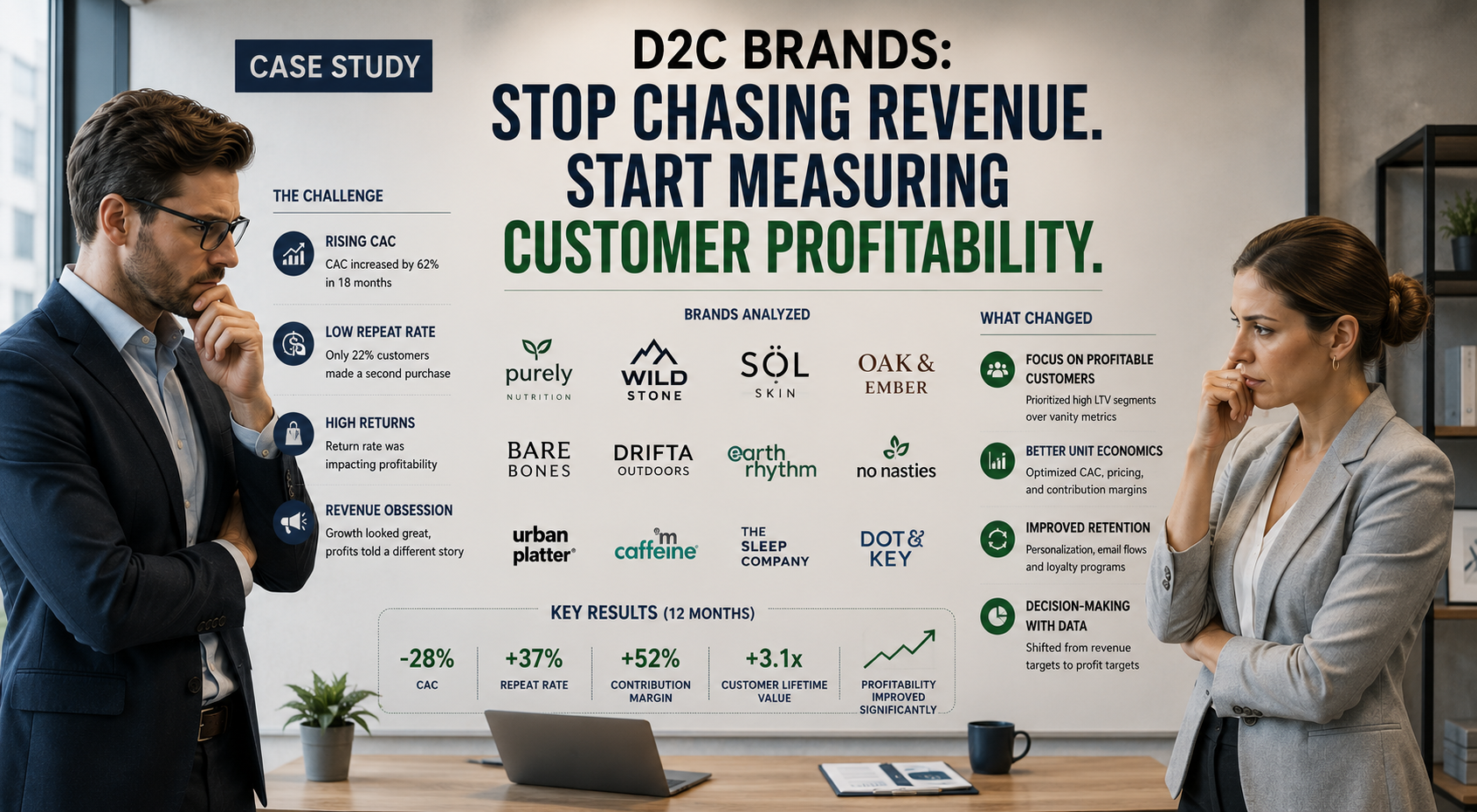
  • D2C Brands: Stop Chasing Revenue. Start Measuring Customer Profitability.

    D2C Brands: Stop Chasing Revenue. Start Measuring Customer Profitability.

    For years, D2C has been presented as the smarter way to build a consumer brand.

    Go directly to the customer. Avoid expensive stores. Build your own digital identity. Use social media to acquire customers. Scale quickly.

    It sounds simple.

    But the reality is very different today.

    D2C Brands: Stop Chasing Revenue. Start Measuring Customer Profitability.

    Customer acquisition costs are rising. Competition is increasing. Online marketplaces are crowded. Consumers have endless choices. And customer loyalty is becoming harder to earn.

    So the real question for a D2C brand today is not:

    โ€œHow do I sell more online?โ€

    It is:

    โ€œHow does my customer actually make a purchase decision, and where should I be available when that decision happens?โ€

    That requires looking beyond the D2C label.


    The D2C customer is not one customer

    One of the biggest mistakes brands make is treating their online customer as a single segment.

    India has very different consumer groupsโ€”from affluent consumers to upper-middle-class, middle-income and value-conscious households.

    But income alone does not determine behaviour.

    Category determines behaviour.

    A consumer may be extremely price-sensitive when buying groceries but may pay a premium for skincare.

    The same person may compare five furniture brands before buying a sofa but purchase a familiar FMCG product almost automatically.

    That is why customer behaviour has to be understood category by category, occasion by occasion and need by need.

    Consider a few examples.

    Fruits & vegetables

    Freshness, availability, convenience and price can dominate the decision.

    Furniture

    Durability, finish, design, comfort, quality, price and confidence in the product become important.

    Beauty & cosmetics

    Product efficacy, ingredients, packaging, reviews, colour, price, trust and brand image can all influence the decision.

    There is therefore no universal D2C customer.

    There are category-specific customers with different reasons to buy.


    The customer knows moreโ€”but not necessarily enough

    The digital consumer today has extraordinary access to information.

    With a few clicks, customers can compare:

    • Prices
    • Reviews
    • Features
    • Competitors
    • Offers
    • Influencer opinions
    • Product demonstrations
    • Customer experiences

    But information availability does not automatically create understanding.

    The customer may see ten products but still struggle to decide which one is right.

    That is where trust, reviews, brand credibility, product experience and availability become critical.

    And this is where physical retail still has an important role.

    A customer can touch a product.

    See its finish.

    Try it.

    Speak to someone.

    Understand the difference between two products.

    And sometimes, simply seeing the brand in a physical environment creates confidence.


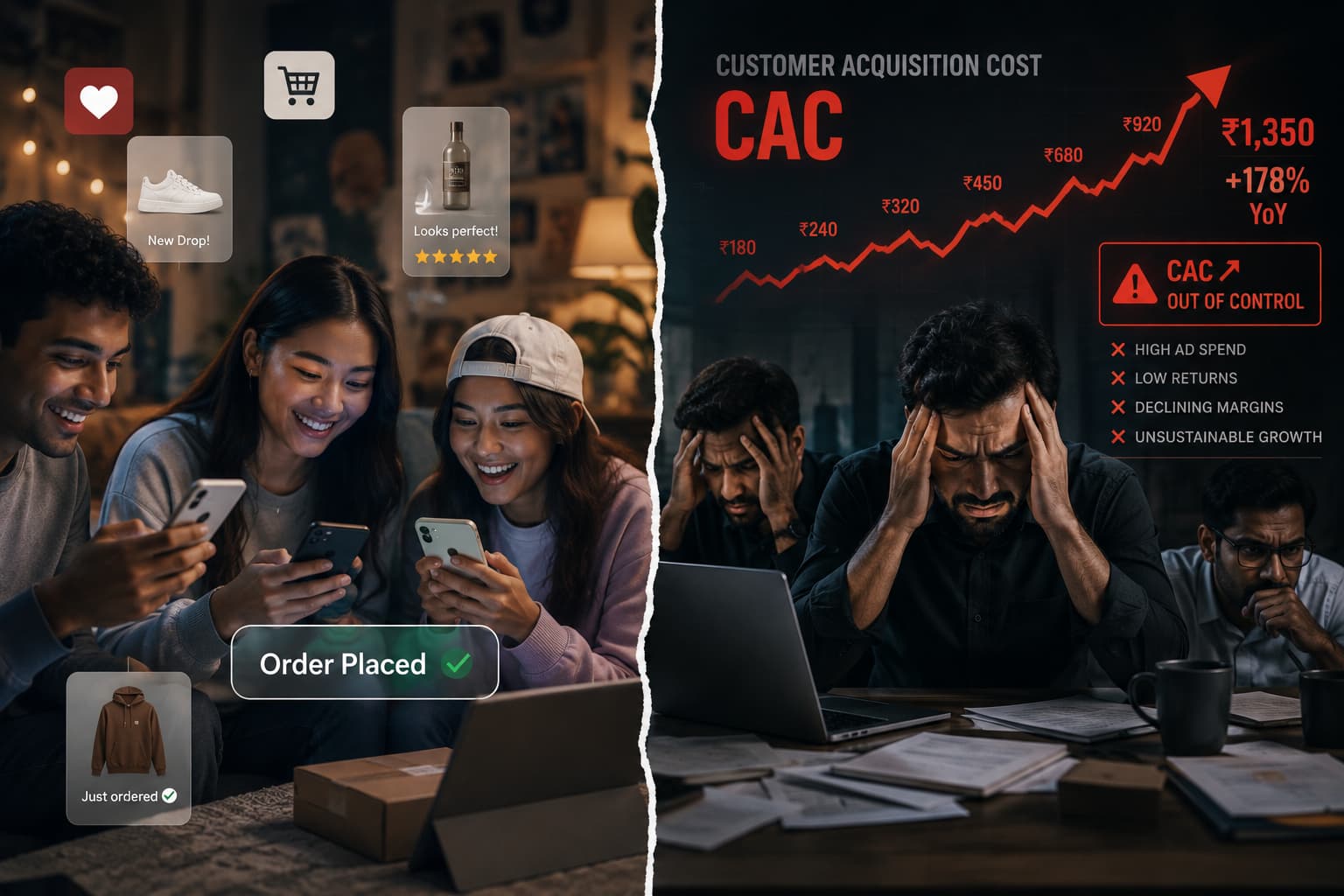
    The biggest D2C problem today: Customer acquisition

    Digital platforms have made customer access easier.

    They have also made competition much more intense.

    A D2C brand is competing for attention on the same platforms as hundreds or thousands of other brands.

    Meta, Instagram, YouTube, Google and marketplaces can generate enormous reach.

    But reach comes at a price.

    As more brands compete for the same audience:

    Customer acquisition becomes more expensive.

    And if the customer makes one purchase and never returns, the economics become even more difficult.

    This creates a dangerous cycle:

    Higher advertising spend โ†’ higher acquisition cost โ†’ lower contribution โ†’ greater dependence on repeat purchases.

    Therefore, the real question is not how much you spend to acquire a customer.

    It is:

    How much value can you generate from that customer over time?


    D2C and retail: Are the costs really that different?

    This is where I believe many D2C entrepreneurs should take a closer look at their numbers.

    Retail has obvious costs:

    Rent + people + inventory + utilities + operations.

    D2C has a different-looking cost structure:

    Technology + digital marketing + customer acquisition + fulfilment + returns/refunds + inventory + customer service.

    The cost heads are different.

    But the underlying economics are surprisingly similar.

    Both businesses have to:

    • Hold inventory
    • Acquire customers
    • Fulfil orders
    • Manage returns
    • Build trust
    • Provide customer service
    • Maintain technology/processes
    • Generate repeat purchases

    So the assumption that โ€œD2C is automatically cheaper than retailโ€ needs to be challenged.

    It depends entirely on the category, ticket size, margins, repeat rate, geography, assortment and customer acquisition economics.


    So should D2C brands enter retail?

    In many cases, yesโ€”but not blindly.

    Retail can provide something that digital advertising cannot always provide:

    Physical discovery and local trust.

    Suppose a brand establishes a profitable store in a particular catchment.

    It understands the local customer.

    It gets the assortment right.

    Its pricing works.

    Its people are trained.

    Its product mix generates healthy margins.

    And it builds repeat customers within a 3โ€“4 km radius.

    Now the brand has something extremely valuable:

    A proven local business model.

    The next opportunity is to replicate that model in another geography.

    Then another.

    Then another.

    That is very different from simply opening stores because the brand wants a physical presence.


    The future may not be D2C versus retail

    I believe the more relevant question is:

    Why choose one when the customer is using both?

    A consumer may discover your brand on Instagram.

    Read reviews on Google.

    Compare prices on a marketplace.

    See the product in a store.

    Order it through quick commerce.

    Buy again from your website.

    And recommend it to a friend on social media.

    The customer does not think in channels.

    The customer thinks:

    โ€œI want the right product, at the right price, with minimum effort and maximum confidence.โ€

    Brands need to think the same way.


    But there is a warning for D2C brands

    Do not rush into retail simply because everyone else is doing it.

    Before opening a store, ask:

    Do I have enough SKUs?

    Is my assortment strong enough?

    Can I create a meaningful store proposition?

    Are my margins sufficient?

    Can the store generate repeat business?

    Do I understand the catchment?

    Can I train people to sell the product properly?

    A store cannot become a physical warehouse for your online products.

    It needs a reason to exist.

    The assortment, store experience, pricing, visual merchandising and customer interaction must come together as one proposition.


    The next competitive advantage: Operational excellence

    For D2C brands, the next phase will not be won simply by having a better Instagram campaign.

    It will be won through better execution.

    Brands need systems that tell them:

    Where is the customer dropping off?

    Why is the customer not completing the purchase?

    Why are returns increasing?

    Which SKU is generating repeat purchases?

    Which geography is profitable?

    Which channel is acquiring the best customers?

    Which customers are worth retaining?

    Where is inventory getting stuck?

    And most importantly:

    What does it cost to serve each customer?

    Technology will play a major role here.

    But technology alone is not the answer.

    Data + process + people + execution have to work together.


    My advice to D2C brands

    Before spending the next โ‚น1 crore on customer acquisition, stop and calculate the economics.

    Compare:

    D2C economics vs Retail economics vs Marketplace economics vs Quick Commerce economics.

    Look at the complete pictureโ€”not just revenue.

    Measure:

    CAC Customer Lifetime Value Contribution Margin Repeat Purchase Rate Return Rate Inventory Turns Gross Margin Cost-to-Serve Store Productivity GMROF

    Then decide where your customer should find you.

    Because the future is unlikely to belong to brands that are only D2C.

    It will belong to brands that can move seamlessly across D2C + retail + marketplaces + quick commerce, while maintaining healthy unit economics.


    The final thought

    The D2C opportunity in India is still enormous.

    But the easy growth phase is getting harder.

    Consumers have more choices.

    Advertising is more expensive.

    Competition is intense.

    Loyalty has to be earned repeatedly.

    And profitability can disappear very quickly behind attractive revenue numbers.

    So don’t ask:

    โ€œHow fast can I acquire customers?โ€

    Ask:

    โ€œHow profitably can I acquire, serve and retain them?โ€

    And don’t ask:

    โ€œShould I be D2C or retail?โ€

    Ask:

    โ€œWhere does my customer want to buy from meโ€”and which combination of channels creates the strongest business?โ€

    D2C may have started the journey by removing the middleman.

    The next stage is about removing the friction between the customer, the brand and a profitable transaction.

    That is where the real scale will come from.

    #D2C #Retail #Ecommerce #ConsumerBehaviour #CustomerAcquisition #QuickCommerce #RetailStrategy #BusinessTransformation #OperationalExcellence #CustomerExperience #Profitability #IndianRetail
  • A case study – D2C 2.0: Digital + Retail

    A case study – D2C 2.0: Digital + Retail

    For more than a decade, D2C meant one thing: go directly to the consumer without traditional retail.

    Build a product.

    Create a digital brand.

    Run Meta and Google campaigns.

    Drive traffic to the website.

    Convert.

    Repeat.

    That model changed how brands were built.

    But the consumer has changed again.

    And this time, Gen Z may force D2C companies to rethink one of their original assumptions: that digital alone is enough.

    The future of D2C is not online versus offline.

    It is online + offline.

    It is Phygital.


    First, understand the Gen Z consumer

    Gen Z does not behave like a purely digital consumer.

    They may discover a product on Instagram, watch a creator explain it on YouTube, compare it online, ask AI for an opinion, visit a store to experience it and finally purchase through whichever channel gives them the best combination of value, trust, convenience and experience.

    Deloitte calls Gen Z the โ€œmost authentically omni-shopping generationโ€โ€”a generation that combines digital discovery with a strong preference for in-person shopping. Its research found that 64% of Gen Z uses social media to research products and 35% uses it to discover products.

    That changes the strategic question for D2C companies.

    The question is no longer:

    โ€œHow do we get Gen Z to buy online?โ€

    It is:

    โ€œHow do we make our brand available wherever Gen Z wants to discover, evaluate and buy?โ€

    That is a very different business model.


    What does Gen Z actually need?

    Gen Z wants value, but value does not simply mean the lowest price.

    They want:

    Good products.

    Fair prices.

    Trust.

    Reviews and proof.

    Personalisation.

    Convenience.

    Speed.

    Experience.

    Identity.

    And increasingly, the ability to move seamlessly between digital and physical channels.

    This matters because Gen Z will become an increasingly important spending force.

    In India, Deloitte estimates that Gen Z will account for 43% of total consumption in 2025, with direct spending power of around US$250 billion. A newer Google-Deloitte report projects Gen Z could command 45% of India’s online spend by 2030.

    This is not a niche customer segment.

    This is the next consumer economy.


    Where are D2C companies going wrong?

    The problem is not that D2C companies went digital.

    The problem is that many of them stopped there.

    They built businesses around paid digital acquisition rather than building a complete consumer ecosystem.

    The model became:

    Advertising โ†’ Website โ†’ Purchase

    That model becomes vulnerable when:

    • customer acquisition becomes expensive,
    • competitors sell similar products,
    • consumers become promotion-sensitive,
    • marketplaces capture demand,
    • algorithms change,
    • and the consumer has too many alternatives.

    A D2C brand can have millions of impressions and still have very little consumer loyalty.

    It can have excellent ROAS and weak profitability.

    It can have a strong online following and weak physical presence.

    And it can have a great product that consumers still want to touch, try, compare or experience before buying.

    This is where retail re-enters the story.


    Retail is not disappearing. It is changing.

    The old argument was:

    Digital will replace stores.

    The evidence increasingly suggests something different.

    Digital and physical are converging.

    India’s retail sector is expected to grow from approximately US$1.06 trillion in 2024 to US$1.93 trillion by 2030, while online retail is projected to increase from US$75 billion to US$260 billion during the same period.

    Online is growing rapidly.

    But even by 2030, it would represent only around 14% of total Indian retail according to the Deloitte-FICCI projection.

    That means something very important for D2C founders:

    The digital opportunity is enormousโ€”but the physical retail opportunity remains enormous too.

    Ignoring either one limits the addressable market.


    India is already showing the direction

    The retail market is not waiting for D2C brands to decide whether they like physical retail.

    D2C brands are already moving there.

    CBRE reported that D2C brands accounted for approximately 27% of India’s retail leasing activity in 2025. In H1 2026, D2C players accounted for approximately 28% of retail absorption.

    That is a significant signal.

    D2C brands are becoming retail occupiers.

    Why?

    Because physical stores can provide something digital cannot fully replicate:

    Trust.

    Trial.

    Touch.

    Demonstration.

    Experience.

    Visibility.

    Immediate gratification.

    And sometimes, simply:

    โ€œI want to see it before I buy it.โ€


    Look at what is happening globally

    The transition is not uniquely Indian.

    In the US, digitally born brands such as Oura expanded into physical retail through major retailers including Best Buy and Target.

    Beauty brand Glossier, which built its reputation through digital communities, expanded through Sephora.

    The lesson is not that these companies abandoned D2C.

    They didn’t.

    They expanded the definition of D2C.

    They realised that direct relationships can exist through multiple channels.

    The store does not necessarily weaken the brand’s relationship with the consumer.

    If managed correctly, it can strengthen it.


    Europe is taking this even further

    Europe is showing how technology can actually make physical retail more relevant.

    Deloitte’s 2026 European research found that 56% of European consumers have already used AI for shopping, with product comparison among the leading uses.

    This creates an interesting future.

    Imagine a consumer walking into a store.

    They scan a product.

    AI understands their preferences.

    It compares products.

    The store provides the physical experience.

    The digital layer provides intelligence.

    The transaction can happen either physically or digitally.

    That is not traditional retail.

    That is Phygital retail.


    Southeast Asia provides another lesson

    Southeast Asia has demonstrated the power of social commerce.

    The consumer can discover a product through a creator, interact with the seller, research the product and complete the purchase without following the traditional retail funnel.

    The lesson for India is important:

    Consumers no longer recognise the boundaries between marketing, commerce and retail.

    A video can become a store.

    A creator can become a salesperson.

    A marketplace can become a discovery engine.

    A physical store can become a content studio.

    And an app can become a loyalty programme.

    The channels are merging.


    India has an additional advantage

    India has something many mature markets do not have at the same scale:

    Digital growth + physical retail growth + young consumers + Tier II/III consumption.

    Deloitte reports that Tier II and III cities already account for more than 60% of India’s e-commerce transactions.

    CBRE’s latest retail data shows Delhi-NCR, Chennai and Mumbai accounted for approximately 66% of retail leasing activity in H1 2026, while D2C brands represented around 28% of absorption.

    The opportunity therefore extends beyond the metros.

    A D2C company that builds digital demand in a Tier II city may eventually discover that the same city can support a physical presence.

    Digital can identify where retail should go.

    That is a major strategic advantage.


    The future D2C company will look different

    The first generation of D2C companies asked:

    โ€œHow can we bypass retail?โ€

    The next generation should ask:

    โ€œHow can we use digital to build demand and retail to expand the relationship?โ€

    That changes the role of the store.

    The store is no longer merely a place to generate billing.

    It can become:

    A brand experience centre.

    A consumer acquisition point.

    A product trial centre.

    A content engine.

    A community hub.

    A fulfilment point.

    A customer-service point.

    A physical expression of a digital brand.

    And digital remains equally important.

    It can drive:

    Discovery.

    Personalisation.

    Reviews.

    Community.

    Data.

    Convenience.

    Repeat purchase.

    So the relationship becomes circular:

    Digital โ†’ Store โ†’ Digital โ†’ Store โ†’ Digital

    rather than:

    Digital OR Store


    And this is where India becomes particularly interesting

    India does not need to copy the US, Europe or Southeast Asia.

    It can combine the best elements of all three.

    From the US:

    Brand building + D2C + retail partnerships

    From Europe:

    AI + personalisation + experience

    From Southeast Asia:

    Social commerce + creator-led discovery

    From India:

    Digital scale + physical retail + quick commerce + Tier II/III consumption

    That combination can create something much bigger.


    The strategic opportunity for Indian D2C brands

    The real question is no longer:

    โ€œShould a D2C company open stores?โ€

    That is too simplistic.

    The better question is:

    โ€œWhere does physical presence create incremental consumer value and incremental business value?โ€

    A D2C company should look at retail when physical presence can:

    • increase trust,
    • improve discovery,
    • allow product trial,
    • reduce dependence on paid acquisition,
    • increase customer lifetime value,
    • strengthen brand visibility,
    • open new geographies,
    • improve consumer understanding,
    • and create an integrated online-offline relationship.

    Not every D2C brand needs 500 stores.

    Not every brand needs a flagship.

    Some may need a shop-in-shop.

    Some may need kiosks.

    Some may need experience centres.

    Some may need selective retail partnerships.

    Some may need franchise expansion.

    The format should follow the consumer and economicsโ€”not the other way around.


    The next D2C battle will not be fought only on Meta

    It will be fought across the entire consumer journey.

    Who discovers the consumer?

    Who earns their trust?

    Who gives them the best experience?

    Who makes the purchase easiest?

    Who understands them best?

    Who gets the second purchase?

    Who builds the strongest relationship?

    That is why I believe the next phase of D2C will be less about direct-to-consumer commerce and more about direct-to-consumer relationships.

    And those relationships will exist across screens, stores, marketplaces, creators, communities and AI.


    D2C has reached its next crossroads

    The first D2C revolution asked brands to leave traditional retail.

    The next one will ask them to re-enter retail intelligently.

    Not because digital failed.

    But because the consumer has become omnichannel.

    Gen Z is proving that point faster than any other generation.

    They may discover online.

    They may validate through a creator.

    They may ask AI.

    They may visit a store.

    They may purchase online.

    They may return offline.

    And they may recommend the product through social media.

    The consumer sees one brand.

    The company must stop seeing separate channels.

    That is the real meaning of Phygital.

    And for India’s D2C companies, the next phase of growth may not come from spending another โ‚น10 crore on digital advertising.

    It may come from asking a much bigger question:

    โ€œWhere should our digital brand meet our consumer physically?โ€

    That is where D2C meets Retail Expansion.

    And that is where the next generation of Indian consumer brands can be built.