
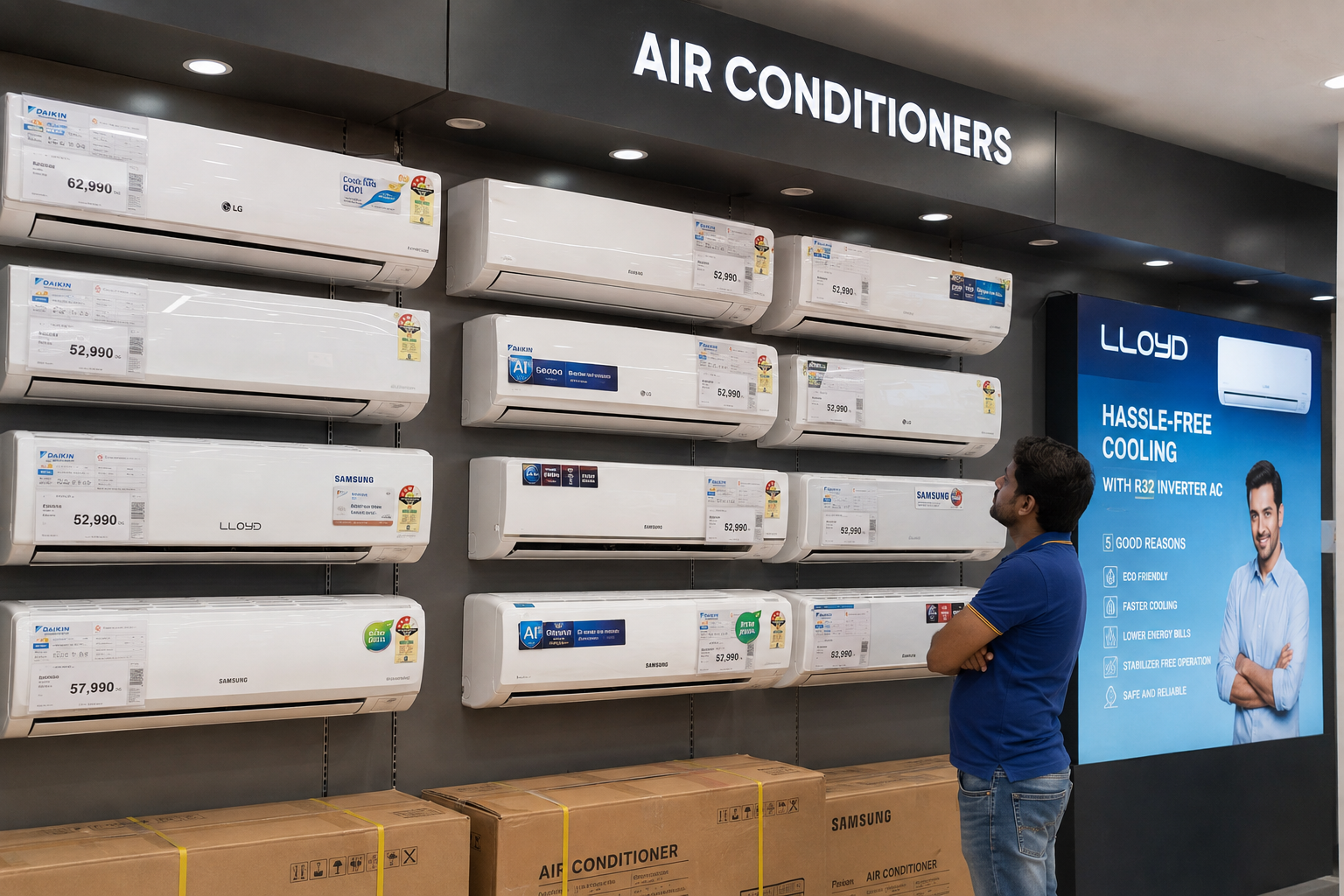
The AC sitting on your wall may say “Made in India”. But how much of it is actually made in India?
That is perhaps the most interesting question emerging from India’s rapidly expanding consumer-durable market.
India’s air-conditioner industry is no longer simply a story about rising summer temperatures. It is becoming a story about manufacturing, localisation, technology, imports, component ecosystems and increasingly intense competition among global and Indian brands.
And the numbers are already significant.
₹35,500 crore—and growing
According to Blue Star’s FY2025–26 annual report, India’s overall air-conditioning industry was valued at approximately ₹35,500 crore in FY26.
Of this, around ₹30,000 crore came from Room Air Conditioners (RACs), while approximately ₹5,500 crore came from central air-conditioning systems, including central plants, packaged and ducted systems and VRF systems.
The room-AC market is expected to expand dramatically. Industry projections cited by Blue Star indicate that annual room-AC demand could reach 30 million units by FY30. India’s room-AC penetration is still only around 10% of households, leaving enormous headroom for future growth.
But there is an important distinction.
Room AC is not synonymous with residential AC.
Split and window ACs are overwhelmingly household products, but they are also extensively used in small offices, shops, clinics, restaurants and other establishments. Therefore, a clean public-data split between “residential RAC” and “commercial RAC” is not currently available.
For a market study, it is better to treat RAC as one category and separately analyse the broader commercial HVAC market.
The window is closing—on window ACs
The Indian consumer has overwhelmingly chosen the split AC.
Window ACs remain relevant, particularly in price-sensitive markets and replacement demand, but the market has shifted decisively towards split systems.
The bigger structural trend is therefore:
Window AC → Split AC → Inverter Split AC → Smart, connected and energy-efficient ACs
Energy efficiency is increasingly becoming a purchasing consideration, while smart features and premiumisation are also influencing value growth. Euromonitor identifies split ACs as the dominant category and highlights localisation as an important future trend.
Who is winning the battle?
The organised branded market is highly competitive—but surprisingly concentrated at the top.
Euromonitor’s February 2026 India report, using 2025 retail-volume data, puts the leading brands at:
- Voltas – 19%
- LG – 17%
- Daikin – 13%
The top three therefore account for approximately 49% of retail volume sales.
Blue Star is another major force. The company reported a room-AC market share close to 14% in FY25, and entered FY26 targeting a 14.3% share.
This creates a fascinating competitive structure:
Voltas → LG → Daikin → Blue Star → Samsung, Lloyd, Panasonic, Hitachi, Carrier, O General and others
But commercial air conditioning is a different game.
In VRF, ducted systems, packaged systems and chillers, engineering capability, project execution and after-sales service become far more important than mass retail distribution. Blue Star, Voltas, Daikin, Carrier, Johnson Controls-Hitachi, Mitsubishi Electric, Trane and others compete strongly across these segments.
Blue Star itself reported 9% growth in India’s commercial air-conditioning market during FY26, driven by industrial, hospitality, healthcare, government and infrastructure demand.
Now comes the more interesting question: What is actually inside an AC?
A modern split AC is not simply a compressor inside a metal box.
Its critical components include:
Compressor | Heat exchangers | Copper tubes | Motors | PCBs/control assemblies | Inverter electronics | Fans | Sensors | Plastics | Sheet metal | Refrigerant systems
Historically, some of the most technologically important components—particularly compressors and electronics—have had significant import dependence.
And this is where India’s AC story gets much more interesting.
From “assembled in India” to “made in India”
The Government of India is actively trying to change the component equation.
The White Goods PLI programme has supported domestic manufacturing of critical AC components including compressors, motors, copper tubes and other parts. The government now targets domestic value addition of 75–80% by 2028–29.
The scale of change is already visible.
Government data released in July 2026 says India’s compressor manufacturing capacity increased from approximately 1 million units in 2021 to 10 million units in 2025–26. It also reports substantial localisation of PCB assemblies and cross-flow fans.
That is a major structural shift.
The question is no longer simply:
“Which AC brand sells the most?”
It is becoming:
“Who controls the component ecosystem?”
Daikin is making a big bet on compressors
Daikin provides an excellent example of this transition.
Daikin and Taiwan-based Rechi Precision have established Daikin-Rechi India, and construction of a rotary-compressor manufacturing facility at Sri City, Andhra Pradesh, commenced in March 2026.
This is strategically important because the compressor is one of the most critical and historically import-dependent components in an AC.
Localising the compressor can reduce supply-chain vulnerability while increasing domestic value addition.
But “Made in India” still does not automatically mean 100% Indian BOM.
Semiconductors, specialised electronic components, sensors and other high-technology inputs can still come from global supply chains.
And then there is Amber—the company consumers rarely see
Perhaps one of the most important companies in the Indian AC ecosystem is Amber Enterprises.
Why?
Because consumers may not see the Amber name on their AC, but Amber operates extensively as an OEM/ODM manufacturer and component supplier.
Its FY25 annual report says the group can cater to approximately 70% of an AC’s bill of materials, and it reported a 26–27% share of India’s RAC manufacturing footprint by value.
This changes how we should look at the industry.
A consumer may buy a Voltas, Panasonic, Blue Star or another branded AC, but the manufacturing and component ecosystem behind that product can involve multiple companies.
Brand ownership, manufacturing and component ownership are not necessarily the same thing.
The next battleground is localisation
The Government’s latest PLI initiatives are targeting exactly this gap.
In January 2026, five additional companies were selected under the White Goods PLI scheme to manufacture AC components such as compressors, copper tubes, control assemblies, heat exchangers and BLDC motors.
So India’s AC industry is undergoing two transformations simultaneously.
The first is on the consumer side:
Low penetration → mass adoption → premiumisation → smart and energy-efficient ACs
The second is on the manufacturing side:
Imported components → local assembly → component localisation → deeper domestic manufacturing
And that second transformation could ultimately be more important.
The real opportunity may not be the AC brand
India’s AC market is becoming crowded.
But the component opportunity is still enormous.
Compressors. Motors. PCBs. Inverter electronics. Copper tubes. Heat exchangers. BLDC motors. Controls.
As India’s RAC market moves towards 30 million units annually by FY30, the companies supplying these components could become some of the biggest beneficiaries of the cooling revolution.
So the next time you see an AC advertised as “Made in India”, perhaps the better question is not:
“Where was the AC assembled?”
Ask instead:
“How much of the AC was actually made in India?”
That is where the next chapter of India’s consumer-durable story is likely to be written.