
India’s FDI Puzzle: Record Money In, Very Little Staying Back
A simple, data-backed look at what’s really happening to foreign investment in India.
Picture this: India just received its biggest-ever foreign investment cheque — $94.8 billion in FY 2025-26. Worth celebrating, right? But once the dust settled, only $7 billion of that actually stayed back to build something in India. The rest walked right back out. And this isn’t a one-off — it’s been the pattern for four years running. Here’s the simple version of what’s happening, why, and what India can do about it.
1. Where Things Stand Today
Two numbers matter here, and once you know the difference, the whole story becomes clear. Gross FDI is every dollar of foreign money that lands in India in a year. Net FDI is what’s left after two things get subtracted: money foreign investors pull back out (called repatriation — they sell their stake, take dividends, or exit), and money Indian companies send abroad to invest in their own overseas ventures. Net FDI is the honest number. It’s the capital that’s actually staying and creating jobs and factories here.
| Year | Gross FDI In | Net FDI (Actually Stayed) | % That Stayed |
| FY 2020-21 | $82 Bn | $44.0 Bn | 54% |
| FY 2022-23 | $71 Bn | $28.0 Bn | 39% |
| FY 2023-24 | $71 Bn | $10.6 Bn | 15% |
| FY 2024-25 | $81 Bn | $1.0 Bn | 1% |
| FY 2025-26 | $95 Bn | $7.0 Bn | 7% |
Source: RBI Bulletin; Ministry of Finance (Lok Sabha reply); CareEdge Ratings.
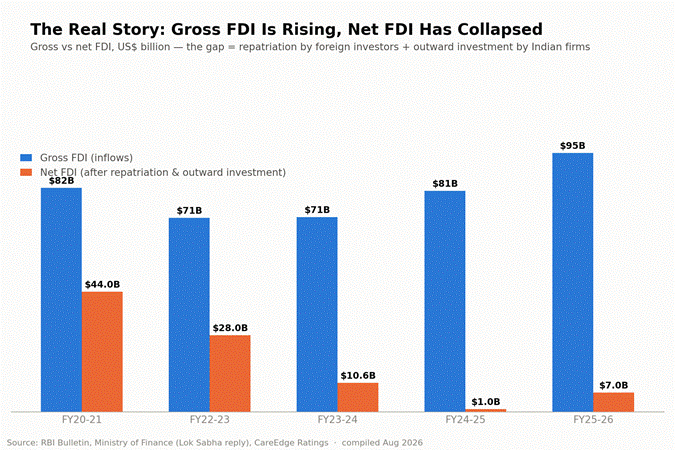
Notice the trend: gross FDI is sitting near an all-time high, while net FDI collapsed to almost nothing in FY24-25 and has only partly recovered since. That gap — not the headline number — is the real story of Indian FDI right now.
2. Why Are Outflows So High?
Two things are pulling money back out, and both are simpler than they sound.
- Repatriation: Investors who put money in years ago are now cashing out — selling their stake, taking profits, or exiting the business entirely. In FY23-24 alone, $44 billion was repatriated out of $71 billion that came in.
- Outward investment: Indian companies are investing more abroad themselves, in their own overseas units and acquisitions. That counts as money leaving too — nearly $65 billion of it between FY24 and FY26.
Together, these two are eating up almost all the new FDI that arrives. It’s a bit like a bucket with a big hole near the top — you can keep pouring water in, but the level barely rises.
3. External Reasons — Forces India Doesn’t Control
- Global money got expensive: Higher interest rates worldwide for much of this decade made investors more cautious and more eager to book profits early.
- Geopolitical shocks: A conflict in early 2026 triggered a broad “risk-off” mood across emerging markets, India included — investors pulled back everywhere, not just here.
- Trade tensions: Tighter US trade policy created uncertainty for investors weighing India exposure.
- Tough competition: Vietnam, Thailand, Taiwan and Malaysia are actively out-marketing India with faster approvals and sharper incentives for the same pool of global capital.
- A natural exit cycle: A lot of India’s FDI over the last decade came from private equity and venture capital, which is built to exit in 4-7 years by design. Many of those funds are simply reaching maturity at the same time.
4. Internal Reasons — What’s In India’s Own Hands
- Land is still hard to acquire: Getting industrial land cleared and ready remains one of the biggest headaches for a company trying to set up operations in India.
- Labour reforms are stuck: The 2020 labour codes still haven’t been fully implemented — six years on, that delay itself signals unpredictability to investors.
- Clearances are slow and scattered: Investors dealing with multiple states and departments face a much slower, less predictable path than in Vietnam or Thailand’s single-window systems.
- Manufacturing FDI is still thin: Real, factory-building manufacturing investment is only about 10.6% of effective inflows — most FDI still goes into services and IT, which don’t need to “stay put” the way a factory does.
- Domestic capital markets aren’t deep enough: When a foreign investor wants to exit, there often isn’t enough Indian institutional money ready to buy them out — so the money leaves the country instead of just changing hands within it.
5. What Should India Do to Lift Net FDI?
- Fast-track approvals with fixed timelines — a genuine time-bound single-window clearance for priority projects, not just a policy promise.
- Finish the labour code rollout — closing a six-year-old gap matters as much for investor confidence as the content of the codes themselves.
- Make industrial land ready in advance — pre-cleared land banks and plug-and-play parks, the way parts of Gujarat and Tamil Nadu already do it, need to become the norm across states.
- Put real muscle behind manufacturing, not FDI in general — sharper, PLI-style incentives specifically for semiconductors, electronics and clean-energy manufacturing.
- Deepen India’s own capital markets — so that when foreign investors exit, Indian institutions can absorb the stake instead of the money leaving the country.
- Make Centre-State coordination visible — one senior point of accountability per big project, so approvals don’t get lost between jurisdictions.
The Bottom Line
India doesn’t have an attraction problem — the last decade of record gross FDI proves that. What it has is a retention problem: turning a strong “come invest here” pitch into an equally strong “stay and build here” outcome. Fix the handful of structural issues above, and the gap between the $95 billion headline and the $7 billion reality starts closing on its own.
Sources: DPIIT FDI Factsheets · RBI Bulletin · PIB · Ministry of Finance (Lok Sabha reply) · Economic Survey 2025-26 · CareEdge Ratings · IBEF. Figures compiled and cross-checked as of 22 August 2026.