
The Hook
India’s retail expansion story is entering its next phase.
The question is no longer:
“How many stores can we open?”
The question is:
“How intelligently can we expand while protecting productivity, profitability and customer relevance?”
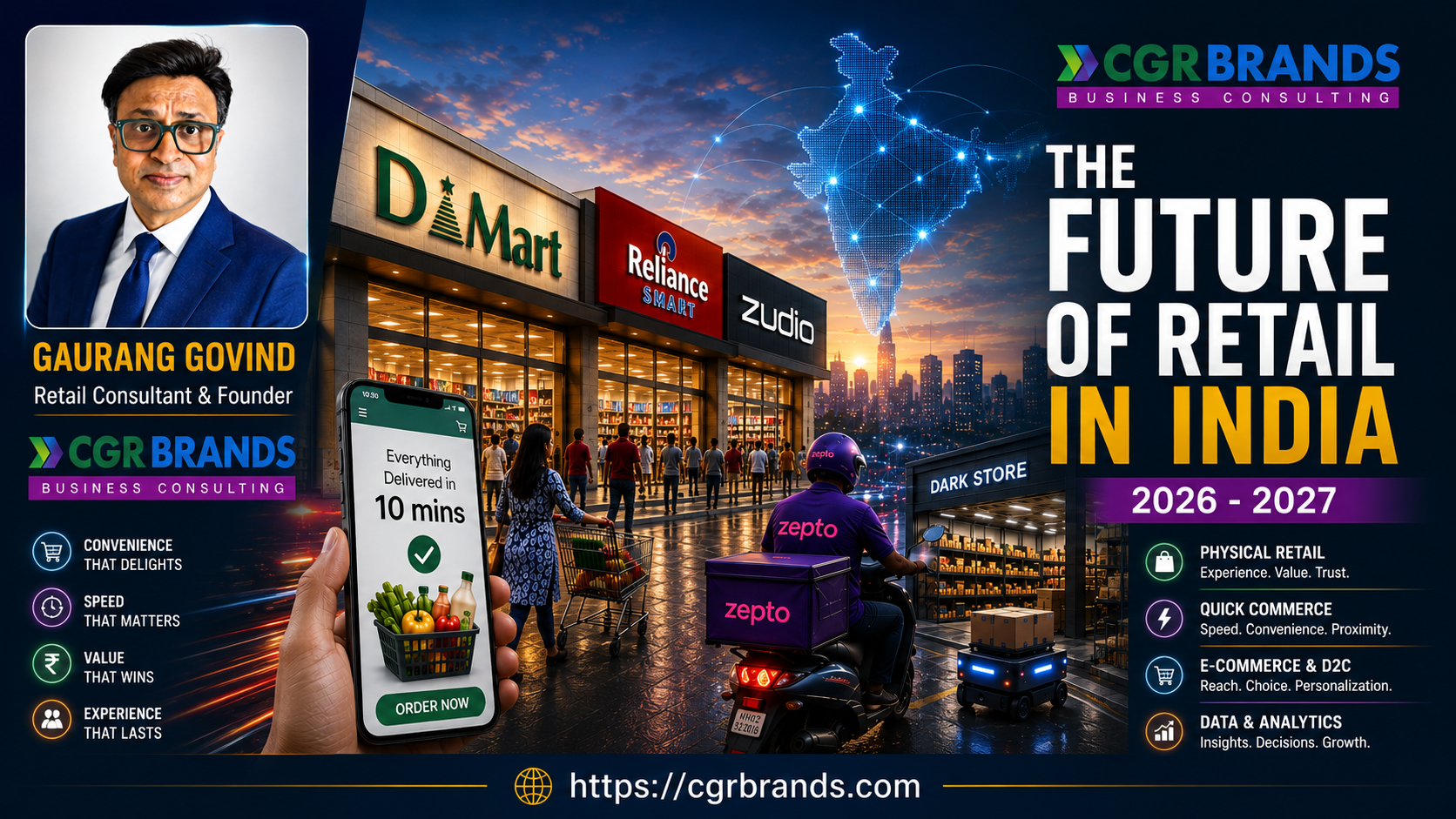
Between 2024 and 2026, India’s leading retailers significantly increased their physical footprints while quick commerce simultaneously created a completely different retail proposition: availability at the doorstep within minutes.
Now the real battle is moving towards Tier 2, Tier 3 and emerging consumption centres.
And I believe the next two years will be less about the race for store count and more about the race for better retail economics.
What happened between 2024 and 2026?
Three examples illustrate the direction.
Reliance Retail
Reliance Retail increased its store network from 19,340 stores in FY2025 to 20,160 stores in FY2026, while gross revenue increased from ₹3.31 lakh crore to approximately ₹3.71 lakh crore. Its Smart Bazaar network crossed 1,000 stores, with a significant part of that network serving Tier 2 and smaller markets.
More importantly, Reliance is combining physical stores, digital commerce and hyperlocal commerce rather than treating them as separate businesses.
Trent’s Zudio
Zudio reached 963 stores across 313 cities by FY2026, compared with 765 stores in FY2025 and 545 stores in FY2024. The company’s own reporting highlights accessibility, sharp price points, in-house merchandise and rapid expansion as key elements of the model.
Avenue Supermarts
Avenue Supermarts, the operator of the DMart chain, moved from 365 stores in FY2024 to 415 in FY2025 and 500 in FY2026.
The FY2026 expansion is particularly interesting: 85 stores were added, including 45 stores in Tier 2+ markets, while the company entered 39 new cities, 34 of them Tier 2+. It also entered Uttar Pradesh, Haryana, Odisha, Uttarakhand and Goa.
The message from these examples is clear:
India’s organised retail opportunity is moving deeper into the country. This we all know.
But there is another force changing the game.
The Quick-Commerce Challenge
Quick commerce has changed the consumer’s definition of convenience.
The customer no longer thinks:
“I need to visit a store.”
The customer increasingly thinks:
“I need it now.”
Blinkit, Swiggy Instamart and Zepto have built large dark-store networks, while Amazon and Flipkart are now increasing their investments in rapid delivery.
In June 2026, Reuters reported that Amazon planned to expand its rapid-delivery service to 300 Indian cities, while Flipkart was targeting approximately 1,500 quick-commerce locations.
This creates an interesting future scenario.
Traditional retailers will increasingly have stores.
Quick-commerce companies will increasingly have dark stores.
E-commerce companies will increasingly combine warehouses, marketplaces and rapid fulfilment.
The consumer will simply choose whichever channel delivers the best combination of:
Price + availability + speed + trust + assortment + experience.
My Forecast for 2026–2027
1. Tier 2 and Tier 3 will become the primary expansion laboratory
I expect retailers to become more aggressive in smaller cities—but also more selective.
The next phase will not be:
“Let’s enter every Tier 2 city.”
It will be:
“Let’s identify the right micro-markets inside the right Tier 2 cities.”
Population alone will not be sufficient.
Retailers will increasingly evaluate:
– Catchment population
– Household income
– Consumer spending
– Competition
– Footfall potential
– Real-estate cost
– Logistics cost
– Delivery density
– Digital adoption
– Category potential
– Store productivity potential
This means location analytics will become a board-level expansion capability.
—
2. Cluster expansion will become more important than isolated expansion
The next winning model may not be one store in 20 cities.
It may be five to ten stores in one carefully selected cluster.
Why?
Because clustering can improve:
Supply-chain efficiency → inventory availability → marketing efficiency → management supervision → brand awareness → customer familiarity.
Retailers should therefore stop measuring expansion only by the number of stores opened.
They should measure:
Revenue per cluster.
Profit per cluster.
Inventory turns per cluster.
Supply-chain cost per cluster.
Customer acquisition cost per cluster.
This is where retail analytics can transform expansion decisions.
—
3. Quick commerce will not kill physical retail—but it will change its role
This is perhaps the most important prediction.
Physical stores will increasingly need to answer:
“Why should the customer visit me?”
For grocery, the answer could be:
Better value + larger assortment + monthly shopping + fresh produce + discovery.
For fashion:
Trial + experience + instant gratification + newness.
For electronics:
Demonstration + advice + service + installation.
For lifestyle:
Discovery + experience + social shopping.
The physical store therefore needs to become more than a transaction point.
It needs to become a customer-experience and fulfilment asset.
—
4. Dark stores will face an operational-quality test
There is another issue that I believe deserves far greater attention.
A dark store is still a retail operation.
Technology can manage orders.
Technology can generate inventory alerts.
Technology can optimise delivery routes.
But people still have to manage:
Expiry → FEFO → hygiene → temperature → receiving → storage → pest control → picking → product handling.
Recent food-safety enforcement in Maharashtra illustrates the risk. Authorities inspected quick-commerce establishments and suspended permits at 12 warehouses after identifying issues including cockroach infestations, rodent droppings and other sanitation problems.
This should not be viewed only as a quick-commerce problem.
It is an industry-wide retail operations lesson.
As the network expands, retailers need stronger:
Retail audits + SOP compliance + training + accountability + store-level ownership.
—
5. E-commerce and direct-to-consumer brands will push deeper into smaller cities
This is another major structural change.
Smaller-city consumers are not waiting for physical stores.
They are discovering brands online.
According to Unicommerce data reported by the India Brand Equity Foundation, Tier 2 and Tier 3 cities were expected to contribute around 66% of new direct-to-consumer orders in FY2026.
This changes the expansion equation.
A brand can now enter a city digitally before opening a physical store.
That creates an important consulting opportunity:
Digital-first → Data validation → Pilot store → Cluster expansion
Instead of:
Store first → Hope for demand → Correct later
This can significantly reduce expansion risk.
—
What should retailers do now?
Action 1: Build a micro-market expansion model
Don’t approve a new store only because the city looks attractive.
Create a scoring model covering:
Demand + competition + rent + catchment + logistics + digital demand + store economics.
—
Action 2: Establish a 12–24 month store maturity dashboard
Every new store should be tracked against:
Sales per sq. ft./ GMROF
Gross margin.
GMROI.
Inventory turns.
Inventory cycle
Conversion.
Average basket value.
Shrinkage.
Manpower productivity.
Contribution margin.
This allows management to distinguish between a temporary maturity issue and a fundamentally weak location.
—
Action 3: Design the store and dark store together
The future will increasingly require omnichannel operating models.
A physical store may serve:
Walk-in customers + online orders + click-and-collect + local fulfilment.
Retailers should therefore redesign:
Inventory → picking → replenishment → manpower → technology → customer journey
as one integrated process.
—
Action 4: Create independent operational audits- audits are crucial specially third party remove bias
Expansion multiplies risk.
Every additional location creates another opportunity for:
Expiry leakage + shrinkage + poor hygiene + inventory inaccuracies + SOP deviation + manpower inefficiency.
Retailers should therefore create a structured audit framework covering:
People + Process + Product + Place + Technology + Compliance.
—
Action 5: Treat Tier 2 and Tier 3 as different markets—not smaller metros
This is critical.
Consumers in smaller cities may have different:
Price sensitivities, pack-size preferences, fashion choices, shopping missions, credit behaviour and local brand preferences.
Retailers should analyse local behaviour before standardising the assortment.
—
The Biggest Prediction for 2027
I believe the retail industry will gradually move from:
“Expansion at scale”
to
“Intelligent expansion at scale.”
The winners will not necessarily have the largest number of stores.
They will have the best store economics, supply chain, data systems, customer understanding and execution discipline.
The next competitive advantage will come from connecting:
Physical retail + e-commerce + direct-to-consumer + quick commerce + data + supply chain.
And this will create a new retail equation:
Right Market × Right Format × Right Assortment × Right Inventory × Right Execution = Profitable Growth
—
Final Recap
The last two years proved that physical retail is not disappearing.
It is changing.
Reliance Retail has crossed 20,000 stores.
Zudio has reached nearly 1,000 stores.
Avenue Supermarts has reached 500 stores and is pushing deeper into Tier 2+ markets.
At the same time, quick commerce and e-commerce are moving rapidly into smaller markets.
So the next two years will not be about choosing between stores and digital.
They will be about building the right combination.
For retailers, my recommendation is straightforward:
Analyse before expanding.
Pilot before multiplying.
Cluster before spreading.
Measure productivity before celebrating footprint.
Audit operations before scaling.
And most importantly:
Build the organisation’s capability at the same speed as you build its footprint.
Because in the next phase of Indian retail, opening the store may be easy. Running 500 or 5,000 stores consistently will be the real competitive advantage.
Sources and further reading
– “Reliance Industries — FY2025–26 Retail Business Overview” (https://reference-url-citation.invalid/7)
– “Reliance Industries — FY2025–26 Integrated Annual Report” (https://reference-url-citation.invalid/8)
– “Trent Limited — FY2025–26 Integrated Annual Report” (https://reference-url-citation.invalid/9)
– “Trent Limited — Annual Reports and Company Filings” (https://reference-url-citation.invalid/10)
– “Avenue Supermarts — FY2024–25 Annual Report” (https://reference-url-citation.invalid/11)
– “Motilal Oswal — Avenue Supermarts FY2026 expansion analysis” (https://reference-url-citation.invalid/12)
– “Reuters — Amazon and Flipkart quick-commerce expansion” (https://reference-url-citation.invalid/13)
– “Reuters — Food-safety enforcement at quick-commerce warehouses” (https://reference-url-citation.invalid/14)
– “India Brand Equity Foundation — Tier 2/3 direct-to-consumer growth” (https://reference-url-citation.invalid/15)
#RetailIndia #RetailStrategy #RetailExpansion #RetailOperations #QuickCommerce #DarkStores #Ecommerce #DirectToConsumer #Tier2Cities #Tier3Cities #OmnichannelRetail #RetailAnalytics #SupplyChain #StoreProductivity #FMCG #RetailConsulting #CustomerExperience #InventoryManagement #GMROI
Gaurang Govind
Business Consulting firm